 Blogcritics The critical lens on today's culture & entertainment
Akademie für Alte Musik Berlin – Uptown
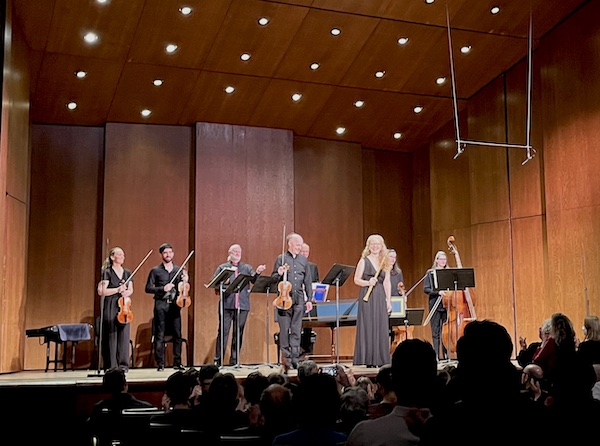
Georg Philipp Telemann, Johann Sebastian Bach, and – Johann Bernhard Bach? The Akademie für Alte Musik Berlin (Akamus) opened its concert at 92NY in NYC on Tuesday night by showing us that J.S. Bach and his sons weren’t the only musical Bach family members. The distinguished ensemble gave us a gorgeous rendition of the Orchestral Suite No. 1 in G minor by Johann Bernhard Bach, an older second cousin of Sebastian’s.
J.B. worked mostly as a keyboardist, but composed too. His exponentially better-known cousin preserved a few of his works, and thus we have them.
The “Ouverture” to this six-movement treat immediately brought out the high quality of J.B. Bach’s creative work. The piece benefited, too, from the meltingly sweet tone Akamus’ six string players can draw from their period instruments.
In the second movement (“Air”) concertmaster Georg Kallweit recounted his emotion-laden solo violin part atop tasteful pizzicato accompaniment. Together, they demonstrated the tight-knit ensemble’s astonishing synchrony in phrasing and feeling.
After a cheery Rondeau and a forceful, stately Loure, the “Fantasie” movement showcased further tasteful solo work from Kallweit.
The finale is a jovial Passepeid that evidenced yet another area where Akamus excels: making baroque music fun to watch. Except for cellist Katharina Litschig and harpsichordist Raphael Alpermann, the musicians performed standing. This allows them – or encourages them to – augment their performances with expressive body language that’s a treat for the audience.
Onward to Glory
Though Mr. Kallweit was billed as the solo violin, the programming spread the glory around, giving the other violinists featured parts in other pieces. Most notably, Yves Ytier led the ensemble – in delightfully animated fashion – in something that (like the J.B. Bach) was new to me, Telemann’s Overture-Suite in G Major, “Burlesque de Quixotte”. This programmatic suite depicts episodes in Don Quixote, which was at least as popular in the 18th century as it is today.
Ytier delivered notably nifty solo work in the middle section of the Overture. The descriptive movements that followed included swooping upward violin glissandos representing the throwing of Sancho Panza up into the air; flurries of sixteenth-notes (including from double bassist Christine Sticher!) and further virtuosity from Ytier representing the attack on the windmills; rhythms depicting the differing gaits of noble steed and of donkey; and music with a proto-Romantic yearning quality expressing Don Quixote’s love for his Dulcinea. The suite as a whole exemplified the ensemble’s eminent watchability as well as its appeal to the ears.
With Telemann’s Quintet in E minor Akamus gave us another side of that prolific composer’s skill at varied forms. Precision harmonies in the opening Adagio found echoes in the beautiful slow-moving ones in the second slow movement. The first Allegro brought out Litschig’s cello virtuosity, and the ensemble executed the bouncing, fugue-like final movement with rich feeling and an attitude that felt like a knowing wink.
Oboe Rex
Selections by J.S. Bach featured agile oboist Xenia Löffler. She played with precision and flow, her baroque oboe at times taking on an almost trumpet-like sound. The Oboe Concerto in G minor, BWV 1056R, highlighted sweeping runs and arpeggios from the featured instrument in the first movement. A familiar Largo and a bright, driving Presto rounded out the concerto, with different violinists taking the lead parts at different times.
Löffler reappeared for J.S. Bach’s Concerto for Violin and Oboe in C minor, BWV 1060R, probably the best known work on the program. It began with a majestic yet smiling take on the opening Allegro. In the atmospheric Adagio, outstanding phrasing characterized back-and-forth between oboist and violin soloist (Kallweit once again). The intense finale was full of dynamic drama.
For a J.S. Bach encore (from one of the composer’s many cantatas) Löffler switched to recorder as the Akademie für Alte Musik Berlin finished its 92NY debut with a gentle goodbye. I had known this ensemble only by reputation and from recordings. I will happily return any time they are in the area – whether they’ve dug out a new Bach cousin or not.