 Blogcritics The critical lens on today's culture & entertainment
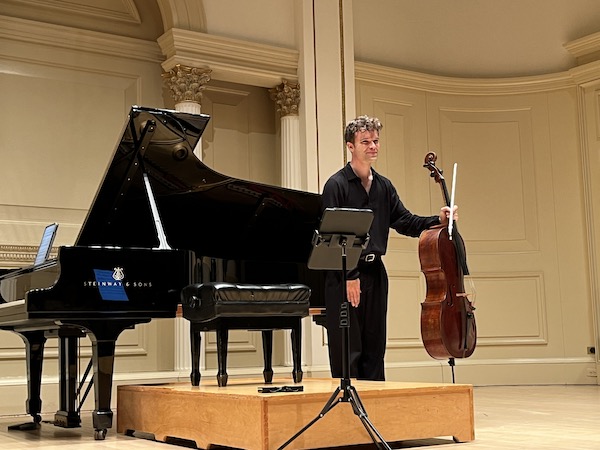
If cellist Rainer Crosett isn’t on your radar, it’s just a matter of time. With ability and fire to spare, and good humor thrown in, his recital debut at Carnegie Hall’s Weill Recital Hall impressed me mightily. He and pianist Victor Santiago Asunción treated a greatly enthusiastic crowd full of friends, family and colleagues to a vigorous, well-programmed evening of music by Beethoven, Franck, Shostakovich, and contemporary composer Reinaldo Moya.
Introducing Rainer Crosett
The concert opened brightly with the playful side of Beethoven’s brilliance in the Seven Variations on “Bei Männen, welche Lieve fühlen”. A charming, liquid performance by both musicians stressed the contrasts among the variations, notably the boisterous third into the tragic fourth, which featured the cellist’s rich lower register, and thence into the light, scherzo-like fifth. Riding Crosett’s buttery tone in the mid-range and a sweet fragility in the upper, the duo leaned into the muscular final variation and manifested all the humor of the false ending.
Naturally, the atmosphere had to get serious for the Cello Sonata in D minor, Op. 40 by Dmitri Shostakovich. Crosett played with great confidence in a rainbow of hues and with absolutely superb intonation.
From a perky, song-like start the first movement metamorphoses into a jungle of passions that eventually subside into a catchy section showing the influence of Russian folk dance. Particularly powerful was the section where the piano flashes staccato figures under a legato melody navigated by Crosett with tasteful softness.
There and throughout the concert the cellist was in beautiful sync with Asunción. The pianist is, not incidentally, the founder of the American Recital Debut Award, which Crosett received for 2025–26, providing the occasion for this recital. Crosett plays with flair and charisma to match his interpretive skills and it’s no wonder he has received this and other awards.
His virtuosity enlivened the perpetual-motion early going of the Shostakovich sonata’s second movement and continued through thumping pizzicatos alternating with aggressive arcos and whistling glissandos. The “Largo” was equally strong in a different and mesmerizing way, somber with muttered dissonances and vaguely eerie harmonies. A grim march emerges, then recedes in favor of a return to the sighing and tragedy of the opening.
Shostakovich rescues us with more Russian flavor and high spirits in the finale, which emerged bright, then prickly, then sweaty, chromaticism mingling with the neoclassical, and adorned with a variety of techniques: pizzicato, tremolos, striking the strings.
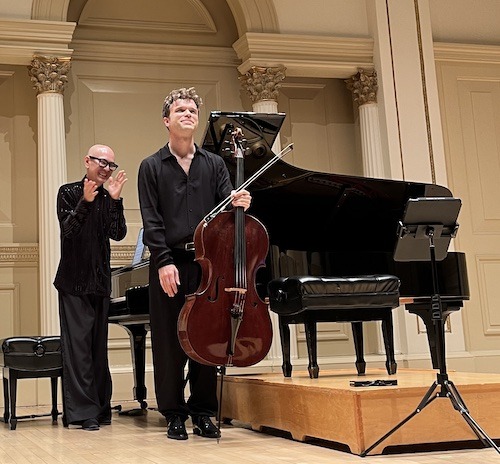
A well-earned intermission followed this strenuous workout. The second-half appetizer was the “Guayoyo Sketches” for solo cello of Reinaldo Moya, three short pieces inspired by and indeed reflecting the effects of Venezuelan coffee. It’s quite a charmer, with references to coffee culture, Bach’s cello suites, and pop-music chord progressions. I found the third Sketch especially fun – mode-shifting, time-warping, quirkily rhythmic, with frenzied playing in the cello’s upper register. Alisa Weilerstein commissioned these pieces; Crosett sold them as if they were his own.
In Perfect Sync
Jules Delsart’s wonderful arrangement for cello of César Franck’s Sonata in A major for violin gave both cellist and pianist ample space to reveal their expressive skills. Asunción, a very fine accompanist, was especially good in the first movement’s crystalline harmonies and the second movement’s Chopin-esque piano parts, with Crosett applying a deft, tender touch and beautiful tone to the melodies. Combined, their performance of the first movement was charged with romance, of the second thrillingly theatrical and full of virtuosic physicality.
The “Molto lento” slow section of the third movement flowed with exquisitely articulated dynamics. Further superb interplay characterized the fourth movement, which had at times the feeling of an energetic hymn. Again, Crosett navigated shifts in energy and focus and volume with a brilliant dynamic touch.
This was as fine a rendition as I have heard of this very popular piece. It’s in the repertoire of many cellists as well as violinists, but it felt that night like Crosett owned it.