 Blogcritics The critical lens on today's culture & entertainment
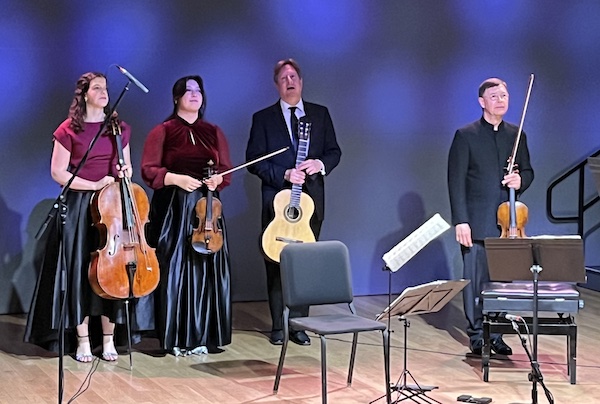
When performing with established artists of the highest caliber, it’s no surprise that young musicians at the outset of their careers will try their hardest to do their very best. Still, while students at the Curtis Institute of Music are among the best of their generation, one could forgive them for not quite measuring up to their elders. Yet that was decidedly not the case at the Curtis on Tour concert on March 26, where two remarkable Curtis students performed with classical guitarist Jason Vieaux and violist and Curtis president and CEO Roberto Díaz.
The Curtis on Tour concerts feature conservatory up-and-comers collaborating with well-respected faculty members and other elders of long experience. This program featured music for guitar and strings by Manuel de Falla, Astor Piazzolla, Niccolò Paganini, and Curtis alum Zhou Tian. Vieaux was joined by cellist Ania Lewis for the Suite Populaire Espagnole by de Falla, and by violinist Emmalena Huning in the Histoire du Tango suite by Piazzolla. Their performances made clear why already in their short careers they have held principal cellist and concertmaster chairs.
Spanish Flair from Curtis on Tour
Mr. Vieaux was in fine form throughout, beginning with the opening harmonics of the de Falla (and despite suffering nail breakage later in the evening). Lewis’s warm velvety tone rang out on her first entrance in the “El Paño Moruno,” her technique as nimble and assured in the upper register as her tone was dark and sensuous in the lower. After the mournful “Nana,” the sprightly “Canción” leapt forth in contrast; the moment when the cello part explodes into double stops was a stunner.
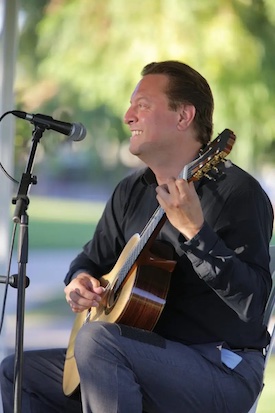
Vieaux’s fleet-fingered skill took the spotlight in the “Polo” with its traditional Spanish-guitar sound. After an elegant rendition of the dreamlike “Asturiana” the pair closed the set by synchronizing songfully and with rhythmic force in the “Jota.”
The atmosphere was very chamber-y, it almost felt like a concert in someone’s living room. That’s thanks in part to the feel of the smaller upstairs concert hall at 92NY, but it was also due to the musicians’ casual enthusiasm. Vieaux and Lewis established this feeling, and it continued when Huning joined the guitarist for the Piazzolla.
Takes Two to Tango
In his Histoire du Tango Piazzolla drew four compact portraits revealing the evolution of Argentinian tango music as he saw it. The high-spirited “Bordel 1900” movement depicts the early tradition, when tango began evolving as a flute-and-guitar form. But the sound and semi-staccato phrasing that Huning somehow emulated in the piece’s early, leaping melodies was that of the bandoneón, the instrument most closely associated with Piazzolla himself. From that moment it was clear that we were in the presence of a violinist with remarkable range.
As the suite progressed Huning demonstrated highly emotional phrasing, with a Romantic-style feel for rubatos. And she conveyed it all with nonchalance to match Vieaux’s. A silken guitar solo was a highlight of the “Café 1930” movement. And it was in “Night-club 1960” that Huning actually came closer to the flavor of a flute. All along she matched Vieaux in expressivity and technique.
In the short last movement Piazzolla endeavored to embody what he saw as the “present moment” of his own evolved tango. Dissonant yet very tonal, with driving rhythms, it capped off a banger of a duo performance.
Lewis then joined the pair for a trio arrangement of Piazzolla’s well-known “Oblivion,” here very much a guitar feature. Conviviality was prominent in the skillful performance, as when Huning delivered a perhaps unexpected glissando that made the others smile.
Chinese Folk Music – and Paganini
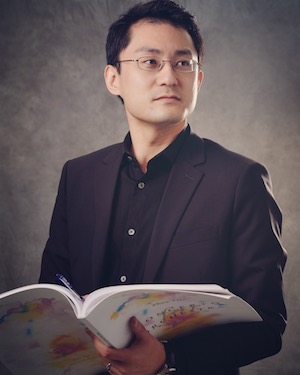
The full quartet took the stage for a Paganini guitar quartet, but first played a short piece by Zhou Tian written to help inaugurate Curtis’ guitar program, which Vieaux co-founded in 2011. Red Trees, Wrinkled Cliffs is a lot of fun to hear, and looked like fun to play too. It asks the musicians to emulate Chinese folk instruments and recall traditional Chinese melodies and scales, all set amid lush Western classical harmonies.
With apparent ease Mr. Díaz drew from his viola the spirit of an erhu. The score calls on all four instruments to use nontraditional techniques to evoke the sound world of Chinese folk. Filled with equal parts flow and anxiety, it was a surprising delight. (See our interview with composer Zhou Tian).
I didn’t know Paganini wrote 15, yes 15, quartets for violin, voila, cello and guitar. For the last of the 15 he listed the viola before the violin, because the work is primarily a feature for that instrument (the composer wanted to show off his rare Stradivarius viola). But it also calls for agile interplay among the instruments, and while Díaz unpacked a magic box of skills the other musicians danced their parts with fluid, indeed spontaneous-seeming precision. That held when they functioned as mere backup too, playing with grace and subtle humor behind Díaz’s pyrotechnics.
Thanks to Curtis on Tour for fostering this wonderful collaboration of two notable veteran virtuosos and two brilliant young artists.