 Blogcritics The critical lens on today's culture & entertainment
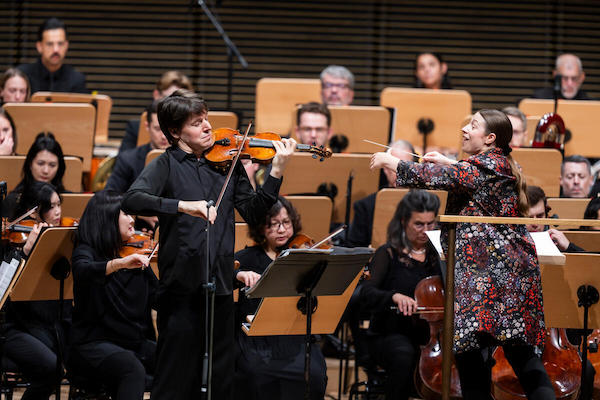
Ukrainian conductor Dalia Stasevska made a strong impression leading the New York Philharmonic in 2023 in Sibelius’ Symphony No. 2 and, with electrifying violinist Lisa Batiashvili, in Tchaikovsky’s Violin Concerto in D Major. This year Stasevska again demonstrated a vigorous affinity with the Philharmonic, this time in a program centered on music by composers from her homeland.
Joshua Bell was the featured soloist in the Concerto for Violin and Orchestra by Thomas de Hartmann, whose works have been experiencing something of a resurgence in recent times. That’s in part thanks to Stasevska and Bell, who have recorded the concerto with the International Symphony Orchestra Lviv.
De Hartmann died in 1956. Contemporary Ukrainian composer Bohdana Frolyak, very much alive, was in attendance at the November 6 concert at Lincoln Center for the U.S. premiere of her volatile new wartime work titled Let There Be Light. The theme of war continued with Benjamin Britten’s 1940 Sinfonia da Requiem.

But before all of that, Stasevska directed the Philharmonic’s brass and percussion players in a crushing “Fanfare for the Common Man.”
Probably Aaron Copland’s best-known work, this short, piercing piece began as a commission in support of the Allies during World War Two. But Copland’s pointed choice of honoree, the “common man,” may have resonated with the New York audience in a way the composer might not have expected, as just days earlier the citizenry had elected the first Democratic Socialist to lead the nation’s largest city.
Timpani thundered, trombones screamed, trumpets and horns stalwartly coalesced. One hears recordings of this piece often, but the human breathiness and slight variations in attack that one can hear during a live performance make the experience as different from a recording as looking at a painting hung on a wall is from seeing a photograph of the work. Stasevska couldn’t have chosen a better call to action for a war-themed concert.
Plus ça change…
De Hartmann’s concerto begins with shifting, almost velvety chords. Bell’s lower register emerged with great songfulness. But quickly the music leaps into glowing dance rhythms. Here De Hartmann’s weaving contrasting traditions and textures together begins in earnest. Anguished dissonant clusters: Modernism. Mournful impressions: Romanticism. Warlike crashing, dark clouds. Virtuoso sixteenth-note passagework in the violin. Sublime melodicism and very high notes.
The second movement’s melodies wander over darkly waving accompaniment. The composer intermingles the two expertly, evoking complex emotions. Conductor and soloist gelled beautifully for maximum expression.
After a short, almost breezy “Menuet fantasque” the Finale begins with a clash. But here again De Hartmann fuses styles. A folk-dance feel opens into music that has a kind of Hollywood sheen. Stasevska made easy work of intricate rhythms and tempo changes as arch dance passages gave way to lilting interludes.
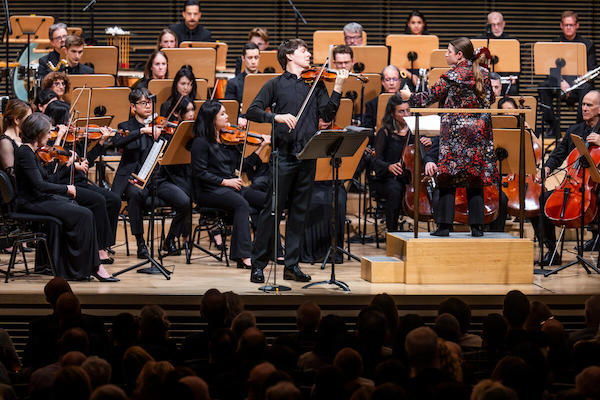
De Hartmann expressed in this concerto a lot of pain, but also a surprising amount of celebration of life given that he was responding to the devastation inflicted on his country in the era of Stalin and World War Two. However, the ovation at the November 6 concert, as I sensed it, was for the performances more than for the music itself. Stasevska’s energy matches Bell’s star power admirably.
They obliged with an encore, an arrangement for violin and orchestra of a Chopin Nocturne. Among the easiest for a pianist, this particular Nocturne allows for wide-open expressivity, which this arrangement captured too.
Searching for the Light
That was nice, because the second half of the concert didn’t include much sweetness. Bohdana Frolyak’s Let There Be Light begins lushly, but unsettled. It seethes with unresolved sevenths and bubbles with motifs in search of a base. Piled harmonies depict the onset of war. Chords flicker, flirt with consonance suggesting hope, but never really find peace. Bad omens seem to abound. After just under 10 minutes, the piece fades away in ghostly sighs, leaving an impression of an uneasy mix of thrill and threat.
Stasevska then marched the Philharmonic through Britten’s Sinfonia da Requiem. A commission from Japan, but also the composer’s 1940 memorial to his parents, this take on some elements of the traditional Requiem Mass doesn’t sound very loving. A thudding, sinister beat creates a sense of foreboding that only increases when taken up by muted trumpets. Tanks or horses gallop and men march amid bugle calls. The piece reflects the horrors of war without respite. The final movement with its jarring dissonances struck me as just plain ugly – and tiresome.
This unusual symphony certainly did fit the theme of the program, which ran Nov. 6–8 at David Geffen Hall. But the truly inspired performances in this lineup came from the pens of the Ukrainian composers. De Hartmann deserves the reconsideration he is receiving. Frolyak merits greater international notice. And as far as I’m concerned, Dalia Stasevska and the New York Philharmonic are a natural match.