 Blogcritics The critical lens on today's culture & entertainment
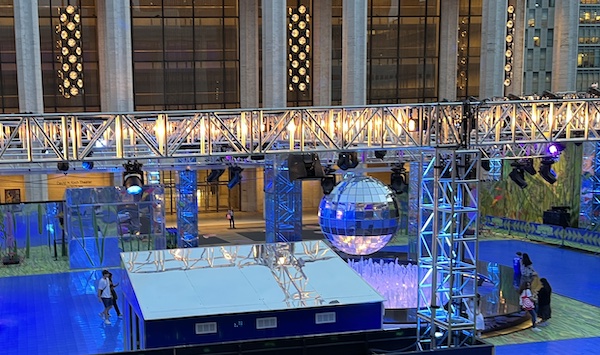
Farewell, Mostly Mozart, and hello, Festival Orchestra. The newly renamed Festival Orchestra of Lincoln Center debuted as part of Lincoln Center’s Summer for the City (formerly Mostly Mozart) festival with a concert that actually began far outside the festively decorated Lincoln Center campus.
Composer Huang Ruo’s “City of Floating Sounds” floated into the open air through audience members’ smartphone speakers as we slowly walked, in otherwise quiet groups, to David Geffen Hall from various locations including Central Park and Riverside Park. Via an app, each phone emitted one stem or another – tracks with individual instruments’ parts – from the 40-minute piece.
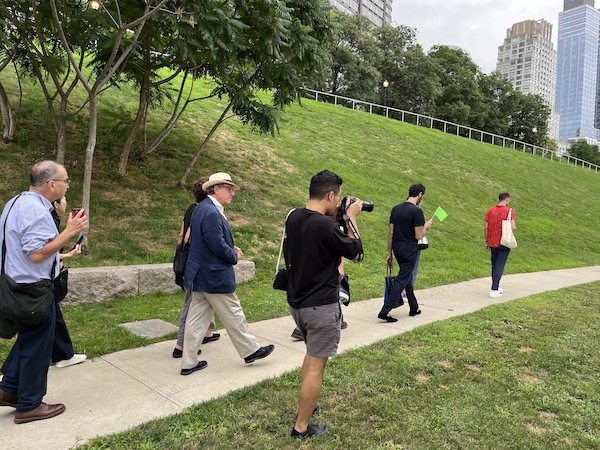
The technical aspects worked fine and the weather cooperated. Multitasking, I even got some nice photos of lower Riverside Park (for – shameless plug – my blog about the New York City parks). Then came a fully orchestrated concert performance of the piece, followed after intermission by Beethoven’s Sixth Symphony (“Pastoral”). So it was our first opportunity to witness not only new music director Jonathon Heyward’s conducting of the rechristened ensemble, but his curatorial vibe.
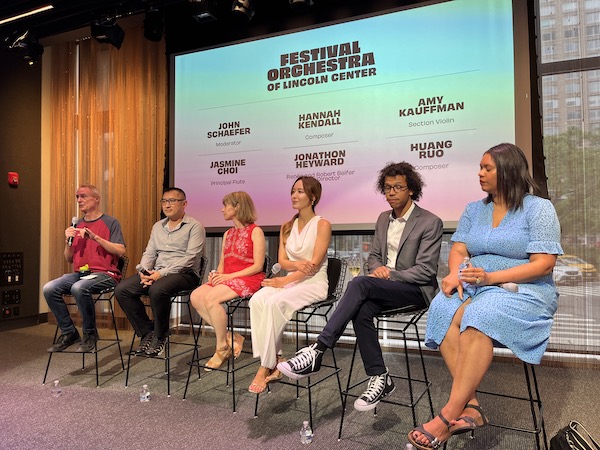
As the conductor said with appealing humility at a panel the day before, he is “always open-minded…always [tries] to implement new and different ideas – [to] try them out and see what happens.” At the same time, it’s also “so important to program with intentionality.” The concert embodied both sides of this philosophy. Both Huang’s piece and the Beethoven Sixth were inspired by outdoor experiences. Beethoven wanted to illustrate his joy at spending time in the country. “City of Floating Sounds,” as the title indicates, situates the listener in an urban landscape. But both engage with the world outside the house, the office, and the concert hall.
The walk through the park and the city streets to the soundtrack of “City of Floating Sounds” was a meditative trip, one of wordless communion with strangers.
From the stage, however, the piece worked very differently. It begins with a long stretch of sustained tones from brass, later joined by winds and strings, with notes and harmonies and implied keys changing at a ruminative pace, with only the tiniest fragments of melody unfurling. Gradually, bubbles of denser, more varied harmonies gather into a froth, with the pentatonic scale often dominant. Somehow without being aware of how it happened, you’re in a rhythmic whirlwind.
After some time I began to grow restless. The program may have been conceived with intentionality, but that quality felt lacking in the piece. By the time it subsided into simple fourths and fifths and a long fadeout, my mind was busy thinking about how many minutes too long the piece had seemed.
The audience-participatory performative walkabouts are a nifty idea. But a musical creation that works in the outside world doesn’t always work as effectively in the concert hall. I admired the orchestra’s committed performance of what sounds like quite difficult music, and Huang’s musical language indeed spoke to me, but in the latter setting it spoke too long.
At about the same length, Beethoven’s evocative “Pastoral” Symphony No. 6 in F Major is nothing if not directional. Heyward’s spirited interpretation took good advantage of the recently refurbished David Geffen Hall’s improved acoustics. His overall touch, light and almost glancing, made accents thunder in contrast, and infused playful sections with joy. Crescendos and decrescendos vibrated with tension; exposed passages twinkled like spiderwebs in the sun.
While this smaller, part-time orchestra can’t boast the precision and richness of the New York Philharmonic, it has clearly responded well to its new music director’s exuberance and optimism. Heyward’s skill and positivity fittingly complement the orchestra’s new era under its new name.
Lincoln Center’s Summer for the City festival continues through August 10.