 Blogcritics The critical lens on today's culture & entertainment
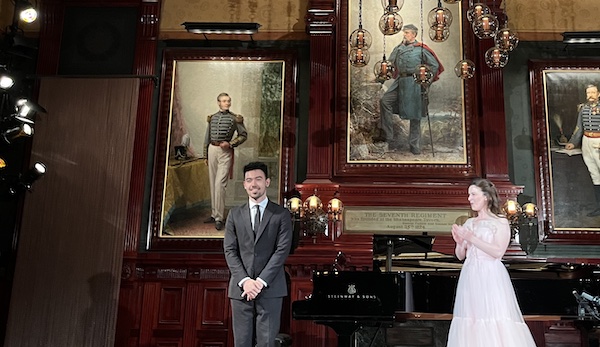
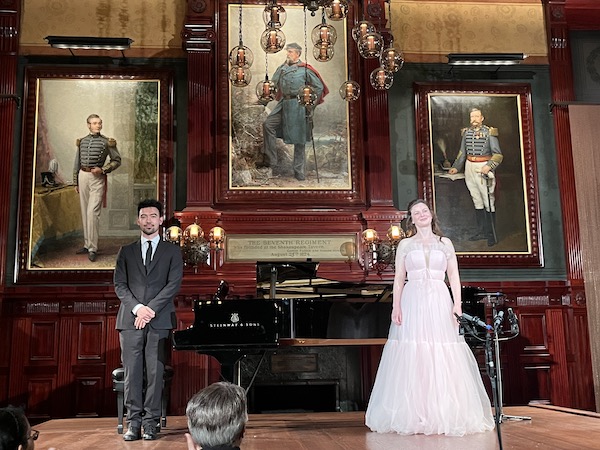
An evening of French chansons is hard for this reviewer to resist. So is a recital at New York City’s Park Avenue Armory, whose Board of Officers Room makes up in intimacy, charm, and elegance what it lacks in polished chamber-music acoustics. Soprano Liv Redpath had evidently scoped out the space before her two recitals with pianist Harry Rylance, for her voice sat in an ideal pocket, at least to these ears.
Redpath and Rylance crafted a program that explores love in many forms – romantic, filial, spiritual. It included settings by Fauré, Debussy, Poulenc, and Messiaen of poems that included many by Paul Verlaine and Louise de Vilmorin. Redpath made many of the English translations in the program, in itself evidence of her close study of the lyrical material.
The recital opened in a whirl of 20th-century Impressionism, with Redpath establishing a rosy, fragrant tone with a hint of fog in Messiaen’s Trois mélodies, youthful songs lamenting his mother‘s death. The first, a setting of the composer’s own poem “Pourquoi?”, finishes unresolved, both musically and textually, with the unanswered question “Why?” The second is a miniature with lyrics by Cécile Sauvage, the composer‘s mother, the third a paean and prayer set amid clouds of sound from the piano.
Rylance gave us a good taste of Messiaen’s mature style, too, in a movement from the 1944 piano suite Vingt Regards sur l’Enfant-Jésus, performed with a fine grasp on the composer’s devotional modernist style, and very movingly.
Impressions of Debussy
The Messiaen selections worked nicely with the six songs of the Ariettes oubliées by Debussy. Though composed decades earlier, in the 1880s, the latter illustrated an earlier chapter in the same Impressionist movement in music. Verlaine’s deeply impassioned poems and Debussy’s flowing music inspired a vivid performance from Redpath, who seemed to live the songs, as a great cabaret singer does. (And as an opera star does, of course. Redpath has a number of operatic and oratorio roles in her upcoming season.)
“C’est l’extase langoureuse” with its descending chromatic scales (the “dull roll of pebbles”), the watery flow of “Il pleure dans mon coeur,” the bright and energetic “Chevaux de bois,” the desolate “Spleen” with its first two lines sung all on one shadowy note – Redpath’s wonderful control of shifts in mood and register continually charmed and impressed.
Verlaine and Vilmorin
Verlaine also inspired Gabriel Fauré in the 1890s with the nine poems of La bonne chanson. This set offered some of Redpath’s finest moments, such as her operatic power in “Puisque l’aube grandit,” an exquisite “J’allais par des chemins perfides,” the darkness-into-light at the end of “J’ai presque peur, en vérité,” the delightful evocations of birdsong in “Avant que tu ne t’en ailles,” the vigor of the celebration of spring in “L’hiver a cessé,” and throughout, a facility with mingling cool timbres with sparks of fire.
Meanwhile back in the 20th century, Francis Poulenc was giving us chansons like those of Fiançailles pour rire, on the evocative poetry of his friend Vilmorin. Redpath and the ever-sensitive Rylance moved easily from the heartbreaking (“Dans l’herbe”) to the fiery (“Il vole”).
Rylance’s great skills as an accompanist elevated the entire program, certainly in the Messiaen and especially in the Poulenc (such as the fun “Le Garçon de Liège” from the triptych Trois poèmes de Louise de Vilmorin). Redpath’s glowing vibrato and velvety lower register lent power to songs like the third of the three, “Aux officiers de la garde blanche.”
The recital ended with a colorful, almost operatic rendition of Poulenc’s epic portrait of the scheming and suicidal “La dame de Monte Carlo.” “Je suis une ombre de moi-même,” declares the lady at one point: “I am a shadow of myself.” Liv Redpath can marshal dark hues in her voice, but her immersion in the chanson repertoire leaves little room for shadows, instead casting bright light on the composers and poets who exemplified it.
There’s much more music, as well as theater and other events, in the Park Avenue Armory’s current season.