 Blogcritics The critical lens on today's culture & entertainment

Is This Thing On?
We depict comedy and tragedy masks side by side for a reason. Bradley Cooper’s third film as a director, Is This Thing On?, adds meaning to the notion that misery loves comedy. Will Arnett and Laura Dern play a couple whose separation leads to catharsis and regeneration when Alex (Arnett) turns to comedy to lighten his soul’s unhappiness. Is This Thing On? screened as the 63rd New York Film Festival’s closing night Main Slate world premiere.
Cooper incisively shepherds the intimate and naturalistic performances of Arnett as Alex and Dern as Tessa. In the opening scene the long-married couple agree without fanfare, while Tessa brushes her teeth, to call “it” (their marriage thing) off.
Throwing stereotypical stormy divorce sequences out the window, Cooper skips to the aftermath of the separation, revealing Alex and Tessa’s amicability and maturity. First, they split custody of their two 10-year-old sons (played with sharp comedic timing by Blake Kane and Calvin Knegten). And the next time they get together with their couple friends (played by Andra Day and Cooper, and Sean Hayes and Scott Icenogle), we find Alex has moved into an apartment in New York City. Tessa remains in their house with their playful labradoodles and sorrowful sons who miss their dad and talk about how their parents argued a lot.
It happened one night
One evening instead of going home to his empty, lonely apartment after seeing Tessa and friends, Alex saves a few bucks of cover charge by adding his name to the open-mic list at a basement comedy club. Fans may recognize the real-life Comedy Cellar. Sheepishly taking the mic, he spontaneously, unabashedly, surprisingly vomits out personal information about his marriage, a lot of it morose, some of it funny. The last thing the self-loathing Alex imagines then actually happens: He gets a few laughs and lots of encouragement from the crowd of wannabe comedians.
Cooper cast many real-life comics as audience members in this atmospheric true-to-life setting. Their authentic jumble of responses picked up works to create the naturalistic environment where Alex slowly recharges his deadened mojo.
Comedy as medicine
A guy who needs to stave off his soul’s sickness can get used to this kind of adrenaline shot. Maybe if he returns a few times, he can reveal to himself what the hell happened that caused him to end up alone. If expiation can indeed soften a crusty-edged, hardened, sad sack, perhaps more spilling of his guts will be the medicine he needs to ameliorate the hell within.
So the initial few laughs and non-judgmental camaraderie of fellow comic wannabes trigger Alex to return for another open mic. And once more, his self-abasing confessions to himself and the crowd magically lift his spirits. Alex’s serendipitous impulse not to take his inner angst to heart blossoms. As he evolves his comedic timing and content, he resolves he can become a better person through confessional stand-up comedy. There’s nothing like getting in touch with one’s inner abyss via artful performance, where self-reflection brings about self-correction.
A secret “affair”
Cooper cleverly alternates and contrasts scenes of Alex’s revelatory jokes at the comedy club and meetups between Tessa and their friends. None of them know of his secret “affair” with comedy. But his emotions and moods gradually change. His friend Balls (Cooper in a funny, facially hirsute turn) even suggest that he might divorce his wife (the beautiful Andra Day) and follow Alex’s route, because Alex seems happier unmarried.
This way to deal with divorce among a community of comics really happened to British standup comedian John Bishop. Bishop’s experience inspired the script by Cooper, Arnett and Mark Chappell (the movie also includes some uneven dialogue prompted by ad libs).
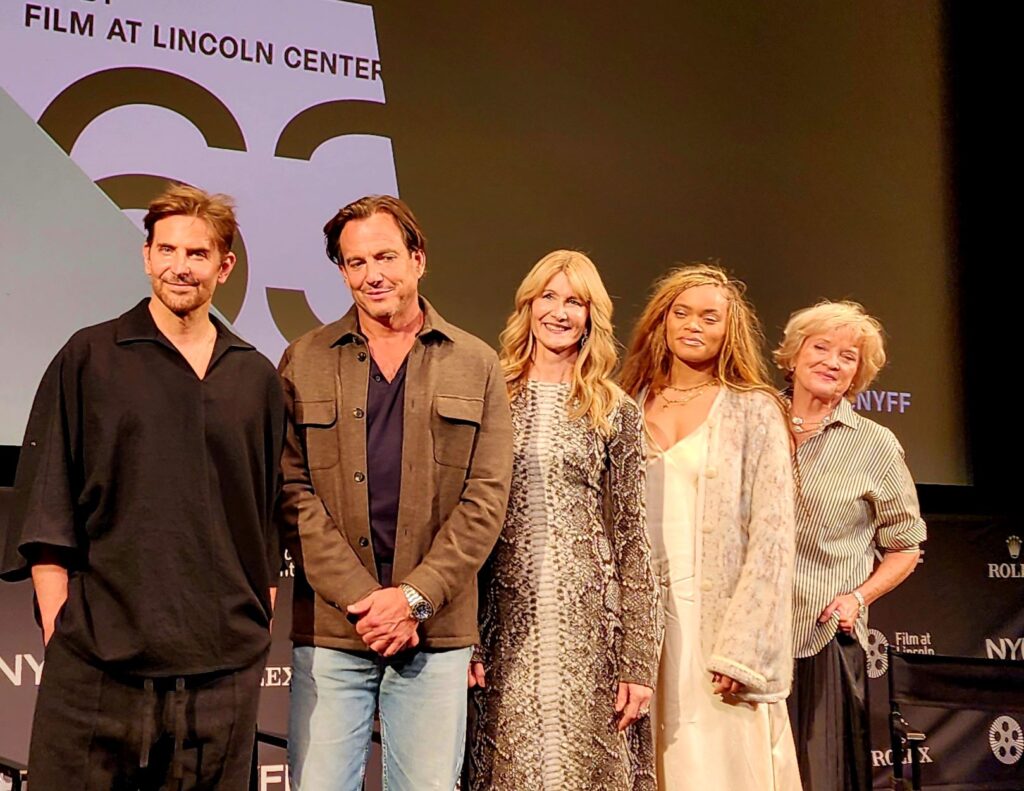
Interestingly, Alex’s wayward jokes that don’t land had to be worked on by Will Arnett and Cooper. At a Q&A after the screening, Cooper grinned when he said that Arnett’s humor outshined Alex’s and had to be tamped down. Thus, the jokes never flow seamlessly like a professional’s patter, since Alex must find his way through trial and error. Likewise, Alex and Tessa’s relationship takes another hairpin turn when Tessa goes on a friend-date (with Peyton Manning).

Too much of a contrivance?
And where do they turn up? At the comedy club, where Alex is hitting a new high/low discussing his first sexual encounter after his breakup. His comments about his wife land in her heart.
Tessa confronts Alex. Though her appearance at the club with her date smacks of contrivance, the coincidence is delicious for the next plot twist. An event in the Hamptons with their friends harks back to the film’s title. Finding their attraction to each other rekindled, do they or don’t they get back together? When and where the answer arrives adds hilarity to their tenuous situation.
More on marriage
Alex’s parents (Christine Ebersole and Ciarán Hinds) also weigh in, though to keep the peace they they refuse to choose sides. In targeting the complexity of human relationships, Cooper’s film shows the difficulties in letting go of an old, tired relationship that’s stuck in destructive grooves. Also, he mines the ground of rebuilding a relationship and setting it in a different, positive direction. With that reconstruction also comes the rebuilding of identity and self-worth.
Dern and Arnett are terrific, surrounded by a great supporting cast. These include the actors mentioned above as well as Amy Sedaris and New York standups like Reggie Conquest, Jordan Jensen and Chloe Radcliffe. These comedians help to make the film a love letter to New York and its downtown scene.
Is This Thing On? will be released December 19.