 Blogcritics The critical lens on today's culture & entertainment
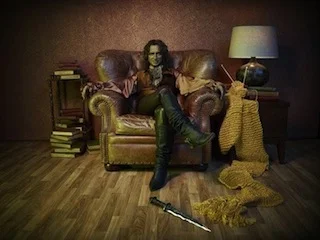
Few characters in modern fantasy television have burned as brightly—or fallen as hard—as Once Upon a Time’s Rumplestiltskin. When the ABC fantasy series debuted in 2011, the show introduced a sorcerer so layered, so unpredictable, so alchemically compelling that he virtually redefined what a fairy-tale villain could be. Part of this was the writing (especially Jane Espenson’s), the acting (the brilliant Robert Carlyle embodied Rumple in all his romantic and villainous prickliness). Carlyle’s ability to shift from impish menace to raw heartbreak in a single line or inwrd glance grounded Rumple in a humanity the scripts sometimes forgot.
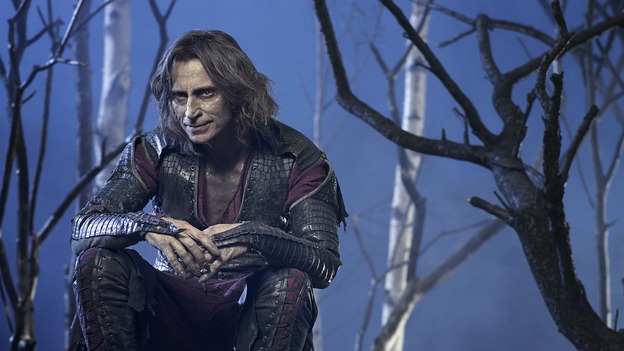
Part trickster, part tragic figure, part gothic antihero, Rumple emerged as the gravitational center of the series’ mythology, a character whose presence could elevate even the show’s weakest narrative threads.
He was, for many fans—including this writer—the reason we tuned in.
And then, slowly, bewilderingly, the show dismantled him.
But before the unraveling, Rumplestiltskin stood as one of television’s most interesting meditations on power, trauma, redemption, and the fragile alchemy of identity. Revisiting him now, with the distance of years, reminds us why his rise was so unforgettable—and why his fall still stings.
The Trickster Made Tragic
From the moment Robert Carlyle first giggled manaically from his entrace in the very first OUAT episode, viewers knew this was no ordinary villain. For all his green-skinned, barefoot menace, Carlyle’s portrayal conveyed tragedy behind those wild eyes. Yes, he embodied the classic fairy-tale trickster, but with a depth that those old stories never afforded him. OUAT’s Rumple was not simply a magical deal-maker but a man running from his own fear, shame, and abandonment. Until the powers that be threw it all thrown out the window in favor of making him a cookie-cutter villain.
The Price of Magic — and of Fear
One of the most compelling early themes in Once Upon a Time was Rumple’s understanding—deep, instinctual. “All magic comes with a price.” It wasn’t merely a catchphrase; it was a worldview. A self-fulfilling prophecy. A trauma response carved into spellbook ink.
Magic cost him his son, his humanity, his marriage, his identity. But like a powerful drug with easy access, he could not stop using it. Rumple’s relationship with magic was like that of an addict. Yes, a brilliant man who understood the cost and paid it anyway, because the alternative—living as the powerless spinner mocked by his village—was unthinkable.
Early seasons of OUAT treated this cycle with the nuance it deserved, often powered by Jane Espenson’s beautiful writing for the character. Rumple was neither redeemed nor irredeemable. He was both. He could be capable of great compassion and save a stranger’s life in one moment; in the next condemn another with the flick of his wrist.
Rumple & Belle: The Story That Could Have Been
Before it was ultimately mishandled, “RumBelle” had the makings of a compelling gothic fairy tale. Not a sanitized Disney retelling, but the kind that acknowledges the thorny complexity of loving someone who both yearns for goodness and clings to darkness.
Belle loved the man Rumple believed he could be.
Rumple loved the woman he did not believe he deserved.
At its best, their relationship served as a mirror for Rumple’s internal conflict, a reframing of the “beast” trope, and a bridge between humanity and monstrosity. You only need to re-watch “Skin Deep” to believe in the Rumple-Belle ship.
At its worst—well, the later seasons ensured we saw plenty of that, as I wrote in my review of the Season Four finale.
But in the early years, RumBelle stood as one of the show’s emotional pillars, offering a glimpse of redemption that felt real, earned, and vulnerable.
When a Great Character Is Rewritten Into a Caricature
There is no delicate way to say this: Rumplestiltskin suffered one of the most frustrating character deconstructions in network television. My preview of the Season Four episode “Heart of Gold” laments of this (to the point that show’s producers for a time denied me access for interviews and appearances on my then-running podcast “Let’s Talk TV.”
Where Rumple had been internally conflicted, capable of growth, fragile beneath the theatrics, bound by believable motivation, by mid-season four, he’d been flattened into a caricature. A plot engine and narrative scapegoat.
The real tragedy is not that Rumple “stayed dark.” I would have been fine with that. It could have been a bold choice. The tragedy is that the writing abandoned the internal logic and emotional consistency that made him compelling in the first place. Made him unrecognizable.
Instead of the careful alchemy that had defined him, Rumple became a contradiction for contradiction’s sake.
It wasn’t darkness that ruined the character; it was inconsistency.
And fans felt that loss keenly.
Even now, he continues to inspire analysis, fanfiction, rewatches, academic essays, and fierce debate. Rumple endures because the idea of him—fragile, powerful, lonely, brilliant, manipulative, broken, magical—was and is larger than the show that eventually failed him.
Keep posted on my latest endeavors (and an exciting announcement coming soon!) on Twitter @BodiceDoublet