 Blogcritics The critical lens on today's culture & entertainment
Goddess
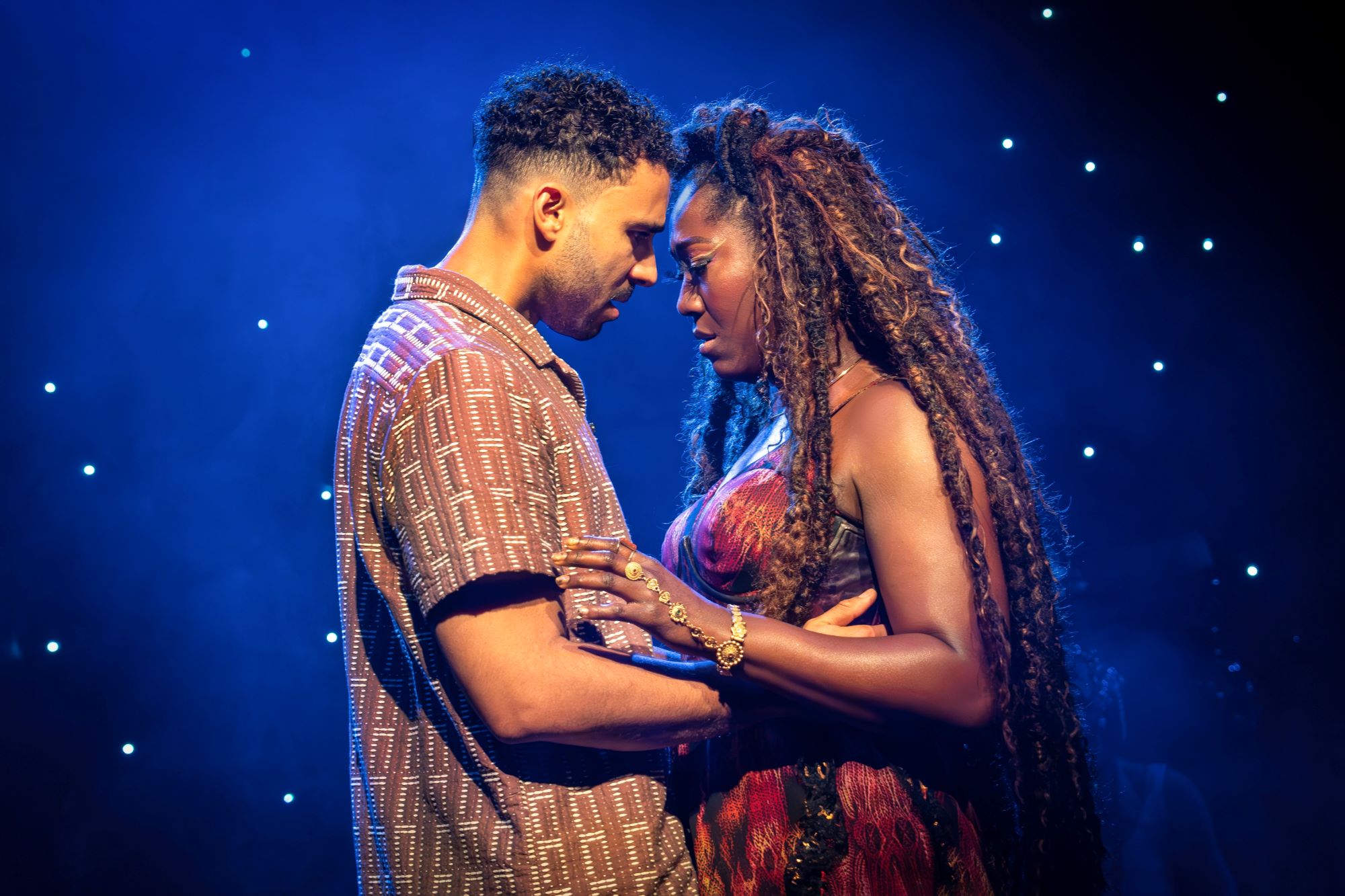
When the mythic goddess Marimba fights with her mother and opposes her mission to make war, she escapes to earth and becomes Nadira. There, she finds refuge in fiery jazz club Moto Moto (meaning hot, heat, fire) where she melds with the sexy, electric atmosphere and vibrant, joyous rhythms. Catching and increasing the fire, Nadira joins the community to sing “like a goddess.” Making incredible music, she gains her purpose, finds love, and understands why she must return to the realm of the gods to fulfill a new mission that will redirect her mother to uplift those on earth and fight evil.
The sultry, imperially-voiced Amber Iman (Lempicka) stars as Marimba/Nadira, who is every inch a heavenly being in her demeanor. Distinctively dressed in Dede Ayite’s exquisite, form-fitting gowns, accessorized with gold-tinged eye makeup and Nikiya Matis’ elaborate hair and wig design, she makes us believe her spirituality. As Nadira lyrically sings her soulful version of a blues ballad or joyously invigorates the audience with a rhythmic Afrobeat number, she exudes confidence and power.
Her goddess backstory is an African myth that Saheem Ali adapted and updated for the stunning musical Goddess, which shines with heavenly and earthly song (music and lyrics by Michael Thurber) in its New York premiere at the Public Theater. At Moto Moto, heaven and earth meet and channel through Nadira.
Griot Ensemble Identifies the Sacred and the Profane
To reveal the show’s cultural influences, Saheem Ali, director and book writer, with additional material by James Ijames, employs a griot ensemble as the poetic storytellers. Through Thurber’s music and lyrics, and Darrell Grand Moultrie’s dances, the Grio trio guides the action. Initially, they uplift our awareness of the conjoining of heaven and earth, the sacred and profane aspects of life that make up humanity.

The “Prologue” introduces the Mombasa, Kenya setting (“Mombasa Mombasa”), specifically the nightclub Moto Moto, colorfully designed in sections by Arnulfo Maldonado. The band’s raised platform separates the musicians from the dance floor, which leads to a bar at the opposite side of the stage. Bradley King’s lighting design uses various deep hues and merges them with dark and light shadows of blues, purples, and yellows. The combined effects vibe with beauty, vibrance, and celebration in a gorgeous atmosphere that unites the secular and celestial worlds. To top it off, Nevin Steinberg’s balanced sound design makes all of this gloriously possible.
A Way of Life
There at Moto Moto, we meet the band members, singers, dancers, and clientele, who all delight in the junction of the divine and earthly music and dance at Mombasa’s most enthralling, life-affirming club. As Omari (Austin Scott) tells his disapproving father, Hassan (J Paul Nicholas), the governor of the province, Moto Moto is “a way of life,” not forbidden (“haram”). Particularly, the musical influences found at Moto Moto integrate with jazz, R&B, Taarab, Afrobeat, pop, and soul music. Just glorious.
The wild, fun characters who partake with abandon include club owner Rashida (Arica Jackson), singer and band member Ahmed (Nick Rasad Burroughs), the shady Madongo (Jason Bowen), and the psychic shaman and fortuneteller Balozi (Reggie D. White). Balozi communes with the gods and gives Madongo a warning which he doesn’t heed. Importantly, among the band and clientele, Marimba/Nadira, the goddess of music, finds a place to express herself using her prodigious vocal gifts. (“Honeysweet”).
The Griot Ensemble
At key junctures the ensemble (Melessie Clark, Teshomech Olenia, Awa Sal Secka) ties the scenes together, functioning as a cultural and narrative device. For example, in a flashback, they reveal the conflict between Marimba and her evil, frightening mother Watamaraka, effected by Julian Crouch’s expert puppet design (“The Spirit World”). The griot trio also introduce the young Omari, who returns from the U.S. to run for governor and inherit his father’s legacy. Omari’s family lives in the wealthy side of town (“Mombasa’s Other Side”), in juxtaposition to the people’s spiritual community of acceptance found in Moto Moto.
The show makes sure to identify the disparate classes and their interests, profane or sacred. The political family represents the profane, restrictive, commercial aspect of human nature that contrasts with the spiritual individuals of Moto Moto who are caught up in the music and dance of life. Yet Omari, a hot saxophone player, combines the best of both worlds as he finds himself drawn to Moto Moto to play (“Boom Boom,” “This Prayer”). This is especially so after he hears Nadira sing.

Their budding relationship jars each awake to themselves. Nadira upends Omari’s direction and purpose in politics and reawakens his love of music. Likewise, Omari’s influence forces Nadira to question herself and her emotions as she discovers human love (What Is This Feeling?”).
Developing Subplots
Because Father Hassan (J Paul Nicholas) has heart disease, the baton of leadership goes to Omari. With the support of his mother Siti (Ayana George Jackson) and Omari’s fiancee Cheche (Destinee Rea), who promotes his election campaign, Omari must win. In a separate “earthy” plot which intertwines with the otherworldly realm of Moto Moto, Omari intends to give a speech at the club that Hassan opposes as shameful. Taking a stand, his father closes down the club. The drinking, homosexual “dancing,” and spirit religion are forbidden. It doesn’t help that a mysterious, frightening disappearance takes place indicating some underlying violent evil lurking there.
How the conflicts play out seems counterintuitive because with the gods, everything and nothing makes rational sense. The relationship between Nadira and Omari blossoms, but for a purpose, and lasts for eternity, though physically unconsummated. Still, their lasting love strengthens both and defies the realm of the mundane, which perishes. In parallel, the budding relationship between Ahmed and Rashida appears joyful and comedic, but temporal, limited as human, mortal love. Ali’s contrast of the two relationships strikes deeply, as does the lust of Madongo which is its own punishment.
See Goddess before it closes to find out why it received an extension. Kudos for the cast, crew, and creatives for a truly unique, engaging, and memorable production.
Goddess runs two hours and 15 minutes with one intermission at the Public Theater (425 Lafayette St) through June 8.