 Blogcritics The critical lens on today's culture & entertainment
Angry Alan
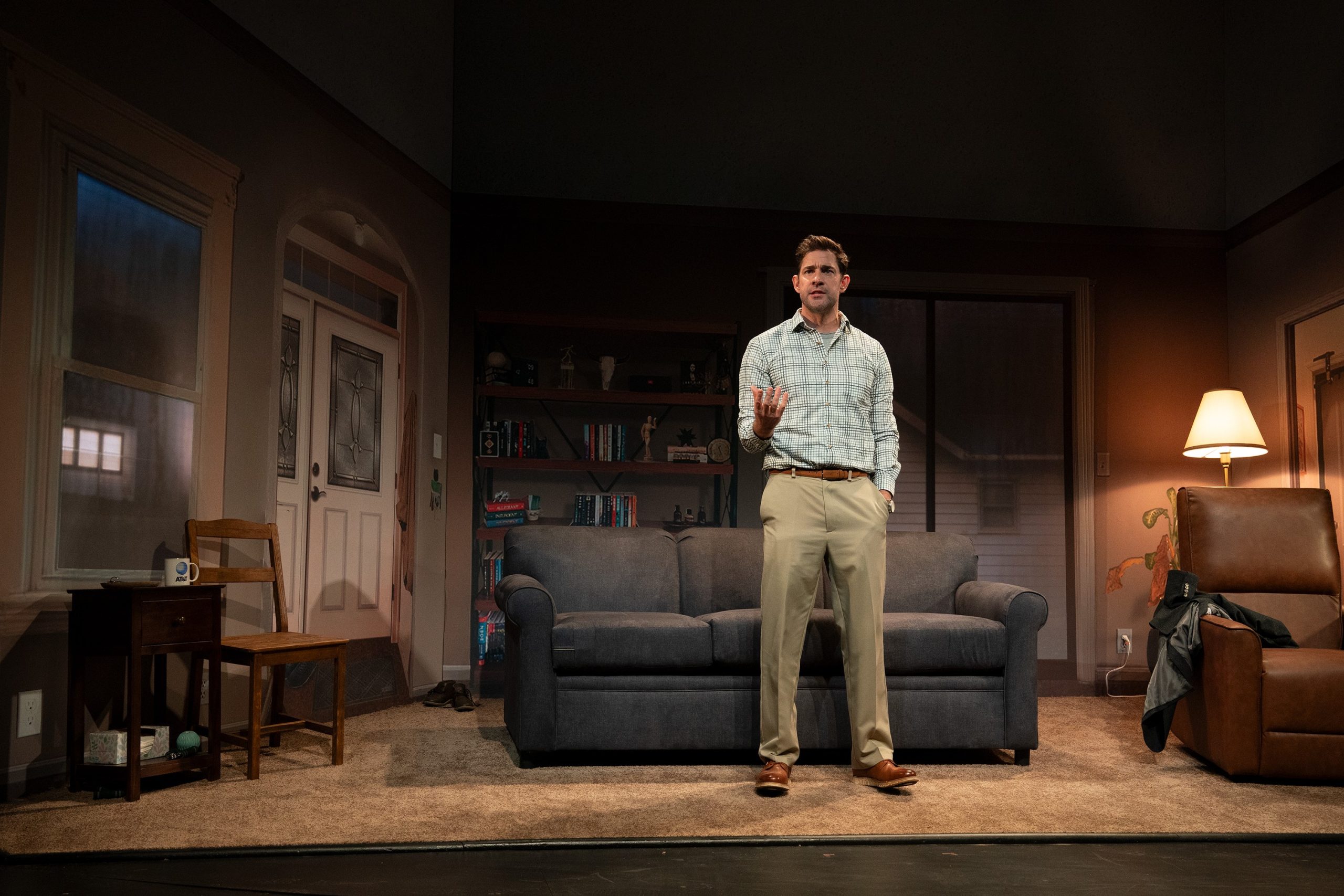
When cruelty spools out gently and gradually, a witness to it barely notices. But in Angry Alan, after a wholesome, middle-aged man morphs from a butterfly of geniality into an ugly, devouring canker worm, the transformation appalls. John Krasinski reverses his character Roger’s good-guy persona (think Jim Halpert, The Office), into a self-satisfied misogynist in the one-man show. In a limited engagement directed by Sam Gold and written by Penelope Skinner (created with Don Mackay), it’s running at the refurbished Studio Seaview through August 3.
In Angry Alan Krasinski is humorous, surprising, gnarly, and at the top of his game as he slyly generates Roger’s emotional breakdown. When we reach the finale, spun out after 85 minutes, Roger’s darkening metamorphosis has numbed our emotions.
Seeking Shelter
With insight and ingenuity, the playwright reveals how cultural influences can harm men as they look for shelter from their own inner pain and torment. Rather than get professional, local help, they may seek like-minded others on social media for a quick, feel-good fix—with disastrous results.
When we meet Roger in his unremarkable, unadorned home in the Midwest, his confessional tone and good-natured aura solicit our interest. Despite his divorce and his firing from an upper-level position at AT&T, his smiling face and energy shine with positivity. Krasinski hones his portrayal skillfully and with power. Winningly, he mines Roger’s goodwill with charming audience interactions. He has us. But where are we going with him?

A “Good Guy” Persona
As we learn his back story, we note his “good guy” persona. For example, ex-wife Suzanne always receives child support payments on time for their son Joe, whom he loves. He also encourages his girlfriend Courtney and her new friends who are feminists and vegans. And he supports Courtney’s taking art classes at the local community college, despite the nude male and female models. He walks the political middle of the road.
Thus, we’re not alarmed by Roger’s frenetic enthusiasm about an online mentor he recently discovered, though he hesitates to discuss this with Courtney. We hear him out. The online coach has drawn him in with his mesmerizing, candid videos. Sure, we know how addictive videos can be. Don’t we immerse ourselves watching them on our phones?
“Angry Alan”
“Angry Alan,” the video creator, uses a handle that expresses the feelings of hundreds of his followers. It turns out Alan pushes a stereotypical, one-sided perspective about men’s oppression by “a gynocracy out of control.” He insists the feminist movement has gone over the edge. Roger goes on to put aside feminism, telling us how Angry Alan uplifts men’s rights. Because women “run the world” (as Beyoncé says), men are in crises. Roger cites various statistics (men are more likely to kill themselves, die in combat, drop out of college) to show how modern men are in trouble.
Roger confides in Courtney about his new interest and gains her support, though she doesn’t watch any of the videos. Instead, the affable Roger filters Alan through his lens of vulnerability and makes him sound reasonable. Roger actually shares one of the videos with his son Joe. And for the first time, Joe texts him, and they agree to Joe’s visit, a first that thrills Courtney. But Roger doesn’t tell her that he is using his child support money for a pricey gold donor ticket to Angry Alan’s men’s conference.

A Turning Point
As Roger spirals downward, the men’s empowerment conference skyrockets his enthusiasm. The truth revealed in Gold’s staging and scenic design indicates Roger’s brokenness and susceptibility to brainwashing. As Roger describes the numbers of men and a few women who attend, Gold represents this with two dummies sitting in chairs and a painted backdrop of indistinguishable figures in the distance. No wonder Roger dismisses the few he talks to and has eyes only for the internet icon and star of the conference, Alan, whom we never see.
The more urgent his need to calm his inner turmoil and isolation, the less Roger focuses on reality. He attempts to cheer up a woman he meets at the conference, but she leaves depressed, expressing truths Roger dismisses. She’s there to report on the economic practices of online personalities, and Roger quotes her: ” I’m upset ‘cos I just sat in a room all day with a bunch of guys like you spewing hate and laughing at rape jokes.” Then she reveals that Alan doesn’t use the donations he receives for charity, but pockets them.
Dismissing Reality
Though she has given Roger the inside truth of Angry Alan’s MO, Roger insults her and walks away. Reinforcing his position, he projects onto her his inner emotional state: “What a bitter woman. Talk about fake news.” This stubbornness thrusts him deeper into the abyss. So, when Joe visits and confides in his father, looking for comfort, Roger can’t accept Joe’s revelation because it doesn’t line up with Alan’s world view. The affable good guy disappears and a monster of hate and rage manifests. “Angry Alan” has spawned “Angry Roger.” Unable to self-correct or self-evaluate, Roger destroys his relationship with Joe.
Krasinski makes Roger’s descent and self-annihilation believable, except in the play’s last moments. Though Roger has a cathartic moment, Skinner drags us back to the internet and Angry Alan’s followers. If she ended the play with Roger feeling the despair of his own pain and sorrow, it might have had more grist and allowed the audience to identify with Roger’s humanity. Instead, Skinner leaves him online. Though Roger hasn’t had enough, we have. Despite Gold’s finely paced direction and coherent technical vision and Krasinski’s performance, the conclusion leaves us cold.
Angry Alan is Off-Broadway at Studio Seaview through August 3, 2025.