 Blogcritics The critical lens on today's culture & entertainment
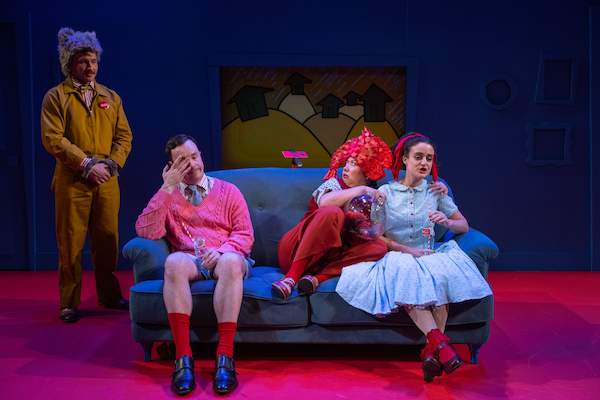
About his 1957 book The Cat in the Hat Theodore Geisel once said, “It is the book I’m proudest of because it had something to do with the death of the Dick and Jane primers.” The vapid “Dick and Jane” reading primers persisted in grammar schools at least until the early 1970s (I know because I was there). And if you’re old enough to remember them, you can get a nostalgic taste of the adorably white brother and sister, at least in name, at We Do the Same Thing Every Week. Robert Leverett’s often clever, sometimes maddening transmogrification of the Dr. Seuss classic runs at A.R.T./NY through May 17.
Dr. Seuss’ Bored Kids
Leverett recasts Geisel’s little-boy narrator and his sister Sally into, yes, Dick and Jane, played unselfconsciously by adult actors (a creepily placid Leverett and a ferocious Jessica Nesi respectively). As in the book, they’re stuck in the house on a rainy Sunday, parents absent, no one else home but a pet fish. The child-adults are desultorily playing gin rummy, drinking tea, and staring out the window when an enthusiastic but ultimately outgunned Cat (Casey Worthington) barges in offering to enliven their day with games. The activities, aside from an anachronistic video game, become ever more chaotic and destructive, just as in the Dr. Seuss tale.

Cat’s helpers, Thing A and Thing B, are puppets operated by an intense Kate Budney and an awkward Justin Choi. The latter sports a half-developed old-New-York accent suited, like Dick’s sweater and Jane’s dress, to the 1950s setting of the original book. But the puppets turn out to be far from the frolicking beasts of fun we might expect. Thing A is a frustrated screenwriter. Thing B feels crushed by his job. Both yearn to free themselves from what feels like a kind of indentured servitude to their boss, Cat.
Dick and Jane and Nihilism
The original story becomes a touchstone for a meditation on the dual extremes of life, summed up in the way someone once described police work as “hours of sheer boredom sprinkled with seconds of sheer terror.” For the most part, Cat’s games fail to relieve the children of their rainy-day blasés. When they do, people – or rather, Things – get hurt. Even an extended bout of trampoline bouncing explodes into a rant by Jane about the sad progression of life from “idiot baby” to an adulthood spent moping over the past.
The show combines absurdism, meta-theater, and existential angst. The scenes are punctuated by terrifying, roaring videos depicting “vacuum decay,” a theoretical destruction-of-the-universe scenario that the preternaturally learned Dick and Jane patiently explain to Cat.
The children’s lack of interest in games, and in life in general, evokes the conformist grimness of The Organization Man, the sociology classic published just a year before The Cat in the Hat. With their logic and resigned attitudes the children always get the better of Cat, but their superiority gives them no pleasure.
Fish and Philosophy
Fish, gleefully overplayed by a turbocharged Tora Nogami Alexander, is a splash of color. Despite sometimes making Fish’s lines unintelligible by screaming them, the actor makes the character a toweringly demented presence through much of the action. Not incidentally, Fish, with his devotion to the family’s absent mother, also embodies the story’s only depiction of love. The play seems to suggest that it takes a “dumb” animal devoid of intellect to experience such an emotion.

Ultimately, despite its philosophizing, the play doesn’t have anything new to say about the human condition – but then, sic semper erat. As Thing B whines to Dick near the end of the play, referring to impending vacuum decay, “And now I’m going to spend my last moments of bodily coherence trying to entertain two nihilistic masochists who would rather drift listlessly toward universal annihilation than put in a good-faith effort to have a good time.”
As a theatrical experience, We Do the Same Thing Every Week is often a good time. It’s funny and cute, at times wicked and weird, sometimes disjointed and, as befits the slacker life of Dick and Jane, occasionally a bit boring. With some tightening I think it could be a triumph.
Plumped up with music and even a little of dancing, this thoughtful and entertaining Attractive Nuisance production is at A.R.T./New York Theatres on West 53 St. until May 17.