 Blogcritics The critical lens on today's culture & entertainment
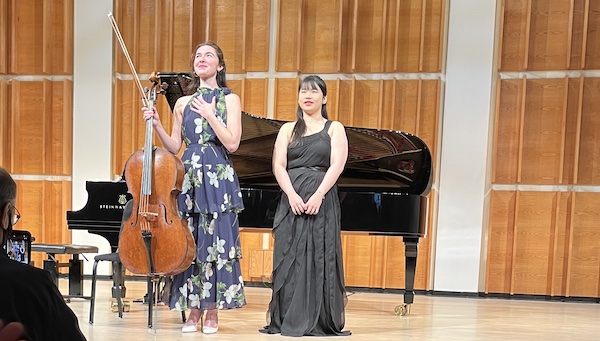
I’ll admit, it nagged at me that it might be something of a drag to hear two of the same pieces played in two consecutive weeks by two different cellists in recital. Especially since the first, Rainer Crosett, had already made such a fine impression, notably in the César Franck Sonata in A major. I needn’t have worried. Miriam K. Smith’s performances were just as penetrating, in a rather different way.
Both concerts began with Beethoven’s Seven Variations on “Bei Männen, welche Lieve fühlen.” This is an apt appetizer for a chamber music program featuring the cello. Smith’s warm and nimble rendition set the tone for the recital: yearning in the slow sections, fiery in the faster ones, and always restrained enough to let Beethoven’s notes speak for themselves.
A couple of the slow variations actually provided the program’s only mild disappointment for me, when pianist Ming-Li Liu, in and otherwise fluid afternoon’s work, injected mini-rubatos that struck me as more arbitrary than expressive.
A Nordic Tour
Rather than follow the relatively light-hearted Beethoven variations with a work of great seriousness and substance, as many artists would have, Smith and Liu filled out the first half of the concert with two less-often heard suites. First, they imbued Percy Grainger’s La Scandinavie (Scandinavian Suite) with strong meaning and decorative flair.
The suite’s first piece, the lyrical “Air et Danse Suédois,” was full of bewitching subtlety. The “Vermelandsvisa” read as a plaintive folk tune that also held power and tension, which arrived in lovely waves. Especially good was the “Polska Norvégien,” a sly waltz-like movement with sudden stabs of drama. Here Smith achieved an exquisitely rich, humming tone in her instrument’s lower register.
The “Mélodie Danoise” enchanted. Almost-predictable harmonic motion in the piano undergirded Smith’s graceful double-stops and full yet understated tone as she filled the melodies with little flourishes, capping the piece off with a final, smile-inducing very high note.
The last movement was great fun. A slow intro leads into an actual “fiddle tune,” with the cello alternating between a fiddle part and a bass part. Here, as elsewhere, the emotion of the music – in this case joy – was plain not just to hear, but to see in Smith’s facial expressions.
The duo followed this with another work new to me, the Troi Pièces for Cello and Piano by Nadia Boulanger. The first of the pieces presents a simple melody in the cello over a glassy piano accompaniment. The duo’s dynamic performance conveyed a feeling of water flowing through larger and smaller conduits as the tempo changed. The second piece was gentle and sweet, the third an anxious episodic adventure with a little of everything: walking bass, rapid figures, glissandos and trills, dissonances, and a furious tarantella at the finish.
Well-spoken
The recital’s second half was devoted mainly to the trusty old Jules Desart arrangement for cello (and piano) of César Franck’s ever popular Violin Sonata in A major. Smith applied a restrained, cantabile tone, not lingering overlong on the phrasing. It’s a nice way to interpret this romantic music – again, as throughout the concert, letting the music speak for itself. The passion, when it did emerge, thus felt wholly well-earned and natural.
The second movement was even more impressive. After a furious piano intro – Liu played with great dexterity here – Smith leaned deeply into the melody without sacrificing any of her sense of self. And she crafted a velvety touch for the slow trio section. Most satisfying.
A richer, woodier quality manifested for the “Fantasia” of the third movement. When the main theme of the first movement reappeared, it was with a darker tinge. The beautifully executed “Allegretto poco mosso” finale had a thoughtful, floating quality.
The concert concluded with what felt like an encore selection, an exercise in flaming virtuosity by Mstislav Rostropovich. This crowd-pleasing “Humoresque” sent me away marveling at the depth of the four-string talent out there, and smiling at my silly worry about hearing the same music two weeks in a row. Miriam K. Smith is one to watch for sure.