 Blogcritics The critical lens on today's culture & entertainment
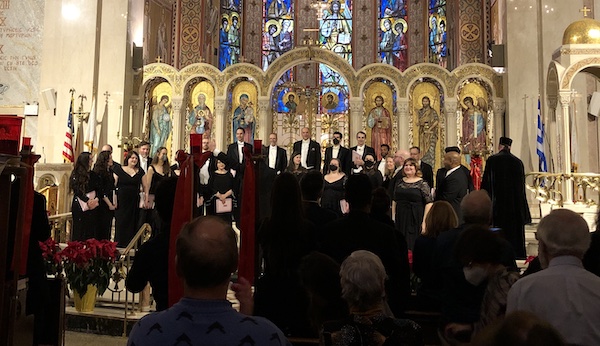
This time around, the Clarion Choir presented a New Year’s concert program that could be described as a miscellany. It included music by Rachmaninoff, whose complete choral music the Clarion has presented over a series of recent concerts marking the composer’s 150th birth anniversary. The first half of the program also included selections by Tchaikovsky and Stravinsky, as well as two other Russian contemporaries of Rachmaninoff, Maximillian Steinberg and Pavel Chesnokov. In the second half we heard Bruckner and Monteverdi, contemporary American composers, and American spirituals.
Still, though disparate, these works often commented on one another. Most were devotional, and all were performed with the choir’s usual solid technical mastery. In a more abstract way, the international character and the sweep of history represented in the music reinforced the notion that since human voices are the same everywhere, vocal music is more universal than any other kind.
Vigils and Vespers
Russian Orthodox church music inspired Rachmaninoff to create his great choral suites. The choir performed the complete Liturgy of St. John Chrysostom at New Year’s two years ago, and the All-Night Vigil in May 2023. This New Year’s, two selections from the former and one from the latter displayed the Clarion singers’ well-balanced sound and stirring harmonizing, with a dynamically astute “In Thy Kingdom,” a hypnotic “Our Father” and, from the All-Night Vigil, a “Blessed Is the Man” that featured an almost overwhelming “Allilúiya.”
Indeed at moments the choir’s sound proved too big for New York City’s Church of the Resurrection. Though the space has decent acoustics, it’s notably smaller than the Greek Orthodox cathedral where the ensemble has held other concerts. A small adjustment in volume would have edged this performance closer to perfection. But perhaps not all the way there, as this rather more informal event included the occasional not-quite-precise entrance. However I didn’t really mind hearing this bit of evidence for this sturdy choir’s fallible humanity under the firm and scholarly direction of its founder, Steven Fox. (The present roster includes such notables as the exquisite soprano Nola Richardson and the remarkable basso profundo Glenn Miller; the latter reached nearly unimaginable depths in the Saint Tikhon Choir’s world premiere of Benedict Sheehan’s profound Vespers in 2022.)
The Russian-focused first half also included a haunting “Ave Maria” by Stravinsky, whom I don’t usually think of as a composer of religious music, and a striking movement from Steinberg’s Passion Week, a work from the 1920s that the Soviet authorities had banned. It was left to the Clarion Choir itself to debut the piece in Russia on a tour in 2016. This New Year’s concert program was in fact based on one from the Clarion’s Russia tour of that year.
We heard another side of Rachmaninoff in two early pieces, a contrapuntal exercise from his student days and a secular romp about a pair of poorly made boots. And we heard a movement from the Vigil for Peace by Russian-born contemporary composer Alexander Levine. The Clarion Choir gave the world premiere of that impressive work a year ago. At the time I described it as possessing “restful power, cloaked harmonies, occasional semi-dissonances, and much beauty.”
Time Travel
In the second half the choir went both backwards and forwards in time, with a rather aggressively attacked psalm from Monteverdi’s Vespers of 1610 – are you noticing a theme? – and another by Monteverdi’s fellow innovator Giovanni Gabrieli. We heard a religious work by Anton Bruckner too.
The sequence’s most impactful piece was the Prologue and Finale from the a cappella musical Avenue X by Ray Leslee, complete with body percussion. Also interesting was the starkly dissonant “One Song, America, Before I Go” by another American composer, Sean Hickey, who trades here in quick melodic dips and harmonic clusters. These contemporary works revealed another side of the Clarion Choir, one that embraces various facets of modernism. These pieces with their sometimes-challenging idioms revealed their inner workings and craftsmanship well in this performance by a top-notch small choir.
The concert concluded with a set of American spirituals. These included Norman Luboff’s stirring arrangement of “Wade in the Water”; the warm harmonic bath of “There Is a Balm in Gilead” arranged by William Dawson and featuring a wonderful soprano soloist; and a majestic “Precious Lord Take My Hand” by Thomas Dorsey. But as it routinely does, the Clarion Choir showed that music touches us at a level deeper than religious ideas, so that whether it’s by Monteverdi, an American postmodernist, or anyone in between, music inspired by one religion can speak to a listener of any religion or none at all.