 Blogcritics The critical lens on today's culture & entertainment
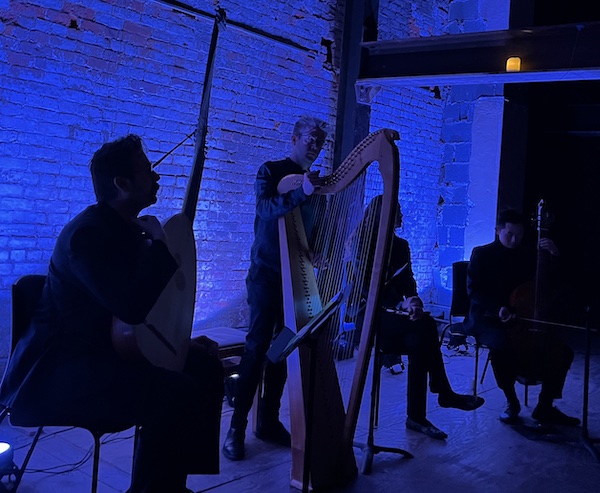
“Love makes us crazy,” writes Parker Ramsay in his program notes to Thursday night’s Aspect Chamber Music concert, “and leads us to do crazy things.” Buffy the Vampire Slayer put it even more succinctly back in the ’90s: “Love makes you do the wacky.” Harpist Ramsay and his A Golden Wire duo partner, gambist Arnie Tanimoto, with huge help from soprano Nola Richardson and lutenist Kevin Payne, limned this eternal truth through the lens of 17th-century English love songs.
Back to the Baroque
Titled “Love’s Sickness,” the program centered on the music of Henry Purcell. It also featured settings by William Lawes, John Blow, and others of the era – even music of Marin Marais from across the Channel. Love’s madness, as reflected in texts from all sorts of sources, inspired many composers of the Baroque era.
Those sources ranged from Greek myth to Arthurian legend, and from Biblical stories to everyday life in the England of Oliver Cromwell and King Charles II, as Ramsay explained in his illuminating mini-lecture. (The harpist speaks as fluently as he plays – he’d surely be a favorite teacher were he to take up education full-time.) His vivid verbal and visual explanations of the context gave the music deeper meaning.
The songs expressed multiple thematic and musical moods, all rooted in one or another aspect of love. The program began with “Music for a while,” a Purcell setting of verse by John Dryden. Nola Richardson immediately revealed a porcelain tone complemented by understated flute-like vibrato and intonational exactitude.
All Together Now
Musicians essaying this music must do research and make choices to create arrangements. The results here showcased both ensemble playing and individual skills. Arnie Tanimoto alone accompanied Richardson in the opening verse of William Corkine’s “Shall a smile,” demonstrating pizzicato as well as bowing on his bass viola da gamba. A gamba solo also began “Haste, give me wings by John Eccles, a dramatic, even operatic song.
Payne’s theorbo alone accompanied Richardson in “Fairest isle,” another Dryden setting by Purcell, with lovely results.
An exquisite harp feature introduced “I’m sick of love,” a Lawes setting of a Robert Herrick lyric that Richardson enlivened with her finely modulated upper register. Ramsay also played a lengthy and affecting harp introduction to the program’s final selection, Purcell’s “She loves and she confesses too.”
Also see our interview with Parker Ramsay.
Richardson’s performance blossomed from merely beautiful singing to spellbinding acting-singing in several selections, beginning with Purcell’s mini-drama “Bess of Bedlam.”
“The Blessed Virgin’s Expostulation” expressed a common extra-biblical Christian theme of the time: Mary’s desperate search for her absconded young son Jesus. Richardson called on her substantial powers of melisma, melodic agility, and timbre modulation to evoke Mary’s desperation, rising to a peak of volume and drama (“I call Gabriel!”), then drooping into crestfallen despair (“he comes not”).
In contrast, John Blow’s “We all to conquering beauty bow” came across like a charming folk song. I closed my eyes and could readily imagine Joan Baez singing it.
But all of this music was meant to be heard in homes and other intimate spaces. That made Blue Gallery (a new venue for the Aspect series) a good choice.
These musicians, all four, made what they do look easy. It is not. It’s wonderful to see young artists celebrating and reviving pre-classical music like this, offering works by Baroque composers both familiar and unfamiliar.
The next Aspect Chamber Music Series concert is March 14 at Bohemian National Hall, with music of Beethoven, Dvořák and Smetana performed by violinist Alexander Sitkovetsky, pianist Wu Qian, and cellist Nicholas Canellakis. Visit the Aspect website for the full schedule.