 Blogcritics The critical lens on today's culture & entertainment
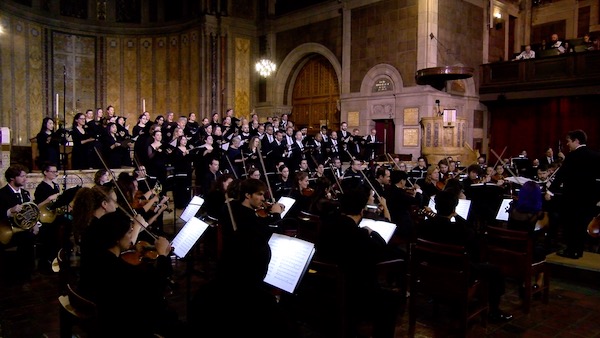
The Clarion Choir finished its celebration of Sergei Rachmaninoff’s 150th birth anniversary with a collaborative concert that included the dark Spring Cantata and the extravagant Piano Concerto No. 3. Saint Bartholomew’s Church may lack the acoustics of a Carnegie Hall (where the choir performed Rachmaninoff’s All Night Vigil in May of last year) but its size and beautiful visuals suited the occasion and seemed to energize the large audience. For the choral music, Music Director Steven Fox led a chorus that combined the Clarion singers with the larger Amor Artis Chamber Choir, the NOVUS orchestra, baritone Aleksey Bogdanov, and in the Concerto, pianist Ilya Maximov.
Spring Fever with the Clarion Choir
The concert began with a trio of short choral works, the Three Russian Folk Songs for Chorus and Orchestra. These date from 1926, well past when Rachmaninoff produced his larger choral works, including the All Night Vigil and the Liturgy of St. John Chrysostom as well as the Spring Cantata. The songs demonstrate not only his mature style but the intensity of his creativity, evidenced in the depth of what he could do in short forms.
The first, “Across the Swift Little River,” opens with an an attention-grabbing orchestral swell and intriguing harmonies. The brief lyric tells of a drake left bereft when something spooks his duck mate and she flies off. To stress the male point of view, it’s scored for the lower voices only. The combined tenors and basses of Clarion and Amor Artis projected forcefully over the large instrumental ensemble. An orchestra can tend to drown out a choir standing behind it. Here, there was good balance, to the benefit of the emotionally charged and harmonically straightforward vocal lines.
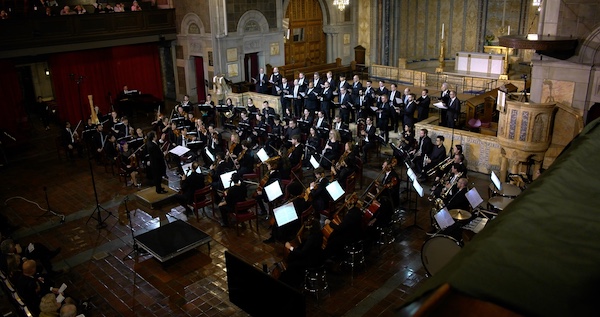
Turning things around, the solemn “Oh, You Vanka, scored for the higher voices only, is the lament of a young wife whose husband is leaving her at the insistence of his father. The music features some disconcerting counterpoint between the voices and the instruments, particularly the cellos, and there is always something interesting happening in the orchestra as the choir sings in steady rhythm. Eerie downward chromatic scales illustrate the narrator’s cold despair at the end.
“My Powdered, Rosy Blushes” calls on the full chorus for a piece rooted in a folk melody that concerns a husband confronting his unfaithful wife. The music suggests the husband marching determinedly home, while the choir intones the words intertwined with the orchestral parts. The performers embodied the composer’s ability to write choral parts that feel like part of the orchestration – quite a feat for all.
Rachmaninoff’s Troubled Spring
Spring is no cheery picture of flowers and showers. The text by poet Nikolay Nekrasov relates a largely dark story of (again) infidelity, with a qualified kind of redemption at the end. The captivating baritone Aleksey Bogdanov sang the role of the husband who wrestles with the urge to murder the faithless wife whom he still loves. The coming of spring stays his hand, but not before much psychic struggle.
In one powerful passage the husband lets loose an internal voice demanding he “avenge the evil deed! Or else you will regret it all your days” as the choir sings tense “aahs” behind him. At the end of the stanza, “when suddenly, spring [comes] stealthily in,” the soundscape opens up dramatically on the word “spring” (vesna).
The choir triumphantly takes over to describe blossoming orchards and forests as the music crescendos heartily and clambers through excited rhythms. When Bogdanov’s resonant baritone spelled out the climax – “The evil thought weakens, the knife falls from my hands” – with the choir and orchestra ably accompanying his commanding voice, the story was complete. But Rachmaninoff’s highly descriptive music has left us charged with emotion, and somewhat uneasy. The great composer was as strikingly original in this secular cantata as in his religious settings. In the end, it reflects the poem’s lack of real human closure: “Forgive while you can be forgiven, and God will be your judge.”
There, at the very end, is the only place in the cantata where God appears. As the Spring Cantata makes clear, Rachmaninoff didn’t need inspiration from traditional Russian Orthodox liturgical music to create a large-scale choral masterpiece.
The Piano Sings
Ranging even further from religiosity, the Clarion program concluded with Ilya Maximov as soloist in Rachmaninoff’s Piano Concerto No. 3. Indeed the composer specified that his inspiration was wholly abstract, remarking that the introductory theme of the first movement “wrote itself…If I had any plan in composing this theme, I was thinking only of sound.” Vocal music was clearly on his mind at the time too, the same period when he composed the Liturgy of St. John Chrysostom, which, not incidentally, the Clarion Choir performed at a New Year’s Eve concert in 2022. Rachmaninoff also said of the concerto’s primary theme, “I wanted to ‘sing’ the melody on the piano, as a singer would sing it.”
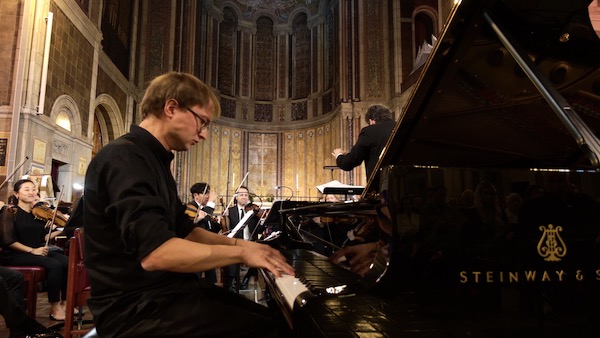
Maximov played as if he had taken this message to heart. Despite a somewhat gruff and brittle quality that the church’s suboptimal acoustics imparted to the piano, he played sweetly and with lyrical ease as the movement began, and then with great, graceful dexterity, clarity, and assurance, so every note of the lightning-charged score came through. The wild and brilliant cadenzas glittered.
The second movement reveled in heady Romanticism, with a brief stormy cadenza, a ruminative quiet section with sensitive work from the woodwinds and brass, and a half-crazed waltz, all negotiated artfully by conductor Steven Fox. This segued directly into the finale, a magical romp over and under the themes introduced earlier. Maximov’s virtuoso playing and Mr. Fox’s sensitive phrasing and dynamics, all executed with precision by the musicians, persisted through a furious gallop, choppy spasms, and a stately, High Romantic conclusion.
To be honest, to my taste, the last half of the third movement is a bit much, even for Rachmaninoff. But, creative genius that he was, he had the full courage of his artistic visions. And thanks to the fine choirs and soloists and the well-honed NOVUS orchestra, all led by the redoubtable Steven Fox, the final concert of the Clarion Choir’s Rachmaninoff @ 150 series fulfilled those visions.