 Blogcritics The critical lens on today's culture & entertainment
Regardless of what’s going on politically, we Westerners tend to think of the arts as a realm of total free speech. A composer, for example, can be an iconoclast to her heart’s content – breaking molds, challenging norms, experimenting wildly. If no one likes the result, the failure derives from artistic merit or popular opinion, not state control.
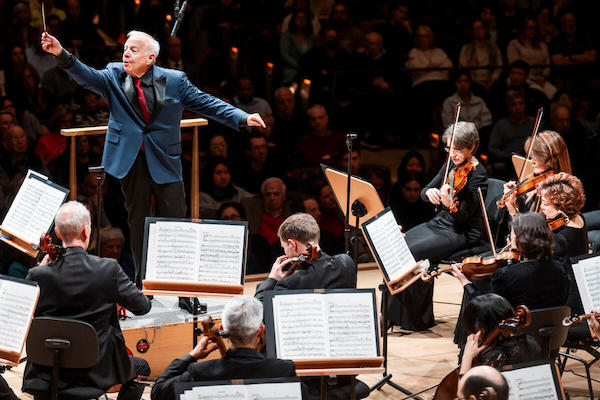
Dmitri Shostakovich’s career is an exemplar of the reverse. It alternately bloomed and wilted with the judgments of Stalin and the Soviet state. Shostakovich’s Fifth Symphony was a comeback for the composer after a period of disapproval. At the New York Philharmonic concerts last week with Leonard Slatkin at the podium, the piece brought to mind the current lurch toward fascism and autocracy in the U.S. So far, Donald Trump’s hostile takeover of the formerly apolitical Kennedy Center, for example, has not resulted in major changes to the institution’s classical programming. But we would do well to beware.
Time Flies
Slatkin and the Philharmonic preceded the Shostakovich with contemporary music that is, if not iconoclastic, then representative of the adventurous spirit of many 21st-century American composers.
Cindy McTee’s short two-part Double Play for Orchestra received an exciting performance. The first movement barges in with majestically crescendoing tone clusters that support (or is it the other way around?) different sections and solo instruments as they pass around the melodic material. (I also enjoyed the rainstick.) The result was simultaneously hypnotic and attention-grabbing.
The second movement, all about rhythm, arrives with curiously syncopated ticking-clock sounds and harmonic swells from the strings. It progresses through rhythmic passages in varying time signatures. There’s a hint of Bernstein-style art-jazz just before a sudden calm; then rhythm returns in overdrive with furiously sawing strings leading to a fiery, brassy coda. The title of the movement, “Tempus Fugit” (“Time Flies”), feels both appropriate and undermined by the nature of the piece as a whole, whose every element seemed to occupy just the right amount of time. McTee, who happens to be Slatkin’s wife, took the stage for a well-deserved bow.
A Saxophone Triathlon
Celebrated composer John Corigliano was also present, for the New York premiere of his concerto for saxophone titled Triathlon. It featured the soloist for whom it was written, the remarkable Timothy McAllister. McAllister played soprano in the first movement, alto in the second, and baritone sax in the finale.
A squeal from the soprano sax touched off the first movement, “Leaps.” The music leaps into nervous squiggles and staccatos from soloist and horns. As a two-note minor-third motive pops up in unexpected places, wide-leaping arpeggios tested the range of the instrument – seemingly no challenge for McAllister – first rapid, then slow in a quiet contemplative section.
Behind the unexpected effects from the sax, Slatkin drew a performance of great clarity and depth from the orchestra – until the end of the movement when a (presumably intentional) harsh, rhythmically distorted section let us know Corigliano had more on his mind than just featuring and stretching the vocabulary of the saxophone.
In the second movement, “Lines,” McAllister reveled in a velvety timbre while at first playing in what seemed a different key from the orchestra. A rising melodic theme ties things together at various times and places. A meditative mood pervades until a burst of energy leads to a hearty chorale-like passage from the brass. The sound subsides to quiet again as the soloist runs up and down scales. It’s a pretty movement, but I didn’t find it very engaging.
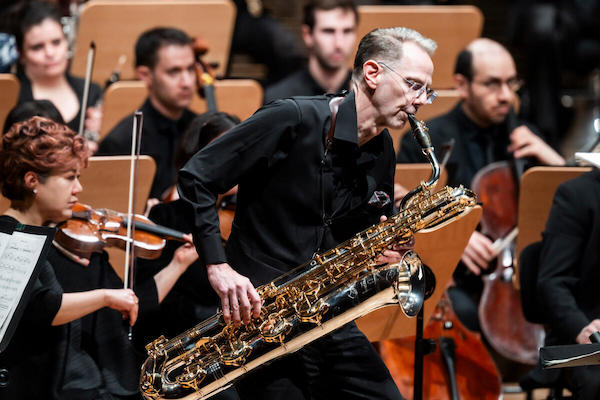
McAllister tapped the keys of the baritone sax percussively in the third movement, “Licks.” He blew unconventional sounds and played spasmodic licks. He traded staccato passages with the brass and other instruments. The movement seems to wander; it felt as if the main purpose were to explore the tone colors of the solo instrument. That it did. But I wanted it to go somewhere and I couldn’t see that it did.
Slatkin and Shostakovich
As for the Shostakovich Symphony No. 5, a lovely airiness characterized the softer sections of the first movement, while alarums and oom-pahs resolved to a soulful ending. The warmth continued in the rather lighthearted scherzo, which felt alternately military, playful, and exciting and fun. The wonderful “Largo” was entrancing and magical, a bit funerary, with beautiful harmonic movement. Flute, oboe, and harp sounded gorgeous as the orchestra explored the growing complexity of the piece’s emotional journey. While I’ve heard the symphony before I don’t know that I ever appreciated this movement as much.
The stark melodies of the martial finale suggest a Stalin-like strongman; you can see why the Soviet leader approved. In the breakdown section it felt like victory was in the wings, and it arrived with the stirring finish.
What a pleasure to see Maestro Slatkin with the New York Philharmonic. Having recently marked his 80th birthday, he looked as fit and energized as ever. Here’s hoping for many more such concerts to come.