 Blogcritics The critical lens on today's culture & entertainment
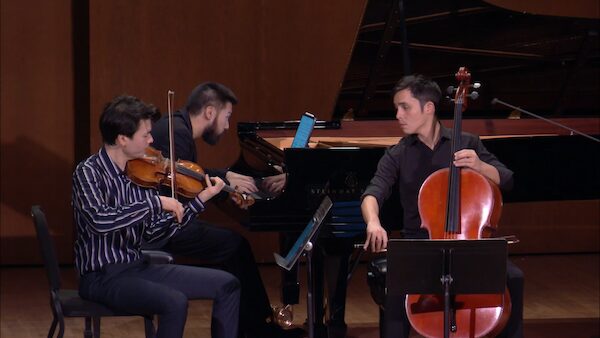
The peripatetic life of a chamber musician typically mixes soloist outings with small ensembles. Along the way, many of these musicians master canonical works in various genres and traditions while also advocating for new and neglected music. The members of the Junction Trio do all of the above, both separately and together.
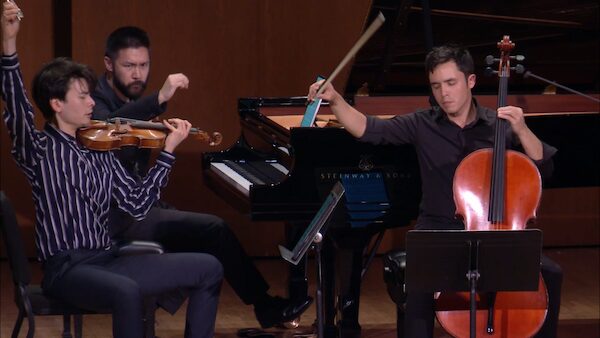
Often during the Trio’s performance at 92NY on Friday, one could imagine that violinist Stefan Jackiw, cellist Jay Campbell, and pianist Conrad Tao did little else but woodshed and concertize together. To prove otherwise, you could look at the program – or at my email inbox. There, I’m informed that Death of Classical will soon present Jackiw playing Violin Sonatas by Charles Ives with pianist Jeremy Denk. Tao is about to perform Bach’s Keyboard Concerto with the Festival Orchestra of Lincoln Center. And Campbell is back at 92NY this coming weekend in a concert of all-contemporary music as a member of the JACK Quartet.
The three formed the Junction Trio almost a decade ago, but with their busy and eclectic individual careers they don’t appear as such all that often. They made their Carnegie Hall debut only last year, and the concert at 92NY was their first at that venerable institution.
It consisted of a smartly conceived program of Shostakovich, Brahms, and in between, a funny shocker of a world premiere by John Zorn, Philosophical Investigations II. The Zorn piece was a follow-up to Philosophical Investigations I, which the Junction Trio premiered at that Carnegie Hall concert in 2023.
Shostakovich’s Piano Trio No. 2
Dmitri Shostakovich’s remarkable Piano Trio No. 2 in E minor begins with a melody from the cello in an extremely high, harmonic register. It’s a part a violin would normally take, but Shostakovich was after a very different, more piercing tone quality. Campbell executed this part beautifully, with the violin joining in with a lower harmony and then the piano in a part lower still. This section was hypnotic and expectation-defying such that when the march-like second section ensued, the ear was soothed while the brain remained on high alert. The Trio negotiated the off-kilter accents, anxious staccatos, and wild hummings with muscular ease.
The percussive and scherzo-like “Allegro con brio” read as a joyful dance, with the piano taking the lead and all three playing with verve until the abrupt end. This primes the audience for the memorable folk-dance themes of the Finale, but first comes the ruminative “Largo,” where the piano first states a slow chordal obbligato that the violin and cello then melodicize dolefully upon. The langourous 6/4 time holds steady under sighing chromatic descents as the movement draws to a close.
Aggressive playing emphasized the Finale’s dynamic excursion through a slant-wise take on Jewish folk music. Time signatures bump off each other with a playfulness tempered by an underlying sad-seriousness residing in the minor thirds and half-step figures. The musicians effectively built up to the score’s eventual harshness, evoking distress, verging even on the macabre, as if a dance of celebrations had morphed into a dance of death.
John Zorn and Two Kinds of Surprise
The furor was such that Jackiw encountered a sudden technical problem that forced him to dash offstage to make a repair, as his musical partners stared after him in stunned wonder. Soon back, the violinist rejoined the others and they played the rest of the Shostakovich Finale without further incident. Rippling piano lines arced under intertwined violin and cello melodies. A restatement of the solemn chord progression from the “Largo” established continuity. The whole performance sounded more than assured – it felt heroic.
John Zorn’s new piece reeks with his characteristic salad-spinning of styles and traditions. Thunderclaps of noise interrupted piano-jazz chords. Dissonant drones and sharp surprise attacks, high-end string harmonies, distorted cello scratching, splashes of traditional harmonies, and a very apt quotation all made it great fun to watch and a bracing challenge to listen to. There’s a method to Zorn’s madness – an aim to surprise, disconcert, upend expectation, draw laughter, and pose questions.
Brahms as Comfort Food
After the concert my wife said, “The Brahms was like a warm hug after the John Zorn.” Indeed the Junction Trio had endowed Brahms’ familiar Piano Trio No. 1 (the later version, revised in 1889) with plenty of warmth, as well as with vigor.
The first movement reveled in a singing quality, the ever-evolving harmonies conveyed with admirable balance of firmness and lyricism. Finesse defined the fast triplet passages, excitement built, and I was reminded how gauzily lovely the end of the movement is.
The “Scherzo” skittered with elation, minor key or no. The gossamer strands of the “Adagio” carried deep feeling; a mournful quality emerged when the instruments spoke with one voice, and persisted when the strings traded melodies with the piano. There was a sense of all three musicians plumbing the music’s mysteries.
For their commanding performance of the “Allegro” finale they summoned aggression, and controlled it to make a pointed statement. Brahms may have tempered the “wildness” of his original version of his first Piano Trio, but his explosive creative spirit remained throughout his life. The Junction Trio dipped productively into that spirit for this Brahms, and for their entire concert.