 Blogcritics The critical lens on today's culture & entertainment
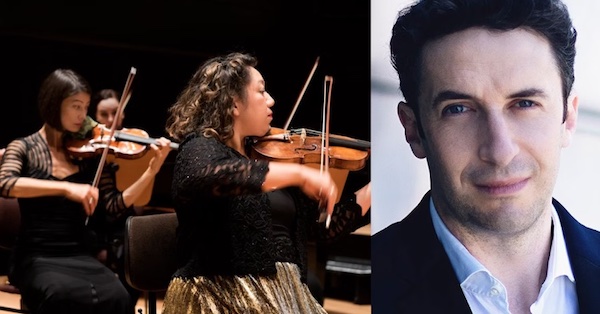
Funny how despite its title, Caroline Shaw’s “Entr’Acte” is often programmed at the start of a concert. Whether for string quartet or, as performed the other night at 92NY, for string ensemble, this devilishly fun, clever, and ear-challenging avant-favorite doesn’t seem to want to go between; It wants to occupy its own space, hitting a roomful of ears filled only with anticipation. It served as a powerful opener for the March 18, 2025 concert by the Orpheus Chamber Orchestra. The piece’s nettlesome timings and techniques were a fine, even an ideal medium for the Orpheus’ string players to demonstrate their edgy skills and their famously conductor-free synchrony.
A Klezmer Concerto
The evening’s biggest showpiece followed, as the full orchestra (including winds, percussion and piano) assembled to back up Noah Bendix-Balgley in the world premiere of the violinist-composer’s Fidl-Fantazye: A Klezmer Concerto. Bendix-Balgley, who has another little gig as concertmaster of the Berlin Philharmonic, was inspired to create this dazzling three-movement work by klezmer music; but his work also takes the tradition to new ground.
Such integration of folk traditions is far from new, even with respect to klezmer. Herschel Garfein, for example, did something similar with his The Layers, creating new tunes using klezmer vocabulary and layering them into concert music. But that was on a smaller scale. Bendix-Balgley’s concerto proved an action-packed journey through dances with wild rhythmic swings, key-signature flips, and virtuosic fiddling courtesy of the composer himself, directing the orchestra while playing his heart out. The show was as entertaining to watch as it was to hear.
Initial fury gives way to a soulful solo dance for violin, with individual wind players taking solo turns as well. At first, all the fire and sadness left me a little cold, as if the music was trying too hard. But as the first movement progressed, an image of Charles Ives transmogrifying the local music he grew up with filtered into my head, and I started to align with the music’s creative spirit.
The inventiveness never flagged. Melancholic doinas and a long solemn 3/4 dance interlaced with a short hora and other celebratory forms. I actually couldn’t totally follow which sub-section was which (they are laid out in the listings of each movement), but that was part of the fun. The whole piece becomes a whirlwind of celebration, mourning, and moods between.
Bendix-Balgley and the ensemble followed up this outpouring with a sampling of the kind of traditional klezmer tunes that inspired the concerto. These added a dimension of appreciation, and of understanding for anyone in the audience who may not have been familiar with the Eastern European-Jewish folk music tradition. It was wise to add this encore.
Folk Dances Courtesy of Bartók and Brahms
Sticking with the theme of music inspired by folk traditions, the Orpheus, joined again by Bendix-Balgley, moved to more familiar ground with a spirited performance of Bartók’s Romanian Folk Dances for Violin and Orchestra, in lush arrangements by Orpheus violist Dov Scheindlin. One, the “Dance from Bucsum,” seemed to nod back to klezmer, a reminder that folk traditions, just like art music, are never “pure.” (Those major chords that mark sudden ends to minor-key pieces will always distinguish Bartók’s musical folk tales from Jewish tunes, or anything else for that matter.)
On the same theme, a selection of Brahms’ Hungarian Dances dominated the concert’s second half. Here, without the presence of a soloist directing from downstage, the performances showcased the ensemble’s amazing togetherness, in, for example, the 16th-notes of No. 4. A rich sound that belied the small numbers of musicians on stage elevated the elfin No. 15, the elastic tempos of No. 5, the ruminative No. 14, the spirited No. 19 (another dance with some similarities to klezmer, except in a major key), and the rest of the nine selections, not least the famous No. 5 which closed the set.
As usual, the Orpheus Chamber Orchestra delivered a program designed to open the mind as well as engage and delight the ear. Visit its website for upcoming concerts.