 Blogcritics The critical lens on today's culture & entertainment
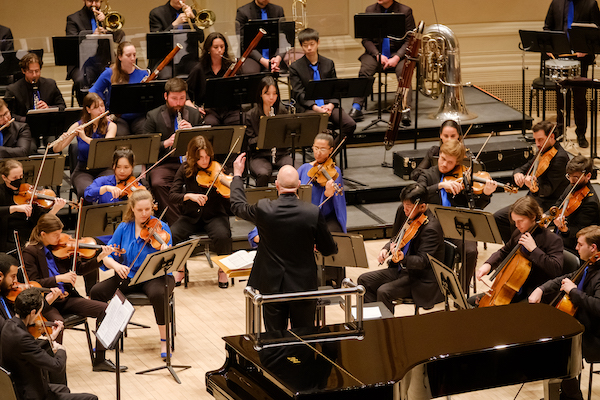
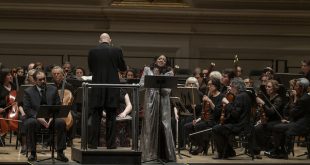
“Charles Ives’ America,” The Orchestra Now’s concert at Carnegie Hall on Thursday night, could as well have been called “Two Sides of Charles Ives.” Like so much of the maverick composer’s distinctive oeuvre, the music on offer was about “what it’s like to be an American,” as host and Ives scholar J. Peter Burkholder put it during a pre-concert talk. But the two halves of the concert also revealed a marked contrast between on the one hand, Ives’ truly avant-garde compositions, and on the other, his efforts to emulate the (in this case) symphonic models of past heroes like Beethoven, Dvořák, and Brahms – without sacrificing originality.
When Leon Botstein conducts, whether with The Orchestra Now (Bard College’s excellent graduate student ensemble) or the American Symphony Orchestra, there’s usually something more than music per se, some enlightening introductory words and musical demonstrations that enhance listeners’ appreciation of the music.
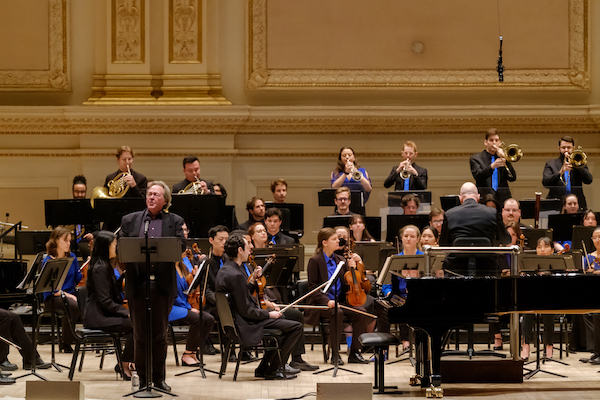
But this concert went even beyond that. Conductor and orchestra didn’t just demonstrate in advance certain passages where Ives (1874–1954) had used particular folk tunes, hymns, or patriotic songs. We also heard baritone William Sharp sing some of those songs accompanied by pianist Donald Berman. Both had also contributed valuable observations during the pre-concert talk.
Hymns and Battles
The first half of the program offered a selection from Ives’ more experimental work. In the unabashedly programmatic “The Fourth of July,” “Central Park in the Dark,” and the three movements of Orchestral Set No. 2, Ives used tunes that early 20th-century listeners would have known. Many are still familiar, like “Battle Hymn of the Republic” and “Hello! Ma Baby.” Sometimes Ives disguises these source materials – at snail-like speed, or with melodic variations, or beset with dissonance. Other times they are blaring and blatant. The effects are alternately subtle, joyful, challenging, and humorous.
“Central Park in the Dark” was perhaps especially interesting for the New York City audience. A humming wash of strings represents the sounds of nature. These are then imposed upon by human activity in the form of ragtime music, sirens, and such, depicted by the other instruments.
The triptych of Orchestra Suite No. 2 was the especially impactful, with its great range of emotion. In “An Elegy to Our Forefathers” many tunes arise out of a sad procession. It put me in mind of the old Twilight Zone episode “The Passersby,” in which a dusty parade of crippled or disillusioned Civil War soldiers trudge down a road to nowhere.
The second “movement” musicalizes the boisterousness of a revival meeting, while the third introduces a solemn and menacing mode in response to the news of the sinking of the Lusitania. Near its end a hymn erupts in full blast, followed by a quiet coda with instruments playing in different keys.
The Symphonic Charles Ives
The three pieces of the Suite together summed up quite neatly the iconoclastic originality of Charles Ives. The second half of the concert introduced a significant contrast. In the Symphony No. 2 Ives uses more traditional harmonic language, avoiding dissonance and employing more easily decipherable counterpoint. The Allegro movements were quite stirring, the Adagio full of sweetness with hints of Brahms and even (I thought) Schubert.
The finale presented a lush spectacle, with much happening at once, in a powerful and assured performance with a quirky surprise at the end.
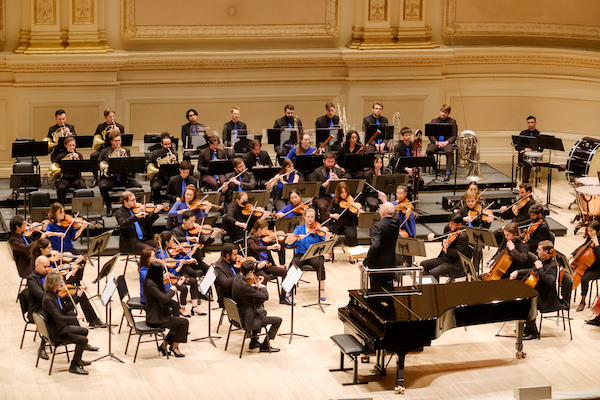
In totality the concert drew a well-rounded picture of what made Ives Ives – the classical studies, the marching-band and church music of his youth, and also the freedom to experiment that he enjoyed from making a good living outside of music. (Ives was an innovator in the field of life insurance too.) That made him less beholden to tradition and cultural gatekeeping.
Botstein and The Orchestra Now are known for concert programs that offer more dimensions than typical classical performances do, and they took that a welcome step further with this one. The conductor said he has noted a lapse in interest in Charles Ives in recent years. This year, the composer’s sesquicentennial, Burkholder and cultural historian Joseph Horowitz curated a “Charles Ives at 150” festival with Bard College and The Orchestra Now, hoping to help revive active engagement with the seminally important American composer. This concert at Carnegie was the series’ final installment.
If Charles Ives appreciation has really experienced a dip in recent years, a reversal of course seems to have gotten underway in 2024. The audience on Thursday was turbocharged by the presence of so many music students’ friends and family. But the music of Charles Ives surely generated some of the enthusiasm. And both were good to hear.