 Blogcritics The critical lens on today's culture & entertainment
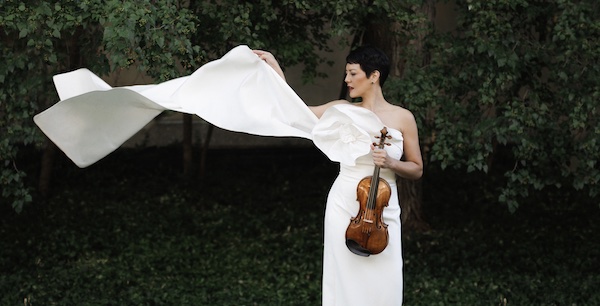
Anne Akiko Meyers: Taking Flight
From its earliest days, the violin has evoked the human voice. Indeed, scientists have found that notes on some 16th-century violins crafted by the greatest early luthiers “displayed some sonic overlap” with vowels as sung by human singers, and that on some of these instruments “every…note appears to carry some degree of human vowel character.”
So when I had the opportunity to talk with celebrated violinist Anne Akiko Meyers in the run-up to her sold-out May 17 concert with the Orpheus Chamber Orchestra at Carnegie Hall’s Zankel Hall, I was curious to know how she thought of her violin in the context of the human voice, especially since she performs and records so frequently with choirs. Was there something about choral music or vocal music in general that goes especially well with – or is especially adaptable to – the violin?
Very much so. In fact, Meyers believes that “the violin I perform on – the 1741 Ex-Vieuxtemps Guarneri del Gesù – is the closest instrument to the human voice and, in many ways, has become my own voice.” Inspired by the human voice’s natural phrasing and breathing, she “strive[s] to reflect that same sense of expression and lyricism through the violin.”
Eric Whitacre: Fire and Water
Fans will experience Meyers’ unique expressivity when she joins the Orpheus Chamber Orchestra in the New York premiere of a new concerto she commissioned from Eric Whitacre, a composer who happens to be best known for his choral music. Meyers told me she has long admired Whitacre’s music, describing it as “poetic, haunting and ethereally beautiful. During the pandemic, I repeatedly listened to his ‘Seal Lullaby’ and found it to be incredibly soothing, comforting, and straight from the heart.”
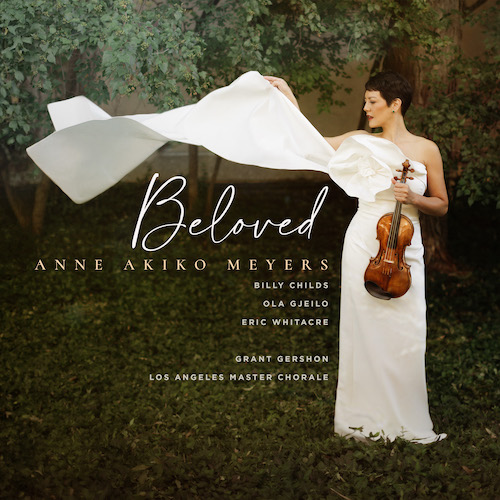
“Seal Lullaby” appears on Meyers’ new album Beloved.
As for the new work, titled “The Pacific Has No Memory,” the composer had been working on a different piece to fulfill Meyers’ commission when he was jolted in another direction by the Los Angeles wildfires of January 2025. I asked Meyers how that inspiration manifests in the piece that eventually resulted, and what audiences can expect.
“‘The Pacific Has No Memory,'” she said, “is a tribute to all the people who experienced the devastation of the Altadena and Palisades wildfires. Eric and his family have many friends in the Los Angeles community, and my family and I were directly impacted by the fires.”
Meyers explained that it was actually a vision of the Pacific Ocean from the film The Shawshank Redemption inspired Whitacre. The main character “spoke of the Pacific and a town close to it where he can escape his past and start anew. The ocean constantly moves and washes away any trace of what came before, allowing for a fresh, hopeful beginning…I always go on an emotional journey with Eric’s music and find that the music is profoundly moving. I think audiences will find it incredibly moving and transporting.”
Whitacre wrote the piece for Meyers and the strings of the Orpheus Chamber Orchestra. Like those early luthiers, the composer is well aware of the kinship between string instruments and the human voice. They are, he has said, “so similar in many different ways, and it’s a natural arc for me to write for strings. I just don’t have the opportunity to do it as much as I do for singers.
“From my very first beginnings as a singer when I was 18, what struck me most is the communal experience: I’m here, and I’m myself, but I’m lost in the group at the same time. It instantly unifies a group of people on this deep, wordless level.”
The Voice of the Violin
The May 17 concert will also include “The Lark Ascending,” one of Ralph Vaughan Williams’ best-known pieces and a staple of the violin literature. Meyers recorded the piece as far back as 1993. I asked her what accounts for its enduring popularity. Again, the human voice, even if not heard directly, lurks in the foundation. “‘The Lark Ascending’ is set to a poem and follows a narrative, much like Vivaldi’s Four Seasons,” the violinist told me. “You can feel the lark searching for freedom, taking flight, and soaring toward the heavens. It’s a profoundly beautiful and deeply gratifying piece to perform.”
Meyers’ consciousness of the kinship between strings and voice is prominent on her recent recordings as well. Beloved features the Los Angeles Master Chorale and includes Billy Childs’ “In the Arms of the Beloved,” another work written for Meyers, and scored for violin, orchestra and choir. In the composer’s conception, the solo violin represents the voice of his mother, the piano as his voice, and the choir as “a shapeshifting sonic environment that sets the mood for the timeless Rumi poem ‘Gone to the Unseen.'” Like “The Pacific Has No Memory,” this piece addresses the effects of recent California wildfires on families and communities.
Beloved also includes Serenity by Ola Gjeilo, who like Whitacre is known for choral music.
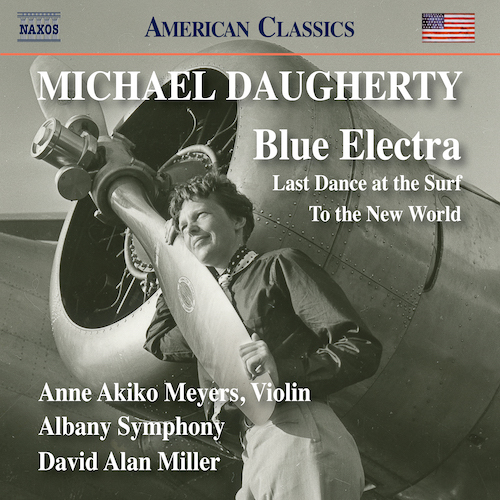
Blue Electra: A Concerto for Violin, Inspired by Amelia Earhart
The theme of the May 17 concert, “Taking Flight,” recalls another recent commission of Meyers’. Michael Daugherty’s four-movement concerto Blue Electra, the title track of a 2025 album featuring Meyers and Daugherty’s music, was inspired by aviator Amelia Earhart’s life and career.
I asked the violinist about this longer excursion into the heavens.
She described Blue Electra as “an incredible concerto” that “skips through Amelia Earhart’s fascinating life in four time periods.” She went on:
“In the first movement, we visit her in 1928, when she wrote a poem, ‘Courage.’ It is remarkable that she wrote poems, fought for women’s rights, was an aviation professor at Purdue University, and was ‘Queen of the Air,’ being the first woman to fly over the Atlantic solo [and] receive the Legion of Honor.
“The second movement, from 1932, paints this celebratory picture with a ‘hot jazz’ soirée in Paris, champagne freely flowing and everyone dancing the night away. In the third movement, we visit Amelia as a child fantasizing how it feels to fly. And finally, the [inspiration for the] last movement, “Last Flight,” dates from 1937. We can hear violent chatter, SOS calls, her plane falling from the sky as she tried to fly across the world and disappeared into the Pacific Ocean.
“There’s much mystery as to what happened to Amelia, her navigator Fred Noonan, and her Electra plane as she piloted this tragic last flight. The ending of Michael Daugherty’s concerto is electrifying and gripping as you hear the entire orchestra and me perform a giant question mark as to what happened.”
With all her commissioning and concertizing, Meyers has also been busy in the studio. Just last year she won the Latin GRAMMY® Award for Best Classical Album, for Fandango, another Meyers commission, with Gustavo Dudamel and the Los Angeles Philharmonic. Since its premiere at the Hollywood Bowl in 2021 the piece has been performed more than 40 times with 16 different orchestras.
The prolific Anne Akiko Meyers has another album about to be released (June 13, 2025) that focuses on the music of Philip Glass. She performs his Violin Concerto No. 1 and a piece he wrote for her recently, “New Chaconne.”
Simone Dinnerstein once said, comparing Glass and Schubert: “I love their pared down quality, their economy, their ability to change everything by changing just one note in a chord. Their asceticism suited the moment. But there is a sensual element in both, too, because the human voice is central to Glass’ and Schubert’s sound worlds.” There it is – the human voice, again making its mark on instrumental music.
I asked Meyers what Glass’ music has meant to her over the years, and whether it poses particular challenges and offers particular rewards.
She described Philip Glass’ music as “very meditative and soulful. There’s much poetry in his music and his Violin Concerto is a masterpiece of haunting beauty. The challenge of Philip’s music,” she went on, “is that it can feel incredibly exposed and when not in sync, the asymmetry can be off-putting. Much like Mozart, one must breathe and feel the rhythm’s natural freedom within the notes, in order to let it float and sing…”
After the Carnegie concert Meyers and Orpheus will be “floating and singing” on the road as they premiere Eric Whitacre’s “The Pacific Has No Memory” at the Colorado Music Festival this summer and the Los Angeles Chamber Orchestra in 2026.
Above: Meyers performs her violin version of Morten Lauridsen’s song “Dirait-On” at an NPR Tiny Desk Concert