 Blogcritics The critical lens on today's culture & entertainment
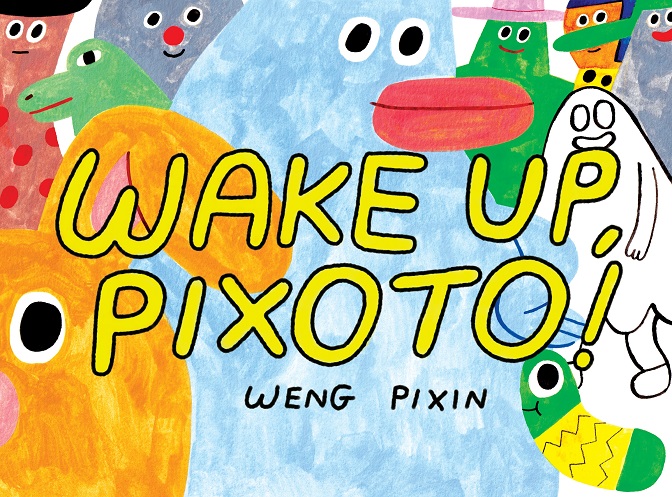
Wake Up, Pixoto! by Weng Pixin, published by Drawn & Quarterly, tells a deeply personal story of Pixin’s complex relationship with an individual who at times serves as mentor, friend, manipulator, and stranger, many times all at once. Like her previous work, Let’s Not Talk Anymore, Pixin tells the story through close point-of-view, inviting the reader to experience it as if looking just over her shoulder.
A Truly Shared Journey
Her telling of Wake Up, Pixoto! begins long after the fact as Pixin, portrayed as a tan rabbit, is talking with friends about this very project. They discuss the difficulties of telling such a story, such as people seeing it as attacks or a revelation of such personal information others could use it against her. Pixin decides to go forward, showing only her side of the story and not claiming any perspective for anyone else because, as a friend says, “What was done to us wasn’t right” and “Great to know I wasn’t the only one.” Everyone has experienced a relationship such as this, whether they realize it or not, to at least some degree, making it a truly shared journey.
Back to 2004
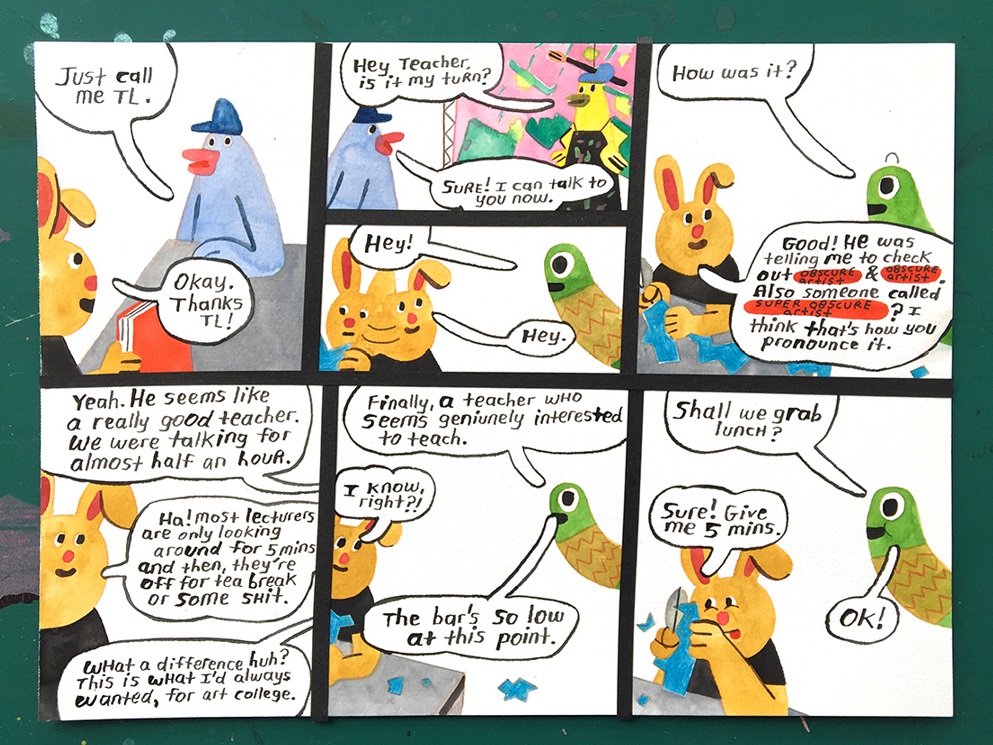
Pixin goes back to 2004, as a 21-year-old art student getting critique from “T.L.,” a teacher portrayed as a friendly blue bird in a hat. He seems hip and wise, giving deep thematic analyses showing perspectives that put young Pixin in awe. Other students note that his critiques rarely have anything helpful on technique, just sweeping philosophical statements, but Pixin is charmed. Even after class, T.L. invites Pixin along to dinners and galleries, meeting other artists even though she is often left out of the conversations. She feels their relationship is complicated, but every time she begins to slip away, T.L. pulls her back in with guilt trips, opportunities that become obligations, and life advice that she feels compelled to follow.
Saved by a Documentary on Cults
One of the recurring themes in Wake Up, Pixoto! is the perception of weakness. T.L. accuses her of weakness in her relationship with her parents and boyfriends, pushing her to separate herself, which of course leaves more time for T.L. as he dominates conversations, insists Pixin follow his advice, and generally leaves her feeling weaker with every interaction she has. Through the months and years, Pixin gradually manages to escape, especially after watching a documentary on cults and recognizing much of the same behavior, purposeful or not, which rings true with another friend commenting that T.L. tries to form a cult around himself. Finally, Pixin breaks herself free, but it is much longer before she is able to heal. Telling the story itself proves part of the process showing her true strength.
Complete Separation
The story in Wake Up, Pixoto! is powerful in its close touch, made approachable through Pixin’s endearing art style. The characters are cartoony animals with a few humans and even objects, such a hotdog and takeout carton. The caricatures serve as characterizations with T.L. himself turning into a fierce red blob as Pixin begins to recognize the toxicity in their relationship. He transforms back and forth back to his friendly bird form as he lightens his touch, but ultimately all that can be done is complete separation so that Pixin can truly be herself.