 Blogcritics The critical lens on today's culture & entertainment
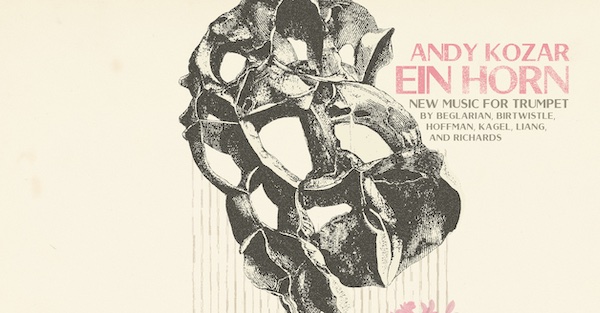
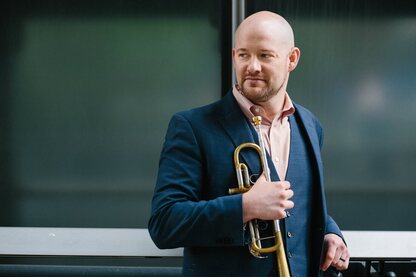
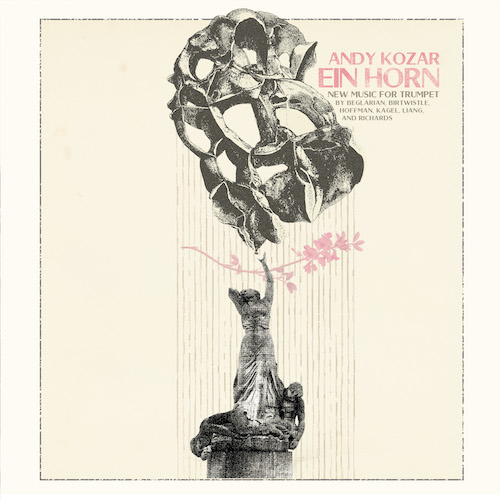
Ein Horn, a new album from trumpeter Andy Kozar of music for trumpet(s), is both a throwback to old forms and a creation of the digital age. Old forms because the sound of a trumpet ensemble goes back to hoary traditions of fanfares and alarums. Digital because Kozar played all the parts (except for some electronics) in scores that number as many as 36 trumpets. And whatever one thinks of the music, one can’t help but be impressed with the ear and the musicianship that went into the intricate overdubbing behind these recordings of pieces like Mauricio Kagel’s Fanfaren and Sir Harrison Birtwistle’s “Placid Mobile.”
The dozen short fanfares of Fanfaren vary in tempo, construction, flow, and dissonant density. But all call for precise ensemble playing. Kozar creates that in the studio, seemingly effortlessly. The ones marked “Vivace” especially impress on that score. The slow ones stretch the definition of “fanfare,” but so do the nontraditional flavors throughout. Harmonies – close, angular, piercingly inventive – along with tricky rhythmic juxtapositions and varied techniques create continual surprises. Only two of the dozen fanfares top two minutes in length. Yet each of the 12 makes a firmly rooted statement.
To vary the color, the album includes two pieces with electronics. The muted sounds, halting rhythm, and questioning ending of the last of the Fanfaren forms an apropos lead-in to the title track by Eve Beglarian. Scored for flugelhorn and electronics, “Ein Horn” enfolds sustained, sliding notes from the flugelhorn amid jingling bells and synthesized harmonic envelopes that open and close like moody ’70s prog-rock jams. Distinctions blur between synthesized and natural sounds. It’s an ambient space-out that lasts just long enough.
36 Trumpets (But No Parade)
Birtwistle’s “Placid Mobile” for 36 trumpets revels in tone clusters that ring like church-organ chords. This piece is all about how cleanly the trumpet, in the purity of its open sound, can temper the glare of extreme dissonance. A “lead” trumpet plays steady tones each heralding a fresh cluster. The studio sessions must have felt like a hall of mirrors.
The reverberant synthesized soundbeds of “Possibly Brahms” by Elizabeth Hoffman feel like submerged echoes of Birtwistle’s clusters. Over them, a solo trumpet plays improvised-sounding figures that suggest soft jazz and other 20th-century musics. Still there’s a feeling of coordination between the two elements, as if the trumpet were triggering changes in the synthesizer accompaniment. A narrative does seem to unfold over the piece’s nine intriguing minutes. Towards the end we hear muted hints of piano. (Is this where the “Brahms” of the title comes in? I have read nothing about this piece; I choose to let its genesis remain a mystery.)
“Lake” by Lei Liang places two trumpets in an eerily resonant space where they interact to create warm, ambient harmonies. The sound opens up a bit at the end with the introduction of the nasality of a muted trumpet, but this remains a laid-back space. The album ends with two pieces by Eric Richards, a short fanfare and the repetitive eight-minute “fons et origo,” whose raison d’être eludes me. It’s a weak finish to an otherwise strong collection of music that proves the continuing relevance of the trumpet and the trumpet ensemble.
Brought to You by the Academy
Recent releases from prolific new-music label New Focus Recordings show that not all “serious” contemporary music sounds uncomfortable to the ear. Some is quite “accessible” to the casual listener. (Lei Liang’s string quartets and David Salvage’s piano music come to mind.) The music on Ein Horn is less so, but nonetheless quite comprehensible. It’s not hard to hear what the composers are doing, what they’re going for.
Still, popular culture disdains “contemporary classical” music generally. Sometimes I feel academic framing contributes to the problem. Ty Bouque’s notes on the album provide good examples, to wit:
“This album is thus not a digital sociality masquerading as embodied presence (that impoverished sense of togetherness which virtual meeting platforms always promise and then fail to surrogate). It is instead (and in keeping with Kozar’s long-standing educational commitments) an exercise, a kind of pedagogy for recognizing the many ways music thinks about alternative forms of relationality.”
Pedagogy? OK, sure, but it’s music. For people to listen to. And it’s interesting and fun music to listen to. Let’s try and keep that in mind.
And this, about “Placid Mobile”: “though quintessential Birtwistle in its extreme negotiation between line and density, [it] encodes a formative early encounter with music-as-architecture which Ryan Streber’s studio mixing here nobly recreates.”
Pish-tush to all that. Just listen. Ein Horn from trumpeter Andy Kozar is out now on New Focus Recordings and available at Bandcamp.