 Blogcritics The critical lens on today's culture & entertainment
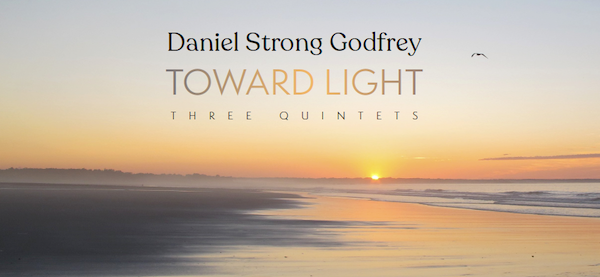
Daniel Strong Godfrey interbreeds contemporary sensibilities and the classical chamber music tradition in three quintets he composed over 17 years, between 2006 and 2023. Now issued together by New Focus Recordings on Toward Light: Three Quintets, these pieces show his distinctive approach to modernism transforming familiar tropes of the violin, viola, cello, piano, and guitar. All three quintets feature the venerable Cassatt String Quartet and an additional musician.
The Cassatt has a distinguished history of quintet collaborations. Just in the past couple of years I’ve witnessed two of their unusual instrumental lineups in concert.
The selections here feature less-surprising additions to the string quartet format – no trombones or shakuhachis here. Instead we have pianist Ursula Oppens, guitarist Eliot Fisk, and a string quintet with two cellos.
Eminent Guest Artists
Often contemporary composers name pieces after traditional forms while stretching the music’s connection to those forms. But when Godfrey calls a movement a Tarantella or a Dance, or designates one with time-tested Italian terms like “Adagio poco rubato,” he means it directly. The album opens with the earliest work, Ricordanza-Speranza (“Recollection-Hope”) from 2006. That may be in part because its guest artist, Ursula Oppens, is the best-known. In any case, the loping theme that starts the “Adagio poco rubato” grips the listener immediately, though the piano doesn’t enter until two minutes in. That opening theme contrasts markedly with the muted chromatics that follow.
When the piano enters with delicate high chords it’s to create atmospherics atop the strings as they build on the theme. The piano takes a more direct role as the music climaxes explosively halfway through the movement. The music emphasizes the contrast between the piano’s attack and decay and the strings’ gentle bowing and non-decaying sustain.
The movement ends with a graceful modulation that sets up the aggressive “Con fuoco.” Tumbling passagework alternates with hurried, almost panicky melody and stichomythic gesturing. Here the piano and strings coalesce into a relentless machine. You can hear the musicians’ enthusiasm.
Near the end, a lyrical settling-down opens up into a minor-key question mark that prefigures a jumpy piano interlude that flows into the final movement. Dance-like rhythms develop, stitched together by more chromatic figurations that recall the first movement. These rhythmic passages delightfully combine traditional harmonies with modernist ones; first the piano takes the traditional side, then the strings.
Dancing at Midnight
The music on this collection speaks to listeners who appreciate something bracing and new from a format – string quintet – that dates back centuries. In Toward Light, the newest piece, guitarist Eliot Fisk joins the Cassatt String Quartet. The music often partakes in harmonies and rhythms we recognize as traditional. This quintet, more than Ricordanza-Speranza, works as a feature for the guest musician. The relatively long first movement sees Fisk and the Cassatt players trading dark statements, the strings issuing sweet but volatile harmonies, the guitar flitting about the fretboard with a kind of somber playfulness.
The pattern continues when a second, more celestial theme arrives. The guitar passages feel almost improvisatory at times. The quartet and guitar stay mostly apart for much of the movement, the strings perhaps representing the first part of its title (“Dusk: Prayer”), the guitar the second. It’s not until more than five minutes of eight-and-a-half have gone by that the five instruments dig in together. Even then it’s for just one climactic burst of tremolo.
The exposed guitar work emphasizes the delicate sensitivity of Fisk’s playing. That continues in the second movement, “Midnight: Dance,” which introduces cloudy auras from the strings and guitar figures and chords reminiscent of Spanish-style playing.
The “dance” takes a couple of different rhythmic forms, but with steady momentum until the dramatic wind-up/wind-down of the final minute. This music flows directly into a substantial guitar cadenza where Fisk impresses with dexterity that makes parts of the music sound like two guitars are playing. Even on my second listen I almost forgot to note that the strings were nowhere to be heard.
Morning arrives with the final movement, “Dawn: Escape,” with insistent climbing figures, plucky pizzicato, and rolling guitar chords. Eighth-note rhythmic stretches encompass bright and troubled moods alike, with percussive effects dwindling to a soft ending that leaves us with a guarded hope for a better day ahead.
Doubling up
Godfrey composed To Mourn, to Dance (2013) for Nicole Johnson and her father, Marc Johnson, who died soon after the two performed at the premiere. This recording features Nicole Johnson on Cello II and Elizabeth Anderson on Cello I. (Through personnel changes, three different cellists and three different violists are heard on the album. Violinists Muneko Otani and Jennifer Leshnower are the constants.)
The very title of the quintet embodies contrast. The yearning quality of the “Prelude” collides with the aggressive “Danza” that follows. In the latter, Godfrey wields his acute harmonic imagination to powerful effect. I can’t help thinking of Mozart’s string quintets, pinnacles of his chamber oeuvre. Though those works have two violas, the density they display finds echoes in Godfrey’s work here.
A contemplative “Interlude” is built around melodic cello solos accompanied by harmonic figures that fade intriguingly. The quintet ends with an energetic “Fugue–Tarantella.” The introductory fugue gains depth from the presence of five instruments; the tarantella that follows is a galloping collage of variations on a dance rhythm.
Throughout the album, the music sounds as inventive as any contemporary work composed for traditional Western instruments. That’s because Godfrey infuses every bar with vivid imagery and an energy that’s at once wise and brash. The Cassatt String Quartet and their guests give the music all the dimensionality implicit on the page. Bravo to a distinguished composer who has continued to produce vital new music that adds to an oeuvre that goes back half a century.
Toward Light: Three Quintets is out now and available at Bandcamp.