 Blogcritics The critical lens on today's culture & entertainment

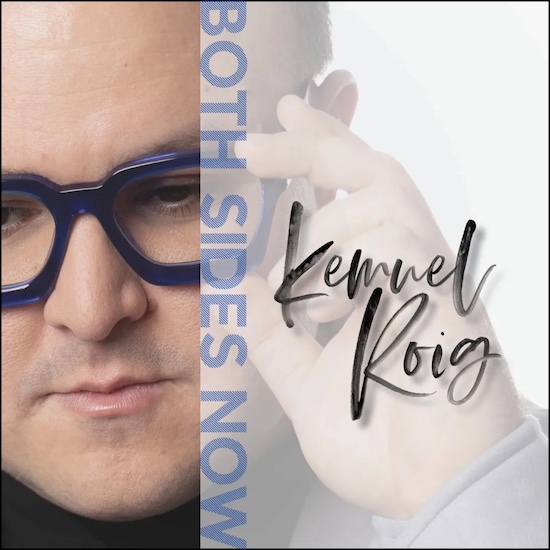
Cuban-born pianist Kemeul Roig made his name in the bands of Arturo Sandoval and Al DiMeola, and through other prominent collaborations. More recently he has both stepped forward as a leader and stepped out as a solo artist. For his first solo album, Roig recorded a set of originals dedicated to his wife and children. Now comes Both Sides Now, a set of ballad treatments and improvisatory musings on songs by the likes of Joni Mitchell, Paul McCartney, Michel Legrand, Cole Porter, and Rodgers and Hart, along with some fine Latin numbers. The album takes the listener on a silken journey.
I’ve been in a piano mood because of my recent deep dive into the music of Fanny Mendelssohn Hensel (plus a humble recording project of my own involving a beautiful Steinway that’s too good for me). Both Sides Now fits right into that 88-key groove. Roig’s elastic tempos – not only in melodies but in left-hand accompaniment – create a sense of timelessness and infinite space that’s in one sense the opposite of classical music. In another, though, the unrestricted possibilities of jazz can be very much akin to those explored by great classical composers. I sense that kinship here.
Jazz covers of pop songs can be overly precious, even vapid, and not infrequently just plain ill-advised. Roig doesn’t fall prey to any of this, not in the title track (his spidery “Both Sides Now” could almost be emerging from a music box), not in “Junk” by Paul McCartney, and especially not in “How Can I Be Sure,” one of the shiniest gems of its pop-music era. Roig takes the Young Rascals hit to heights of unsentimental sensitivity.
A whispery “Solamente Una Vez” is a highlight among the album’s Latin tunes. Here Roig stretches a delicate web over a softly undulating foundation. And his “Besame Mucho” may be my favorite rendition to date of that overplayed classic. Initially suffused in understated romance, it cruises smoothly into a delicate swing beat just in time for a tasteful improvisation, then glides into a soulful Latin feel.
Even when the pianist takes a more straightforward approach, as with Cole Porter’s “I Love You,” his own free-flowing melodic voice, chordal substitutions, and gracious passing chords paint original landscapes. “Windmills of Your Mind” plays out like a theme and variations, with Legrand’s eternally haunting melody supported by slyly shifting harmonies.
In “Don’t Explain” Roig offers a clinic in the importance of what’s not there, the notes not played. It’s a beautiful way of paying tribute to the Billie Holiday original without copying her phrasing. And when he gets a bit flashy, as in “My Romance,” the bones of the song still gleam through in a way that tells you Roig is interpreting these numbers not out of duty or tradition, nor to challenge himself, but because they speak to him.