 Blogcritics The critical lens on today's culture & entertainment
Composer Michael Hersch and librettist Stephanie Fleischmann combined forces to create the stunning full-length opera Poppaea (recording reviewed here), which blasted away the usual traditions and expectations for operatic treatment of classical subjects. Now New Focus Recordings has released the pair’s Medea, another classics-inspired piece, this time a one-act opera that’s no less tragic and intense.
Hersch’s work in these operas dispenses almost entirely with our standard ideas of melody and rhythm. It slips the bounds of the 12-tone scale. And it breaks our weird habit of endeavoring to make lyrics audibly intelligible.
What remains? Sounds most impure, spurning all restrictions of convention – and thus in a sense more pure than traditional music.
A Medea for a Fractured World
One can follow the libretto in the insert, or more immersively in supertitles at a live performance. But very often the music and lyrics relate only abstractly. Syllables climb octaves; words become moans or shrieks following an inner, unknown logic. The sounds, both vocal and orchestral, express pure and even pre-verbal emotion.
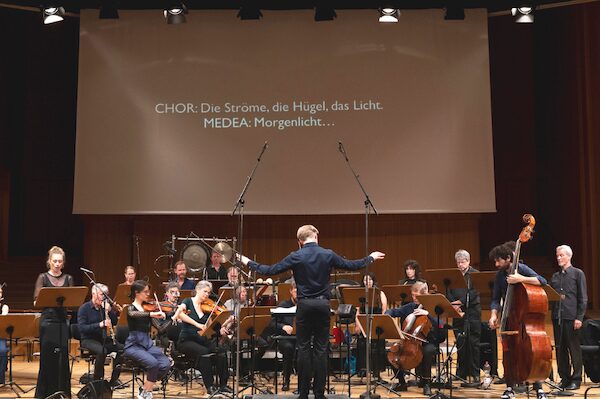
The composer writes that “the graphic nature of much of the text along with musical elements does not require an openly visual corollary.” He is referring to the idea that the opera can be productively listened to on this recording rather than seen in a theater. But the point extends to the relation between the music and lyrics. Fleischmann’s libretto is essentially a multi-part poem. Hersch’s score is another poem, a wordless one that accompanies the libretto more like a demon than a partner.
Yet there is a plodding, pounding, grim and gritty propulsiveness to this unconventional take on the old myth.
The remarkable (and aptly named) soprano Sarah Maria Sun centers the production as Medea. The chamber voices of Schola Heidelberg serve as a Chorus, alternately responding to, echoing, and expanding upon her monologues and plaints. And Hersch’s score has the musicians of Ensemble Musikfabrik make the instrumental parts as meaningful, sometimes indeed more intelligible, than the voices.
It’s no accident, I think, that one of the most exposed and melodic moments for Medea is on the lines “They say that inside/the box of the voice/is the soul.” Often Sun’s voice, and those of the Chorus, are twisted together with the orchestra, contributing to the obscurity of what the singers are saying. At some moments it’s even hard to be sure whether a note we’re hearing is vocal or instrumental.
Exceptions are thus all the more effective. Addressing her enemies, Medea sings, “the bile buried in your bowels, the smoldering coal of spite you won’t snuff out,” spitting out each of the last five words like individual barbs. Another moment of clarity comes when, having murdered her sons to get back at their father, she sings, “I would let the carrion crows/tear my boys’ sweet flesh/from their bones” all on one high note, as if to seal up any possible chinks in her armor.
Only in the final minutes do Medea and we, her listeners, find any peace, as she leaves her dead children behind and flies towards her ancestor the sun.
Medea Lives
In another sense, though, we have not really given Medea any rest for thousands of years. We continue to revive her and re-mythologize her for every era and genre. Through the medium of the astounding soprano Sarah Maria Sun and the fluid talents of the other performers, Hersch and Flesichmann give us a tragic Medea for our fractured age, even as the composer advances art by pushing its limits.
Even for an experimental-music aficionado, these works can be challenging to absorb. But it’s worth exposing oneself to art that tears away boundaries and expectations, and Michael Hersch is one of our best and most determined practitioners at this ragged edge of music and opera. Medea is out now on New Focus Recordings and available at Bandcamp.