 Blogcritics The critical lens on today's culture & entertainment

Over 14 seasons, NYC-based New Thread Quartet has commissioned and premiered more than 150 new works. But their music has lived mostly in the ephemeral universe of concerts and broadcasts; Saxifraga is only the second album under their name, and the first since 2019’s Plastic Facts.
New Thread is by no means the only saxophone quartet around; the format has a history both in new music and in jazz. Contemporary composers continue to explore the character and colors of the saxophone in many different settings. Yet the instrument’s presence outside jazz , rock and pop can still feel somewhat exotic. When, for example, an esteemed composer like John Corigliano writes a saxophone concerto, it’s something to note.
New Thread, No World?
The composers on New Thread Quartet’s Saxifraga run with this spirit in very different directions. The album opens with “Without World” by Scott Wollschleger. It’s a rhythmless narrative of repeated chromatic motives, blaring dissonant chords, growls, whispers, whistles, multiphonics, and sounds from the instruments’ mechanisms. It’s a defiant choice as an opener, as there is more “accessible” music later in the program. But I find its deliberate pace rather restful, its eccentric harmonies and chromatic figuring intriguing and at times quite beautiful.
Mysteriously derived percussive effects dance with trumpet-like exclamations and hesitant mumbles. Snaps, pops, and distorted overblows enliven the central section of the 16-minute piece. Gestures from individual instruments create fresh interest as we move toward the final minutes, where uneasy growls and now-familiar chromatics rise toward a sudden ending.
I’m not sure Wolschleger succeeded in depicting “a musical landscape that is without the human idea of ‘world.'” There’s a distinct sonic language here, and to say that is much the same as to say there’s a sound world. Regardless, whether intentionally or not, it made this listener feel welcome – even at home.
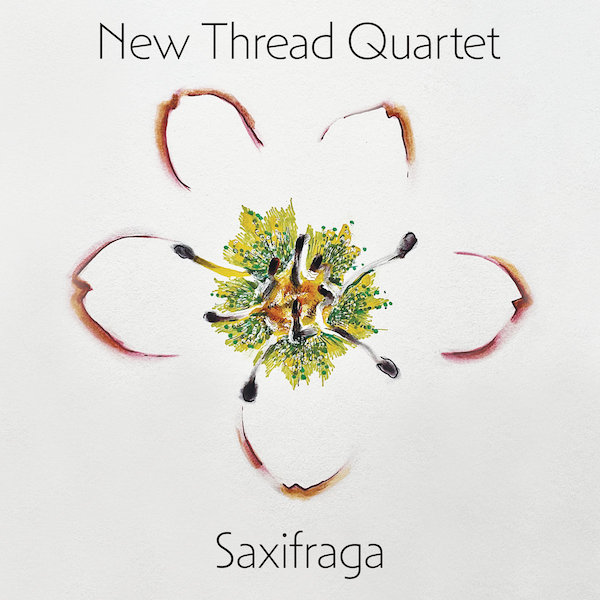
A Sonic Botanic Garden
The five-part avalanche lily by Amy Beth Kirsten was inspired by the Wyoming countryside and its flora. The suite starts with the boisterous rhythms of “saxifraga,” perhaps reflecting the busy mats of colorful flowers that plants in that genus can produce. But inspiration aside, avalanche lily is abstract music; you don’t need to know anything about botany (or Latin) to appreciate it.
“Saxifraga” feels like like a dance number would like to emerge, something flecked with big-band or Latin jazz. But it reveals itself as a composition integral to itself, bending but not breaking any rules, testing only a few of the limits of traditional saxophone technique. When chordal elements break out they are harmonically friendly. A squawking solo line at the end feels like a soprano sax playing the part of a klezmer clarinet.
“Tree monks” starts out like a dialogue between thick tree roots and canopy fauna like birds or monkeys. Jazzy midrange harmonies intervene, suggesting a human presence. We then slide smoothly into “pipsissewa,” which sounds like a deconstructed jazz arrangement. “Toward the rubicon,” an assembly of cool, layered tones without obvious structure, has plenty of sly attitude.
Twirling figures intrude as the final movement, “marcescence,” emerges. The soprano sax chimes in with expressive melodies as the piece climbs toward a powerfully fidgety conclusion capped off with a series of piercing alarums.
Tuning out, Tuning in
The album ends with “Walk for a Shell” by Victoria Cheah. Here the saxophones play long tones that vary only slightly in frequency. The interferences produce audible pulses, familiar to anyone who has (let’s say) tuned a guitar by turning one key until the pulsing between two vibrating strings goes away.
Quieter breathy tones curdle under the higher pitches. The different instruments’ varying colors swim into consciousness, then recede. It’s a quivering, unstable sound environment. The composer suggests the piece should enable the listener to “find worlds in the most unexpected and mundane of places.” This particular world is a murky one.
Slowly and inexorably the music coalesces into a reality where there’s no such thing as “out of tune,” only a persistent conversation among related voices. A choral effect arises in the last few minutes when multiple voices are audible, including the soprano sax an octave above the dominant tones.
It’s an interesting way to end the album, with 20 minutes of this. It leaves one realizing that even the most familiar of instruments harbors endless possibilities. Mining them is a task that never ends, and never should. New Thread Quartet wants us to know that they’re on it.
Saxifraga from New Thread Quartet is out now on New Focus Recordings.