 Blogcritics The critical lens on today's culture & entertainment
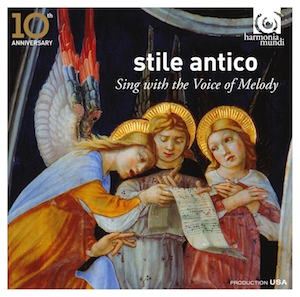 When a musical group reaches its 10th anniversary, as the 12-member London polyphony choir Stile Antico has done, an album of the members’ own favorites seems fully justified. This month Harmonia Mundi releases the English choir’s Sing With the Voice of Melody, a “choice selection of [the members’] personal favourites, drawn from five centuries of glorious repertoire.”
The 12 tracks of (mostly) Renaissance polyphony include pieces by well-known composers like Thomas Tallis, William Byrd, and Tomás Luis de Victoria. They range from works of straightforward harmony like Jacobus Clemens non Papa’s “Ego flos campi” to some, like Byrd’s brief but complex Gradualia motet “Ecce virgo concipiet,” more demanding of the listener but at least as rewarding – it’s among the most beautiful of the pieces here.
There are longer dramas as well. Nicolas Gombert’s “Magnificat primi toni” which alternates polyphony and plainchant, like Allegri’s Miserere Mei Deus, and Tallis’s “Gloria (Missa Puer natus est).”
There’s one modern piece, John McCabe’s setting of “Woefully Arrayed,” a text better known from William Cornysh’s Renaissance version. McCabe, who died earlier this year, melds modernist dissonance, angularity, and repetitions with baroque colors and textures to create a piece that sounds like a lot of fun both to sing and to hear in concert.
As Andrew Griffiths writes in the liner notes of “Ego flos campi,” “Stile Antico must have performed this piece at least eighty times, but it never loses its freshness or allure.” And it’s true that while Stile Antico applies a constant smooth tonality to its performances, even in a studio recording these can still feel fresh, the centuries-old music almost as much as the recent.