 Blogcritics The critical lens on today's culture & entertainment
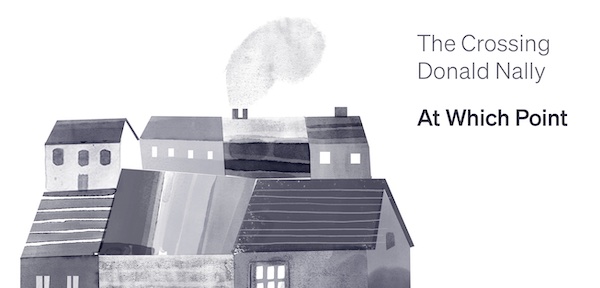
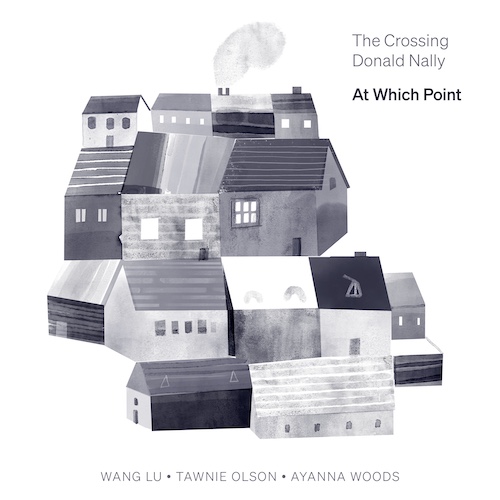
The Crossing, the elite new-music chamber choir led by Donald Nally, routinely pushes the boundaries of what kinds of music a group of human voices can create. Its recent releases have included David Shapiro’s atheistic mass Sumptuous Planet and a pandemic-themed Christmas album. For At Which Point, their latest release, the choir worked with three composers who take excellent advantage of the ensemble’s strengths and predilections.
At Which Point: A Hooey-free Zone?
Often when I read liner notes with contemporary composers’ commentary on their music I have to swallow an urge to cry “The emperor has no clothes.” Put differently, “What a load of hooey.” It’s not that knowing the inspiration or genesis for a piece of music can’t deepen one’s experience of it, but composers’ verbal explanations too often are little more than pseudo-poetry or sophism. Anyway, I appreciate when music stands on its own without verbal explanation.
Of course, when the music has lyrics, the idea of “meaning” takes on another dimension. How do (or don’t) the melodies, harmonies, rhythms, and other technically abstract elements correlate to the sense of the words? Often a choral composer will seem to treat the sung words as mere pegs on which to hang unexpected intervals, experiments in harmonization or vocal technique, or other elements of their compositional voice.
In All Seriousness…
The three works on this album defy contemporary composers’ blathery tendencies in different ways.
On first listening to the title work, a setting by Wang Lu of two evocative poems by Forrest Gander, the music may seem disconnected from the words. For one thing, as with much choral music, it’s very difficult to discern the lyrics anyway, unless (or even if) you’re reading along. After a short, peppery prologue of vocalise, the grief-related lyrics of the first poem, “Beckoned,” begin to spin out. The dominant high voices drop out after a reference to a “tetric silence.” Sprouting walls of sound illustrate phrases and words like “no way out” and “flared.” Quiet whoops and guttural trills effectively suggest the sound of a “vulture-bone flute.”
Portamentos, throat singing, and other extended techniques along with whimsical-nervous cuckoo-like intervals and dizzying counterpoint help drive the setting of the second poem. The words are quite difficult to make out in this music; I found myself compelled to give up trying. Instead of concrete meaning, the piece – a setting of a poem called, not incidentally, “The Sounding” – carries the listener on a thrilling journey of sonic surprises and curiosities.
Infinite Body
Composer Ayanna Woods herself penned the lyrics to her four-movement “Infinite Body.” The lyrical opening movement blooms with pleasing harmonies, its main surprise arising from a keyboard interjection. The powerful second movement, “One Body,” hits with punchy, almost industrial accents that reflect pointed lyrics about society’s pathological pressure on us to “maximize” our energy, productivity, and even downtime. As Woods puts it, it’s about “how capitalism asks us to relate to our bodies, versus what our bodies have to say.” This is an unusual instance of a composer’s seemingly abstract verbal description actually lining up with both music and text.
The smooth sounds of the lyrical “Do Be Do” movement jibe with its text. “Do you worry about falling short? / You know the way water falls; / isn’t it beautiful – dropping the dew?” Woods writes that the music “peers through the lenses of the natural world, burnout culture, and embodiment to observe and unsettle the notion of our separateness.” Oneness with nature is reflected in the solo voice singing over bubbly, wordless “do be dos” from the ensemble. I suspect that Woods understands how the distinction between doing and being is not as simple as it seems.
Ethereal cooing introduces the final movement, “Golden Hour.” The lyrics align human love with oneness with nature. The music positions sturdy chorale-like passages against solo voices and gauzy warblings; the effect is one of peace and relaxation. Chords held impossibly long (surely assisted with electronics) carry the suite to its close. The suspended-fourth of the final word, “golden,” echoes a stereotypical “Amen” from a Christian choral mass, and though the chord never resolves, it drops out in favor of a wordless fadeout that takes the music’s easeful notion to a meditative finish.
Beloved of the Sky
The journals of Canadian painter Emily Carr (1871–1945) contain much reflection on the creative process. For Beloved of the Sky, composer Tawnie Olson set short, telling selections from Carr’s writings, “because I wanted to explore and celebrate the creative process and the search for ‘beauty,’ however defined. And because when I went down deep into myself, I found that they rang true.”
Olson’s settings ring true to this listener. The first short movement has just one lyrical line, and not even a complete sentence at that: “I went down deep into myself and dug up.” It begins with the upper voices, the lower ones not entering until “dug up.” All sections unite for a repeated declaration of the statement, forming an energetic introduction to Olson’s music (and, for that matter, to Carr’s thought).
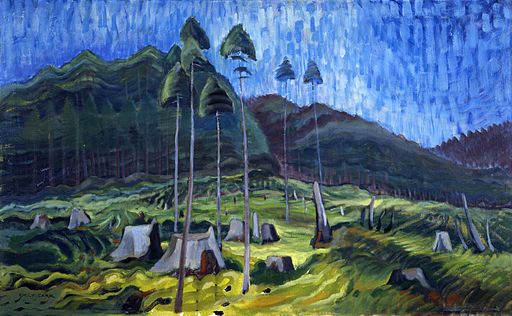
Light textures and gently complementary parts animate the second movement, “I woke with this idea…,” which is about what Carr calls complementaries, “positive and negative colours in juxtaposition” – just what Olson does, in sonic form, in these passages.
Olson favors the chorale form in several places, including most of the short third movement, a piece about creative blockage. With all singers articulating the same words together, the text is easier to understand.
The fourth movement also begins in chorale; then the sections begin conversing intensely. Pauses dot a phrase about the breath. Rhythms thump on the words “a heartbeat.” The movement climaxes with three achingly harmonized clarion calls on the word “God!” A soprano soloist intones the final thoughts.
The tenors hesitantly open the final movement with the line “I made a small sketch.” The text goes on to describe the content and development of that humble beginning, with the music calmly illustrating the subject of the picture, a “woods…in quiet mood, dreamy and sweet.” A buzzy hum then underpins a solo soprano voice introducing the final statement, where Carr quotes an inspirational phrase from Walt Whitman. The suite concludes with a return to the “small sketch,” ending on one of those haunting tone clusters that The Crossing, a co-commissioner of the piece, delivers so well.
At Which Point from The Crossing is out now on New Focus Recordings.