 Blogcritics The critical lens on today's culture & entertainment
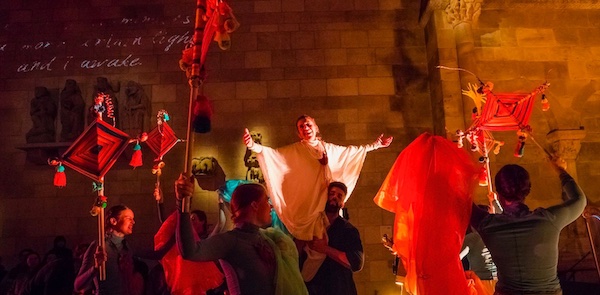
A mystical pyramid ascends toward the heavens. A protagonist yearns to follow, to heights from which she can experience a view of the whole world. Like Phaeton, her vehicle comes crashing down. “Primero Sueño” — a poem of 900-plus lines by the Mexican nun, scholar and proto-feminist writer Sor Juana Inés de la Cruz – has been intriguing and tantalizing readers ever since it appeared in 1692. Now a “processional opera” based on the poem and co-composed by Paola Prestini and singer Magos Herrera is receiving its world premiere at the Met Cloisters.
The music that drives, or I should say floats, this slow-moving but often breathtaking production is a beautiful mix of late-Medieval, Indigenous, contemporary, and Latin folk sounds, with touches of jazz and more. Herrera leads the cast as Sor Juana, our protagonist. The writer is on something resembling a classical quest, but with a difference: This quest is mostly in her mind.
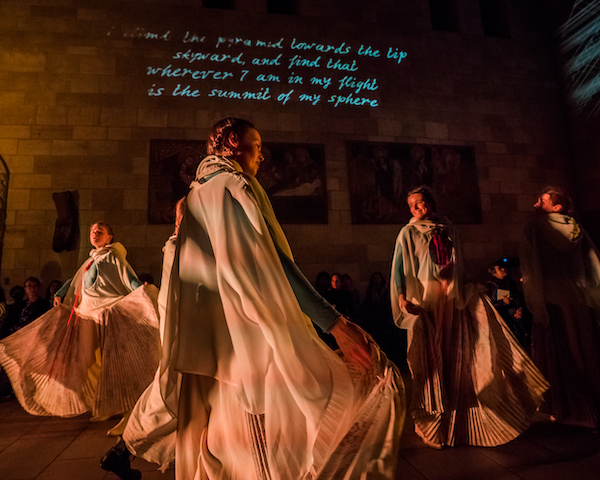
She’s accompanied by six women singers as her fellow nuns; two musicians playing the often archaic-sounding score on various string and percussion instruments; a silent male dancer playing several roles (the imposing Jorrell Lawyer-Jefferson); and another (David Herrera) who carries a variety of sculptural elements.
The nuns project lighting from devices on their bodies. Supertitles appear in a cursive script (sometimes a bit difficult to read) on walls and cloths. Along the journey Sora Juana and her companions encounter mythical figures (Morpheus, Quetzlcoatl), pray to the Virgin Mary, limn parts of the body, and much more, all with great solemnity. The audience follows the performers through several stony spaces inside the Cloisters, some with seating, others without.
The music alternately hypnotizes and electrifies. The movement, under director Louisa Proske and choreographer Lawyer-Jefferson, expresses religious devotion and ecstasy, artistic creativity, and mystical experience in general. (I couldn’t help wondering if Sor Juana, with her deep knowledge of Indigenous culture, had been imbibing some psilocybin.) It all takes place in a kind of ambient stillness despite the expressive, precisely blocked movement.
Indeed, there are stretches where the piece starts to suffocate under the weight of its own self-seriousness. But the vivid performances and the sheer beauty of the production carry it forward to a brilliant finish.
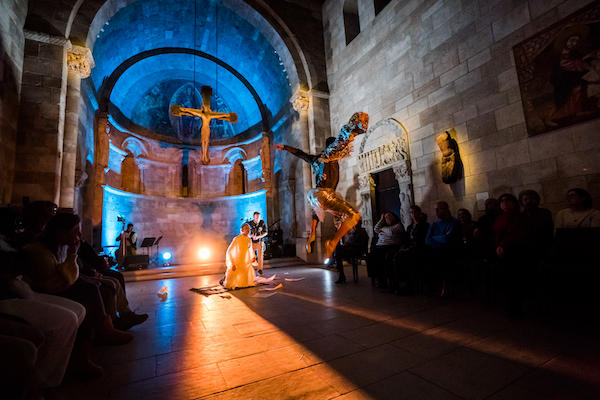
The musical score opens with an extended welcome on a wordless, slowly pulsating major-seventh chord. This establishes a middle ground for the vocalizing to come: one the one hand, the warm, folksy, emotional singing of Magos Herrera; on the other, the cool, incantatory, abstract, and often-enough dissonant harmonizing of the nuns’ operatic voices. Accompanied by Luca Tarantino and Celso Duarte on harp, Spanish guitar, lutes and percussion, the score surprises, lulls, stuns, mesmerizes.
A stately pace dominates. A passage from the poem seems to apply. From a translation from the Spanish by John Campion, which I don’t think is the one used in the production:
“ill-fated birds…composed the dreadful-hooded choir…the notes waiting for the slow and awkward measure / which the phlegmatic movement of the wind marked / with so slow a beat, so delayed / it seemed, at times, to fall asleep between.”
A stately pace is certainly the guiding conception here. Happily, though, slumber and delay are not the fate of Sor Juana. Aided by Phaeton and her chorus of supporting sisters, she overcomes failure and doubt to complete her poem — and with it, for us onlookers, a distinctive experience designed to take advantage of the unique Cloisters setting. The poem ends with “the World illuminated / and I awake.” This luminous production is one to be remembered.
Produced by MetLiveArts and VisionIntoArt, Primero Sueño runs through January 26, 2025 at the Met Cloisters in New York City.