 Blogcritics The critical lens on today's culture & entertainment
“Immersive” is an overused word in theatrical discourse these days – or maybe an overdone concept, an effect aspired to a little too often. But immersiveness doesn’t have to be deliberately coded into a production; at its best, perhaps, it’s achieved through the sheer collectivist power of an artistic expression. Such was the case at Music for New Bodies, the new concert opera or vocal symphony – its form is hard to put a name to – by Matthew Aucoin, conducted by the composer, with a libretto derived from the poems of Jorie Graham, and in Peter Sellars’ staging. Even sitting amid a polite concert-hall audience at David Geffen Hall, and despite still struggling with aftereffects of jet lag, I felt pretty well immersed in what I’ll settle on calling a five-movement symphonic concert opera.

Like the best lyric poetry, such as Graham’s, Aucoin’s concert piece revealingly mixes the universal and the personal. The story, such as it is, concerns a cancer patient’s diagnosis and reaction to it. This reflects personal experience that the poet has described and explored in her work.
The piece also parallels the poet’s illness with humankind’s profligate trashing of our planet, specifically with regard to mining the ocean floor.
If that conceptual pairing sounds a little hubristic, it’s not. People have called the human race a “cancer” on the planet, for one thing. But more important, the music and lyrics, and the staging too, are abstract enough and musically adventurous enough to create a unified, forceful artistic message.
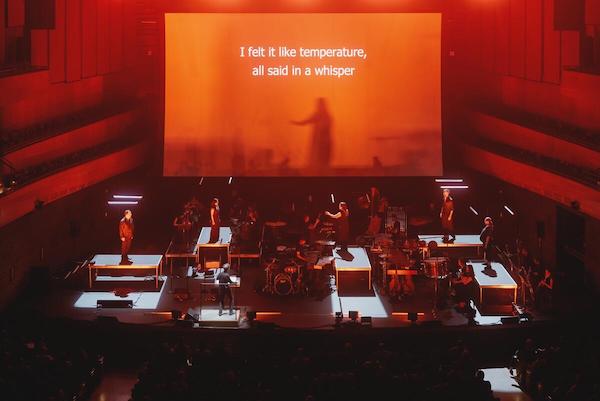
Presented by AMOC (the American Modern Opera Company), which Aucoin co-founded, the work is scored for five singers, 14 ensemble musicians, electronics, and four percussionists, the last roles energetically filled here by the members of Sandbox Percussion.
Aucoin’s vision asserts itself from the first touch of the first movement’s mysterious music, with fluttering melodies from angsty high-pitched woodwinds and metallic percussion strokes. In that movement the character learns of her diagnosis. Disjointed harmonizing among the instruments reflects the dizzying effect of such news. In a weird kind of possession, the singers shift to intoning the graphic descriptions of Jesus on the cross by the mystic Julian of Norwich. This serves as another suggestion of the out-of-body feeling that a shock to the system can create. It also evokes a parallel between sickness – a person’s or a planet’s – with the suffering of Jesus.

Nervous rhythms propel the second movement, in which the character looks at herself in a mirror. Awkward pauses dramatize her inability to recognize what she sees there. For the third movement the “scene” slips to the seabed, with howls and electronic pulses reflecting the cries of a plundered environment.
The fourth movement sees the patient undergo surgery. Throughout the work, the five singers take turns or combine to voice the character, and here their interplay creates hallucinatory effect. The final movement offers a voice from beneath: “The earth said / remember me.” Musical serenity arrives for a time. But the climax is a buzzsaw to the head. The audience was rapt; it was almost palpable in the air.
The staging saw the singers moving among different platforms and locations, lining up together and separately, and here and there enacting scenes in stylized fashion. Despite its overall abstract quality, this added depth to the production. So did the shifting positions of the musicians as the movements progressed, increasing the immersiveness as the sound, while emanating from the stage, shifting angle and position, with the added effect of the electronic sounds’ different directionality. In all of this there was at least an echo of Peter Sellars’ long and distinguished career as a theatrical innovator. His was a fruitful collaboration with Aucoin and the rest of the production team.
But the fundamental genius of this work was all Matthew Aucoin. He is a remarkable figure in today’s culture: a mightily talented composer in genres including opera, who is also a profound thinker. His operas in particular have received many plaudits. Music for New Bodies continues the flowering of a prodigious – and immersive – talent.