 Blogcritics The critical lens on today's culture & entertainment
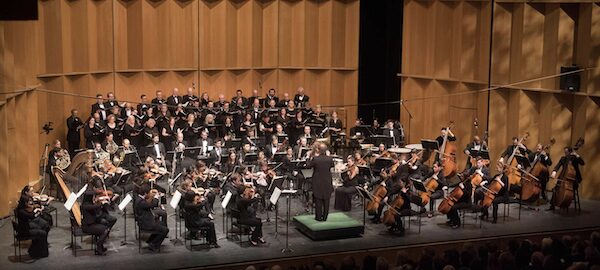
Mozart? Check. Beethoven? Check. The greats are essential fodder for classical music purveyors like the Modus Operandi Orchestra (MOO). Now what about Brahms? Check. Music director and conductor Justin Bischof and his orchestra approached the Romantic era’s greatest avatar full-on at Merkin Hall on Tuesday night, with a program that sandwiched music by contemporary composer Rachel J. Burckhardt between Brahms’ Tragic Overture and his Symphony No. 4.
Modus Operandi at full strength can be almost too much for the relatively small Merkin Hall. Fortunately Maestro Bischof’s sharp delineation of phrasing minimized the tendency of overflow that might have reduced clarity in the Tragic Overture. The orchestra delivered a robust performance full of bright colors that almost confounded the music’s “tragic” or darker themes. Words that came to my mind included “invigorating” and even “triumphant.” Brahms couldn’t help it; his brilliance stirs listener joy even at his pictures of destruction and downfall.
Brahms’ Fourth Symphony
The first movement of the Symphony No. 4 unfurled with both lyricism and steel. The musicians handled the 16th-note pickups adroitly, the staccato passages with power and intent. Bischof gave a lovely sway to the dance-like intervals, and solidity to the rhythms of the shifting oppositional beat counts (3 against 4, 2 against 3).
The “Andante Moderato” second movement commenced lilting, sweet and dark. The full richness of Brahms’ orchestrating emerged in the development and Bischof had the musicians lean hard into the deep romance of the final section. Wonderful woodwind runs danced amid the violin melody in the stirring “Allegro giocoso.”
The finale teemed with extravagant passion. The flute solo was remarkably beautiful, while the long section where the French horns hit every other beat in the 3/4 rhythm had plenty of vigor. (MOO’s excellent horns did bravura work in the first movement too.) I was also reminded that amid all the majesty, Brahms showed a sense of humor in this movement. I smiled a lot during this lively performance.
Church Meets Orchestra
Rachel J. Burckhardt orchestrated a selection of her songs and church music for this MOO concert. The set began promisingly with a brassy fanfare that rocked through shifts between 3/4 and 4/4 time and between passages of legato and of accented themes. My favorite of the set was “Aire Mount Auburn,” originally part of a Requiem that included an Irish tenor and a choir. It begins with a lovely harp introduction, then a languid 5/4 chordal setup for a folk/Irish theme in the flute and violin that the orchestra then takes up. The piece ends smoothly as the flute solos over a subtle viola drone.
The trio of pieces comprising Shloshah Tehilli (Three Psalms) worked less well. The first was pretty, and orchestrated with rich harmonies, but lacked momentum, and I didn’t find much of interest thematically. The second felt aimless, phrases trailing off rather than resolving or evolving, and with little dynamic contrast. The third was better, benefiting from a lighter touch in the orchestration (though it did indulge in heavy layering in the middle section) and an earworm-y theme.
Finally, Variations on “Afternoon Light” (a piece by Bill Desmond originally scored for electric guitars and percussion) succeeded in creating something of a spell, but halting melodies in the middle section depleted the piece’s overall force.
Of course I wouldn’t expect much contemporary music to measure up to Brahms, but quality aside, the pairing of Brahms and Burckhardt didn’t prove enlightening. Still, I’m very glad I attended. Old Johannes, just like Wolfgang and Ludwig, needs no help, as the musicians of the Modus Operandi Orchestra continue to demonstrate with their fine classical music programs.