 Blogcritics The critical lens on today's culture & entertainment
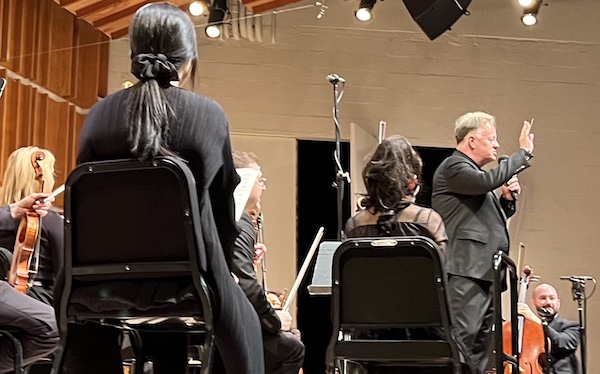
New York is a big city with a big music scene. In spite of the many challenges artists and ensembles face – funding, promotion, venue rental – every day concertgoers have a choice of events big and small. One day it might be the New York Philharmonic at Lincoln Center; the next it could be something smaller-scale but just as musically informed and invigorating. Something like the Modus Operandi Orchestra (MOO), which I had the pleasure of seeing at Merkin Hall on March 12.
MOO’s all-Beethoven program included the Seventh Symphony and the “Emperor” concerto featuring pianist Alexandre Moutouzkine. MOO is just one of the many small-ish but ambitious and highly skilled ensembles that flower in and around NYC, presenting classics and contemporary works alike. For this concert the orchestra and director Justin Bischof went the tried-and-true route, and in their hands, bows and embouchures Beethoven seemed to spring to life.
A Majestic ‘Emperor’
The small stage accommodated an orchestra made up of just half of Modus Operandi’s full 65-member complement. Yet they produced a bright, forceful sound in a moving and indeed sumptuously pictorial performance of Beethoven’s “Coriolan Overture.”
Pianist Alexandre Moutouzkine is on the staff at the Manhattan School of Music, where many members of MOO have ties. His touch in the Piano Concerto No. 5 “Emperor” Op. 73 offered something of a master class in producing a rich, bell-like tone. This moved from porcelain in the cascading arpeggios to gossamer in the quiet, exposed passages to moments of aggression without unneeded overemphasis. (My seat, in the front and off to the side, wasn’t ideal for hearing the piano, so the fact that I took in those colorations testified to Mr. Moutouzkine’s skills. I did get plenty of violin sound, with a good look at the violinists’ fleet fingering, and with the French horns’ bells pointing at me I could appreciate the superb playing from that corner.)
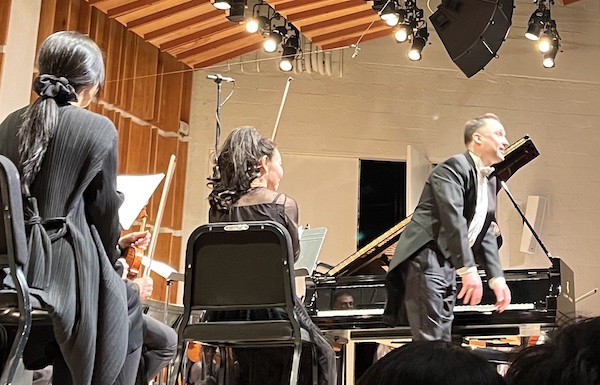
The second movement was a rapturous dreamscape of piano and strings, while in the third, Moutouzkine reveled in the proto-Romantic lushness of some of Beethoven’s piano writing. Despite a few small lapses in crispness in tutti entrances, Maestro Bischof with the aid of thrilling timpani rhythms drew from the orchestra the pounding emotion and triumphant spirit of the movement.
Seventh Heaven
Beethoven’s Symphony No. 7 has never been out of style. I enjoyed hearing it from a chamber-sized orchestra, close-up, in a relatively small hall; the ability to sometimes hear individual instruments makes the music feel more human and organic. Perhaps for that reason, Beethoven’s wit shone in the first movement alongside the music’s martial elements. There was a muscular eloquence to the tightly played dotted-eighth figures and a playfulness to the up-and-down scales. At times when I hear this symphony my mind clouds over a bit during the opening movement in anticipation of the amazing second, but that didn’t happen here.
A nimble approach and a moderate tempo made the slow build of that famous “Allegretto” wonderfully effective. This is one of those pieces of music that when played sensitively can almost bring me to tears, yet in a lesser performance can evoke disappointment. This rendition, played with beautifully dynamic intensity, was very much of the former sort.
With the third movement, a carnivalesque atmosphere conjured a needed breaking of the spell. Bright energy in the speedy sections and easy majesty in the slower combined into a perfectly completed puzzle of delight.
In the finale, Mr. Bischof leaned heavily into the off-beat accents. A mood of joy arose from the thunderous attacks and pinpoint rhythms. Any earlier fuzziness in entrances was blotted away.
I look forward to seeing the Modus Operandi Orchestra at its full size, though I appreciated the intimacy of this concert. If it plays new works as well as it does the classics, I look forward to seeing its contemporary side too. Meanwhile, any time this ensemble wants to bring the Beethoven, count me in.