 Blogcritics The critical lens on today's culture & entertainment
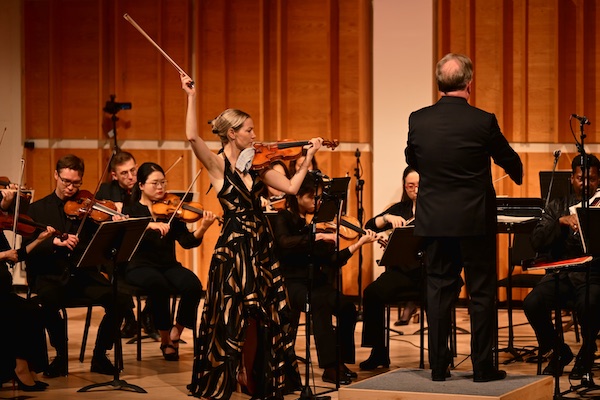
The Modus Operandi Orchestra (MOO) followed up its March all-Beethoven program with an all-Mozart concert on October 15 that touched the profound. Affable conductor Justin Bischof sandwiched the Violin Concerto No. 5 with soloist Chloé Kiffer between Mozart’s last two symphonies. Kiffer, a friend and colleague of Bischof’s, performed at the highest level both as a virtuoso and as a collaborator. And the renditions of the majestic Symphonies No. 40 and 41 were all one could ask for from a small orchestra.
Violin Concerto No. 5
I thought the Symphony No. 40 would be the highlight of this concert for me. Its many memorable themes formed part of the soundtrack of my childhood experience listening to classical music LPs with my parents. This symphony got baked into my brain, as happens with certain pieces when we’re young and still forming those lifelong circuits. But the Violin Concerto No. 5, with which I’m not quite as familiar, made just as strong an impression on me at Merkin Hall, much thanks to the violinist’s rich-toned, elegant, and note-perfect playing.
Soloist and orchestra moved in smooth synchrony, creating sweeping landscapes of ineffable thought and emotion. Kiffer crowned the glowing first movement with a gorgeous, spectral cadenza.
The tight yet elastic connection between soloist and orchestra beautified the weighty Adagio with gentle rubatos. The musicians graced those angelic passages where only the violins and violas accompany the soloist with gentle delicacy. Mozart’s delicious dissonances had great power, and Kiffer’s playing was exquisite, with a cadenza that harked back to the Baroque.
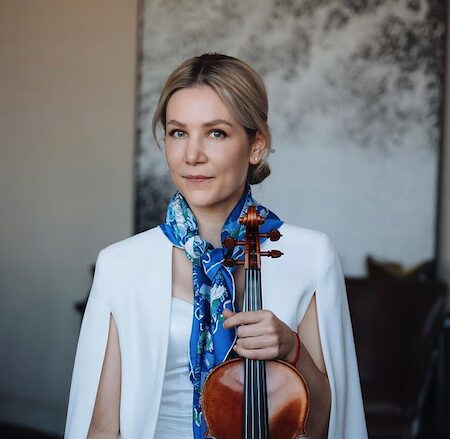
The Finale’s dancing rhythms and motifs give this concerto its nickname, “Turkish.” Kiffer’s audacious fiddling evoked folk traditions, while the orchestra’s precision down to the tiniest grace note made the movement sing. In a few passages I felt the mix could have used a couple more violins, but that’s one of the downsides of a chamber ensemble in a venue with bright acoustics that can overemphasize the brass.
Symphonies 40 and 41
The concert had opened with muscle. In the first movement of Symphony No. 40 the ensemble showed impressive solidity for its size. I especially noted virtuosic decisiveness from the cellos and basses, as well as the strings as a whole.
The languidly graceful Andante had a lightness that contrasted very effectively with the intrusions of the cataclysmic full-orchestra dissonant chords. I’m not sure if this was my imagination, but the feel overall seemed to have a slightly behind-the-beat – dare I say – jazziness which I loved.
The classic grim theme of the third movement rode on march-like energy, with crystalline clarity from the winds. Equal parts precision and passion marked the bright, forceful Finale.
Those G-minor themes that live in my bones rose fully to the surface as I listened to that thrilling, dramatic 40th. The 41st, in C Major, provided a contrast of equal power.
The opening movement rang with dense, multidimensional calls to arms. Bischof’s sturdy conducting unpeeled layers of tragedy, even despair, in the slow movement. The musicians convincingly conjured the last movement’s epic spell, with its fugues, fireworks, and alarums. For me it had been a long day on little sleep and I was feeling fatigued, but one would have had to be very sleepy indeed to tune out that astounding final movement in a performance of breadth like this one.
With roots in the suburbs and composed of freelance musicians, the Modus Operandi Orchestra has only recently begun to make its name in NYC. But it’s well on its way. See its concert schedule, which includes both a Messiah and a Fauré Requiem, at MOO’s website.