 Blogcritics The critical lens on today's culture & entertainment
The Hills of California
The Hills of California, now in its New York premiere, features the successful duo, playwright Jez Butterworth and director Sam Mendes, who teamed up again after their multiple award-winning run with The Ferryman. In the Hills of California, the layered, complex family drama takes place in a shambling, boarding house “resort” called Seaview in Blackpool, England. The time period shifts in flashback from the present 1970s to the 1950s, as the playwright reveals the visceral, raw heart of an incident that changes the lives of a mother and her four daughters and pits them against each other forever. The producers have extended the production until December 22nd.
On the coast of the Irish Sea, the “Seaview” ironically belies its name, because none of the rooms has a treasured view of the sea. However, the name indicates the aspirations of the inn’s owner, Veronica (Laura Donnelly). She hopes to lure lodgers based on the fantastic dream of a view. As such, dreams and aspirations figure greatly in the life of war-widowed mother Veronica, who in the 1950s looks toward America for inspiration and hope. She names rooms in her boarding house for various states in the United States to identify where her lodgers can stay. Rooms Minnesota and Mississippi become rooms of foreboding that by the end of the play are the places where the worst decisions of Veronica’s life in the 1950s occur.
Veronica’s determined desire for her daughters
We learn that these decisions involve Veronica’s most determined desire. She intends for her daughters to be wildly successful, and she divines a way for all of them to use their talents to lift them and her out of a sordid life of poverty.
As the Hills of California begins in the present, Jill confers with the nurse
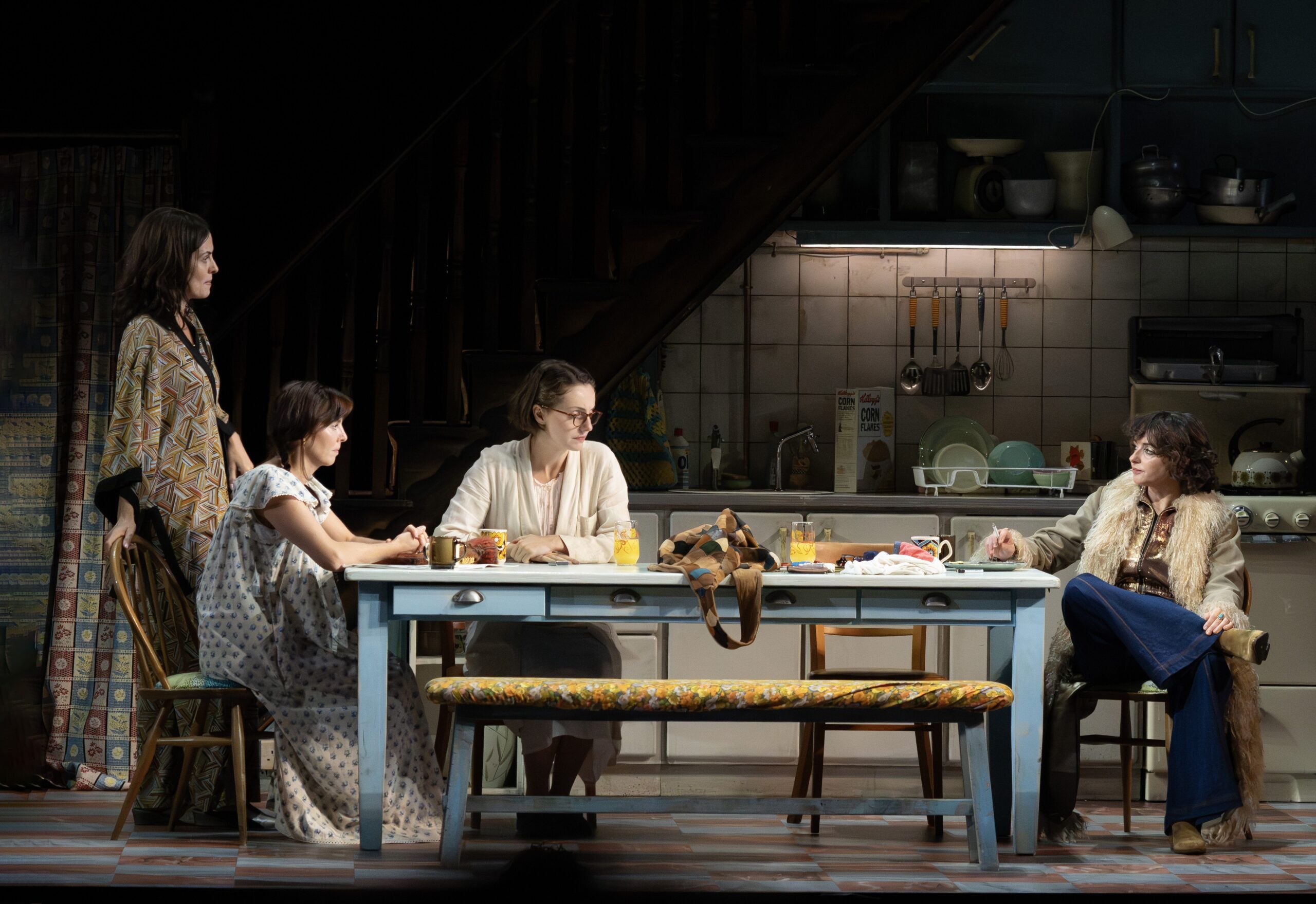
At the top of the play in the present Seaview, Jill (Helena Wilson), the head of the household, confers with the nurse who takes her blood pressure. We wonder if this fairly young woman’s wan, washed-out thinness evidences some chronic illness. However, as Penny (Ta’rea Campbell), pursues the conversation, we understand that daughter Jill takes care of her dying mother Veronica.
As Veronica rests in bed upstairs, Jill refuses to make a decision to stem her mother’s agony in her hopeless struggle with cancer. Either Veronica’s condition slowly worsens, as she lives in hourly agony, or Jill calls a specific doctor who will give Veronica morphine. With a large dose, Veronica will drift into the arms of Death peacefully. However, Jill refuses to give any go ahead on the morphine until all her sisters arrive to say their goodbyes. Jill waits for her sisters and especially Joan, who promised she would take a flight from California where she lives.
Gradually, the sisters arrive except for Joan
Ruby arrives with her husband Dennis. Then Gloria comes with husband Bill and their two immature acting teenage children. In this expository segment the deadening atmosphere clouds with the extreme heat of the day and the boredom and disassociation of the sisters from each other and their families. As they wait for their oldest sister Joan, estranged from them for two decades, Gloria adamantly affirms Joan won’t come. In Joan’s defense Jill insists she will, and they must wait for her.
From their conversation and behavior with each other, we note the lack of warmth and sense that no love binds them together. Cold and bitter with her sisters, Gloria’s argumentative, bullying, and angry harangues with her husband and children reveal her inner rage and misery. Gloria uses verbal abuse and physical violence to stop her kids’ antic behavior, actually encouraging their acting out. She particularly faults Joan’s absence. By the conclusion of the play, Gloria boils over with her complaints against her sister which tragically might be imagined.
Jill and Ruby’s mild mannered nature and sweetness run counter to Gloria’s acidic harshness. Though Jill tries to soothe with pleasantries and catch up her sisters with her mother’s activities, winning prizes at bingo. Gloria cuts Jill’s peaceful picture to ribbons. Instead of encouraging more positive discussion, Gloria mentions a letter she received about her mother’s drunken behavior, alcoholism, wandering the streets in her bra. We realize the immense pressure their mother’s impending death causes at a time family should rally and comfort each other. Little comfort happens, and the children show no interest in visiting their grandmother.
The opening sequence of Hills of California highlights clues about the family
The playwright gives more clues about the women as Jill and Gloria imply their mother favored Joan. The favored daughter, Joan, hasn’t come to pay her respects, which intimates more alienation in this family. Though Jill resists her sister repeatedly, Gloria suggests they wait no longer, and give their mother the dose of morphine so they can leave. Her distress at being with her sisters in the ramshackle house with her mother dying in agony, explodes. Gloria breaks down in tears. However, Gloria refuses Jill’s comfort and screams out, “Don’t touch me.”
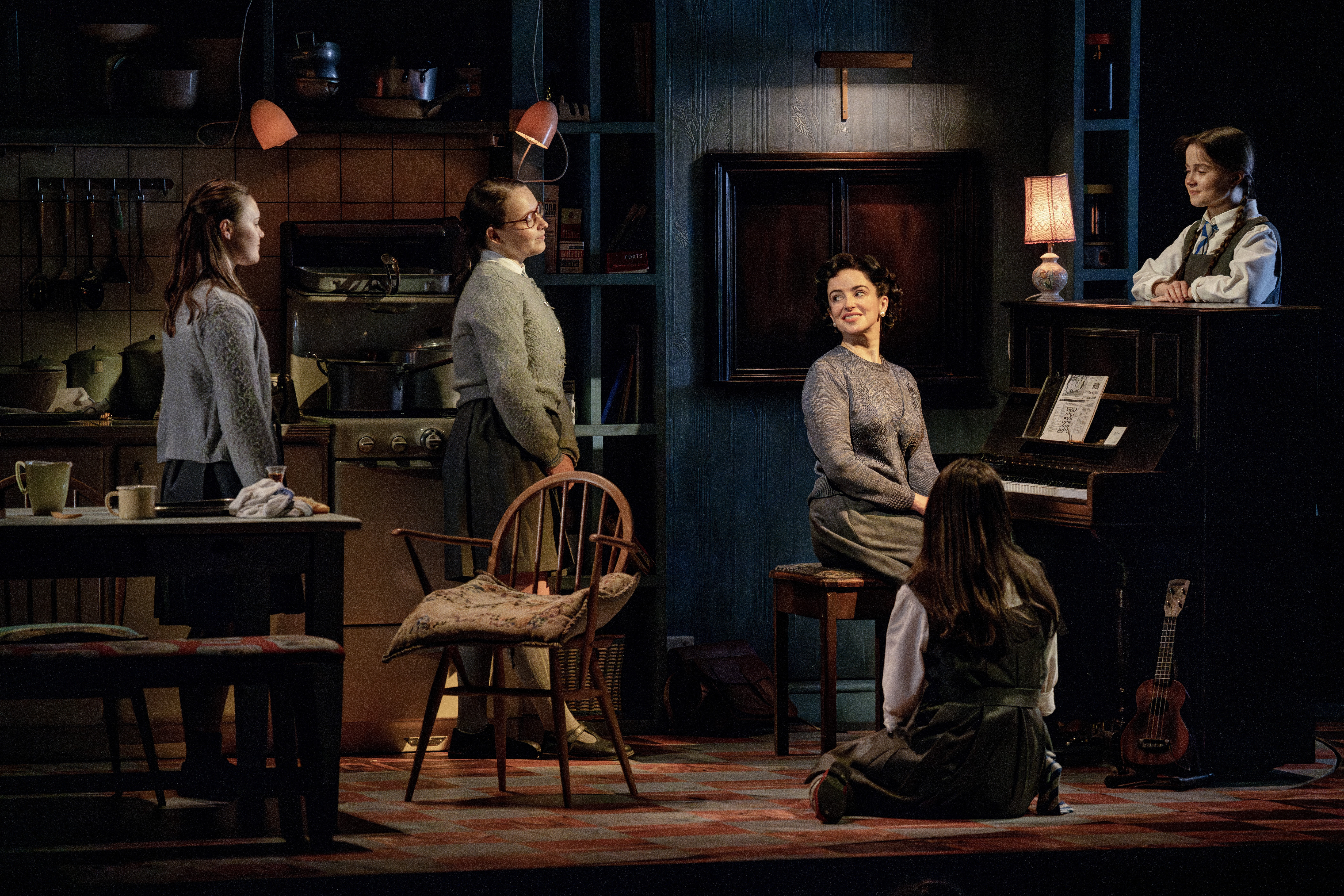
In a surprising mood altering shift, and with a lovely voice, Jill sings a ditty about their home: “The Seaview Luxury Guesthouse and Spa. Just around the corner from the Cinema.” Delighted, Ruby asks her to repeat the song and together, with happiness that rankles Gloria, they sing and dance. Though Gloria demands they stop, they succeed in shaking her away from tears back to her usual stance of anger and rage. At this juncture, their dying mother calls for Joan. And time begins to revert to the past in Gloria’s reverie. The flashback turns to the back kitchen twenty years before. As we note teenage versions of Ruby, Joan and Jill stand around the piano with accompanist Joe Fogg (Richard Lumsden), the girls sing, “The Hills of California,” as they wait for Joan.
Veronica attempts to fulfill her dreams through her daughters
The most striking figure, the beautiful Veronica (Laura Donnelly), dressed with pencil skirt, white blouse and up-swept short hair, directs her daughters’ singing while she cooks fish and chips. A bundle of enthusiasm, energy and the joy of life, like a conductor, she cues in each girl to sing. Then, all stops as Joan enters late. The actions in the second sequence correlate with the sisters’ actions in the first sequence in the present, as they wait for Joan to arrive from California. Though the time differs by twenty years, the sisters past and present parallel each other. We note Joan, the oldest, as a teenager, shines with independence and confidence and the same abides in the present when she finally arrives from California.
Veronica has molded her singing group for success and her determination even moves toward selling herself for an opportunity to introduce her daughters to agent Luther St. John (a terrific, unassuming David Wilson Barnes). She raises expectations so high for herself and her daughters, her vulnerability leaves her open to St. John’s manipulations. Unable to have anything to leverage for the success she so desperately wants for the family, Veronica makes a critical mistake when St. John only wants Joan to audition because he believes only Joan has star quality and talent.
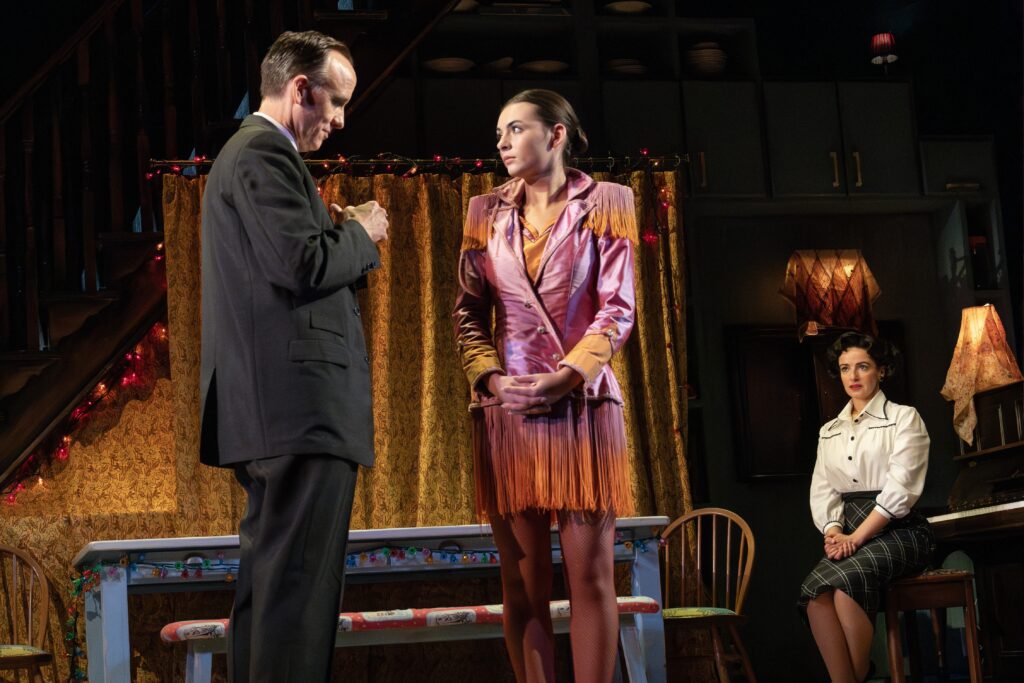
The Hills of California reveals a familiar story of the music industry, then, now
From this juncture on, in a typical turn of events for the time period, Veronica with Joan’s obedience allows the agent to work with Joan. As a result, this turning point ends the sisters singing together as a potential successful act. Joan goes her own way to California where she lives, and Gloria and her husband scathingly refer to Joan making an album. However, none of the sisters except Joan, and Jill, who Veronica confides in on her death bed, know the true story. Revealed with chilling yet understated action and contrasted with Joan’s revelations when she finally arrives, the mystery of what happened with St John clarifies.
As both Veronica in the flashbacks and Joan in the present, Laura Donnelly’s performance shines, especially as California dreaming Joan, with the ease and comfort of her hippie portrayal and American accent. It is fitting that Joan and Veronica’s similarity in appearance, confidence, and assertiveness should be portrayed by the same actress.
Unlike Veronica, Joan’s apparent freedom only moves in another country. When confronting her mother and the past, Joan can only go so far. We realize that the trauma that happened in the past impacted all of them and led to the decisions they made in the future. More than the destruction of dreams, the lies, and cover ups connected with the event kept them bound up in repeating the hurt, torment, and rage, stuck in a circularity of trauma. Not understanding of discussing the truth of the event deprives them of love and success, and alienates them from each other.
The Blackpool boarding house is a macabre character
Rob Howell’s cavernous, shambling boarding house becomes a macabre, haunting character from the outset. The bottom floor revolves on a platform to reveal a kitchen and parlor, a fanciful if time-worn Tiki Bar, a back kitchen, and back room for the guests. The two long diagonal wood staircases reach up into the darkness of the upper floors. There, guests and lodgers occupy Oklahoma or Alaska or Massachusetts. In Minnesota and Mississippi, transactions are made.
Watching Veronica (1955) arrange a deal with Jack Larkin (Bryan Dick) so he’ll introduce her to an agent to assist her daughters’ singing career, we note Veronica’s long symbolic upward climb, and look for a difference in her demeanor as she descends the steps. Mendes’ vision, enhanced by the phenomenal set and Donnelly’s portrayal, allow us to feel the import of the sacrifice Veronica makes to get her daughters a shot at success. On the other hand, when fifteen-year-old Joan (Laura McDonnell) climbs up the stairs followed by St. John as they go to Mississippi for her audition, the climb upward chills us to the bone. As we watch Veronica’s elation at hearing Joan sing, then note her reaction when Joan stops singing, though nothing has been said, the silence speaks volumes. We understand what happened.
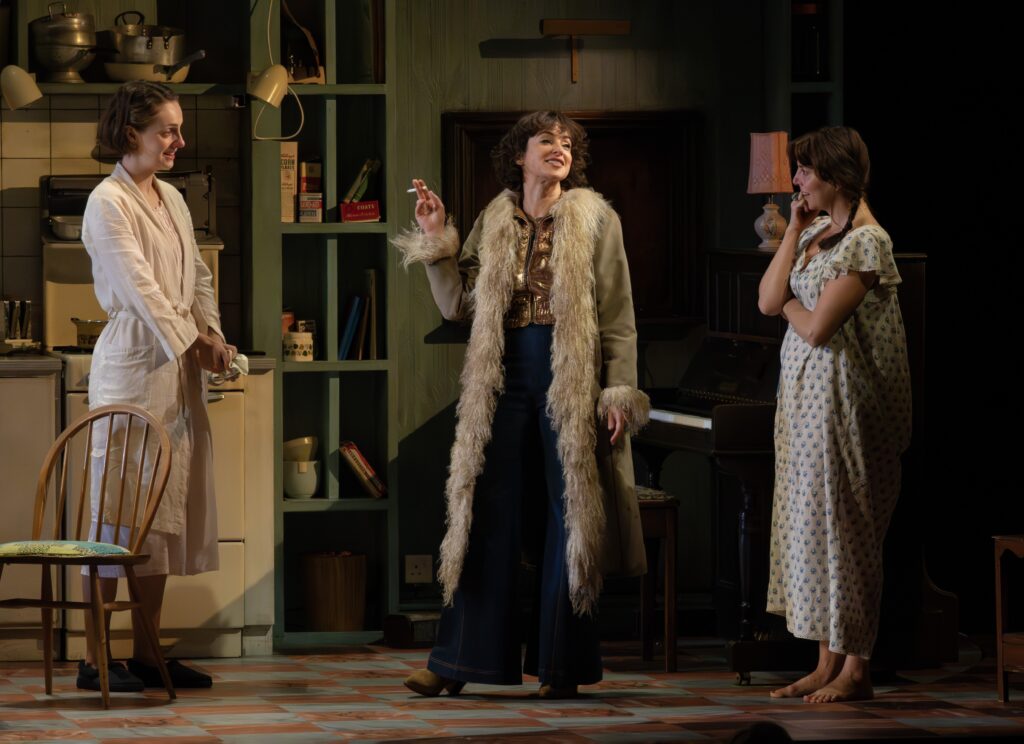
The Hills of California has many superb dramatic moments
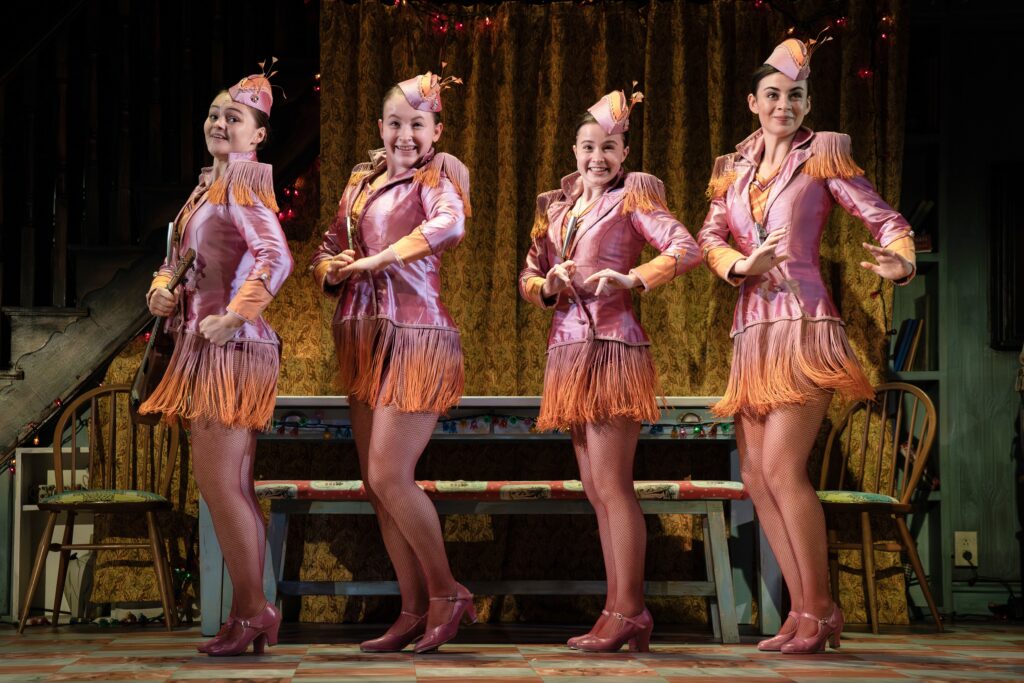
The superb dramatic moments, elucidated with the coherence of Mendes’ direction and Rob Howell’s sets, stir our emotions. Such flourishes occur throughout this incredible production. The singing and dancing of the young hopeful, vibrant sisters (Nancy Allsop, Nicola Turner, Sophia Ally, and Lara McDonnell), enliven the play from the moment Veronica commands their performance of Andrews Sisters’ songs. Contrasted with the morbid atmosphere of the first sequence, the play takes off in the second sequence and elicits our interest with the teens’ singing. As Butterworth goes from past to present and back to the past to the moment of trauma, he prepares us for each turning point with foreshadowing. The scenes with the women work best and the family ensemble strengthens as we learn more of the trauma as tragedy.
Butterworth’s play, told in two acts and a pause for a third, stylizes trauma subtly and sparingly. Though we’ve seen these types of characters before (the stage mother, the malevolent agents), the trenchant desperation, the time and place after World War II as the United States shined like a beacon, and California was the place of glory, resound with nostalgia, horror and irony. Though stories surface about the entertainment industry’s rapaciousness, how playwrights weave them into drama reveals their vitality and thematic relevance. And ironically, stories still surface about what human beings do for perceived success which, even if achieved, often comes by selling one’s soul to the trending Devil. Butterworth’s decisions about character, setting, and the unraveling of the lies of omission and family’s resulting cruelties, are unique, impactful, profound.
The Hills of California is memorable theater
The Hills of California, as memorable, striking theater, is mind-blowing. Fortunately, I read the script and adore the play. I’m not entirely sure I would have understood salient points about the characters and backstory because of the thickness of the accents. However, I’m loathe to admit I heard every word of the “American accents.” Other dialogue I didn’t get.
Kudos to all the creatives including the fine ensemble work and direction. The Hills of California runs two hours forty-five minutes with one intermission at the Broadhurst Theatre on 235 West 44th St. https://thehillsofcalifornia.com