 Blogcritics The critical lens on today's culture & entertainment
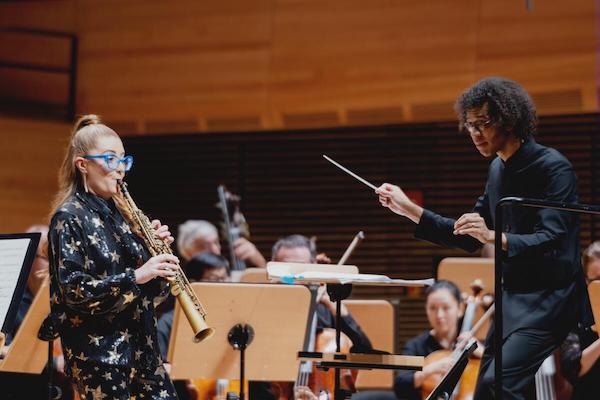
Large numbers of young people attended this week as Jonathon Heyward, Music Director and now Artistic Director of the Festival Orchestra of Lincoln Center, conducted the large chamber orchestra in the second program of its season. Brahms’ Symphony No. 1 was the mainstay. The “Faust Overture” by 19th-century Romantic composer Emilie Mayer served as the stirring opening number. And most notably, Glasslands, the glowing new concerto for soprano saxophone by Anna Clyne, made in its New York premiere featuring Jess Gillam.
Surely the choose-what-you-pay pricing encouraged younger people to crowd David Geffen Hall. I like to think that Gillam’s dynamic, glam charisma might have contributed too. And it’s hard to go wrong with the Brahms First.
In any case, a robust reading of the “Faust Overture” was an energizing start. Heyward’s enthusiasm is obvious even as he jogs onstage. His agile direction heightened the drama in Mayer’s brief but capacious evocation of the Faust story.
Imposing unison passages set up profound harmonic development. A miniature chorale leads from a lighter section into a jubilant dance. The dense drama returns, then we waltz again – a happy ending to Faust? Stranger things have happened. Heyward revealed the brightness and the fury of Mayer’s exciting orchestration. It isn’t subtle music, but in this performance it rang strong and clear.
Summer of the Banshee
Anna Clyne wrote Glasslands specifically for Jess Gillam and worked with the saxophonist as she composed. Despite its longtime popularity in other spheres, the instrument has never achieved routine star presence in contemporary concert music. When today’s composers do write for it, they sometimes try too hard to hammer home the possibilities of the saxophone family, as with John Corigliano’s recent Triathlon.
In Glasslands Clyne takes a different approach. The music excites while avoiding blatant showiness. Yes, Gillam’s superb musicianship and vibrant onstage personality made the piece a joy to watch as well as to hear. But the saxophone parts are woven into the orchestra’s with cool skill.
The first movement opens with a banshee call at the top end of the soprano sax’s range. That’s not a simile, actually; the piece is intended to evoke the shrieking spirit of Irish folklore, and the opening indeed feels like a wail from the supernatural realm.
The saxophone explodes from there into a series of quick, broken downward scales. The main theme that then emerges quotes a suspenseful counterpoint line from Mussorgsky’s Pictures at an Exhibition, specifically “The Old Castle,” a rare 19th-century (alto) saxophone feature. This acknowledgment of inspiration from the past quickly becomes a powerful theme in its own right.
The score goes on to lock the soloist and orchestra into a sometimes loving, sometimes agonized embrace.
While I’m sure this suggestion was in my brain in advance, the mood really does evokes a misty Irish landscape where supernatural beings lurk.
The slow second movement arrives as a needed breathing space. It begins with the saxophone accompanying a melody from a lone cello. Ethereal harmonies slide into place, and in an especially effective, subtle touch, a bass viol saunters lightly up and down scales under the shifting chords. It’s joined by a bassoon as the saxophone and orchestra project incandescent harmonies.
A bout of angry weather punctuated by staccato bursts subsides for a peaceful ending to the movement. Applause erupted, a rarity following a slow movement and an affirmation of the music’s spellbinding quality.

A more explicitly magical atmosphere takes hold in the third movement. A light-footed dance develops as the saxophone virtuosically scans its range. A sudden interruption of the rhythm suggest the casting of a spell.
As the piece draws to a close, an eruption of something like terror brings home the notion of a grim folk tale indeed. We end with a recapitulation of the banshee scream that opened the concerto.
At a pre-show press event Maestro Heyward mentioned that this New York premiere was his eighth time conducting Glasslands. It’s wonderful that such an energized conductor is championing a deserving work like this.
Brahms’ Living Voice
It’s a bit of a stretch to fit Brahms’ Symphony No. 1 into the “folklore and legends” theme, until you remember that Brahms took years to complete it as he wrestled with the legacy and legend of his symphonic idol, Beethoven. How was he to measure up?
The end result was both a tribute to Beethoven and a triumph in its own right – then, now, and probably forever a pillar of the symphonic repertoire.
The Festival Orchestra leaned into the majesty of the first movement from the very first chord. The musicians brought out markedly the colors of each instrument, as they had in the first half of the concert, but here, in the absence of a soloist scooping up most of the attention, even more assertively. An organ-like texture from the brass was a minor marvel to hear.
Again the audience, though knowing full well the present-day custom not to applaud until the completion of a multi-movement work, broke protocol to clap when the movement ended. (This reticence is a custom and protocol I will be very happy to see left in the dustbin of classical-music history.)
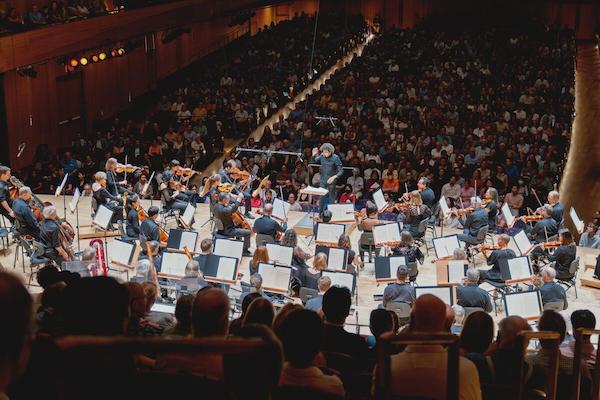
The second movement was exceptionally moving, its curtains of harmony waving beautifully amid Heyward’s eloquent dynamic sculpting. The strings were velvety and the woodwind soloists spun their narratives like gossamer.
In an interesting if perhaps accidental twist, the third movement’s descending first theme harked back to the opening of Glasslands. But it was the stunning buildups and accelerandos in the famous pizzicato passages that hushed the audience so completely it seemed everyone was holding their breath in amazement.
Brahms’ finale, with its famous Beethoven-inspired melody, is so loaded with ideas it can almost fall over. In Heyward’s hands it shone sturdy and bright with a celebratory energy that is becoming a trademark of the conductor’s marvelous work with what is, let’s face it, in some sense a pickup orchestra.
Pick up your tickets for the rest of the Festival Orchestra of Lincoln Center’s 2025 season before NYC’s youngish concertgoers, who are clearly seeking inspiring experiences at a great price, gobble them all up. The many choose-what-you-pay concerts and free events are all part of Lincoln Center’s Summer for the City.