 Blogcritics The critical lens on today's culture & entertainment
The Two Worlds of Gabriel Kahane
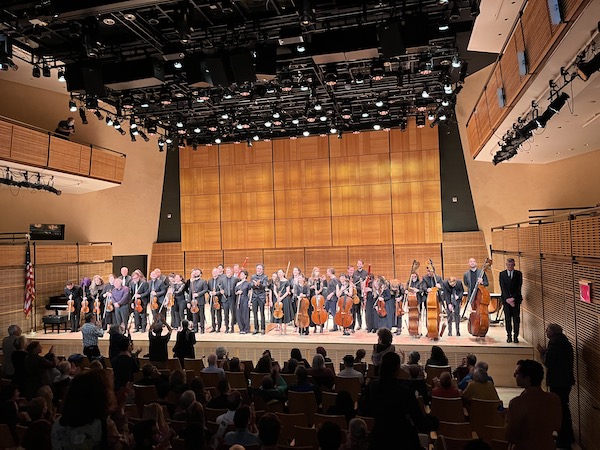
A number of years have passed since I last encountered the music of Gabriel Kahane. His song cycle at BAM in 2017 was a gussied-up singer-songwriter set that displayed both his gifts and his limitations. Thursday’s concert at Carnegie Hall’s Zankel Hall revealed Kahane’s blossoming as a composer of modern classical orchestral music. The three-movement piano concerto titled Heirloom featured the pianist for whom it was written, the composer’s father Jeffrey Kahane, and the adventurous Brooklyn chamber orchestra The Knights.
Kahane’s folk-pop roots showed in two ways. First, one of his songs, “Where Are the Arms,” appeared in disguise in the concerto’s first movement (“Guitars in the Attic”). Later, in singer-songwriter mode, he sang that song, and another as an encore, his velvety voice couched in light orchestration.
The contrast between Kahane’s performance as a troubadour and his creative energy as a classical composer is striking. Of the 2017 BAM show, I observed that “with just piano and voice, a cool folk-pop vibe dominates throughout, and the musical palette begins to feel too limited.” By contrast, the main theme of the piano concerto’s first movement, a 7/4-time folk-pop melody, undergoes much intriguing development. For most of the way the piano and orchestra work more as partners than as soloist with accompaniment. Blaring muted trumpets and other somewhat cartoon-y effects punctuate the movement and contribute to a fragmented feel that nonetheless commands attention.
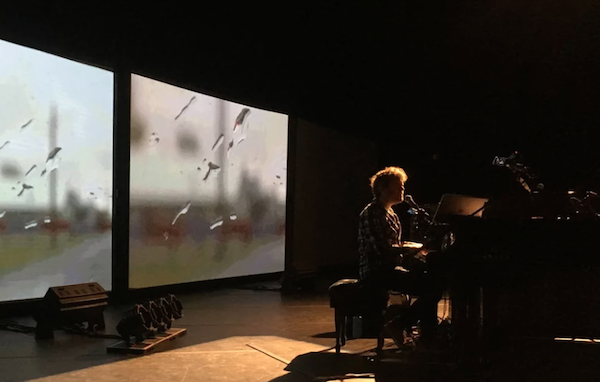
The simple, celestial second theme arises against a backdrop of dissonant harmonies that finally fade in a rising arc. This contrasting effect grows stronger in the second movement, pretentiously (if meaningfully) titled “My Grandmother Knew Alban Berg.” The piano plays modally against a very 20th-century, 12-tone-ish orchestra part, the two sometimes sounding like they’re in different keys, sometimes different worlds. The mood then modulates into a dance-like rhythm that suggests a trio section but turns out to occupy most of the rest of the movement. Something new was always happening, and it featured sparkling playing from Jeffrey Kahane, who infused his performance with jollity and joy.
The playful finale felt like a scherzo that at first delighted with its quick, tricky rhythms. But although it was not a long movement it came to feel goal-less and didn’t seem to quite merit its length. Still I must say I was deeply impressed by the concerto as a whole, with much credit due to the pianist, and to The Knights under the fiery baton of conductor Eric Jacobsen.
Contemporary and Classical
Jessie Montgomery’s “Rhapsody No. 2,” originally for solo violin, impressed as well in an inspired new arrangement for violin and chamber orchestra by Michi Wianchko. The result is a true collaboration. The violin passages pass from soloist to other instruments and back, swirling like a wind. A slower, contemplative section is built on widely spaced two-note chords, again exchanged and developed between double-stopped violin and orchestra, at first gently dissonant and growing more aggressively so until the spinning figures of the opening section return for a coda. Colin Jacobsen, who serves as concertmaster, handled the soloist role with assurance and a distinct sweetness of tone.
“Shorthand” for Cello and Orchestra by Anna Clyne flows the opposite way, beginning like a slow romance, then breaking into a klezmer-style dance. For much of the piece the soloist is first among equals rather than featured star. This is how it’s written, but also results from the strings-only setting. Tactically placed portamentos help anchor the melodies and deepen the mood. Behind the nimble playing of soloist Karen Ouzounian the orchestra churned out quickly rising and falling arpeggios. The sound was sonorous, the performance exciting.

The same was true of The Knights’ take on the Symphony No. 31 (“Paris”) of Mozart, which closed the program. I’ve marveled before at the strong, positive energy that courses through this work given the 22-year-old Mozart’s difficult circumstances at the time he composed it. It unfolded under Eric Jacobsen’s direction with sparkle and verve in the Allegro assai, grace and lightness in the Andante, and a big, supple sound in the Allegro finale.
Earlier, strapping on his electric guitar to sing the Paul Simon-esque “Where Are the Arms,” Gabriel Kahane joked, “Here we are in Bushwick, 3 a.m. on Sunday.” There was a bit of an underground vibe in Zankel Hall. Classical music and hipness don’t have to inhabit separate worlds. And so what if the creative set is already being priced out of Bushwick – there’s always a new neighborhood to consider. And, if you practice enough, there’s always Carnegie Hall.