 Blogcritics The critical lens on today's culture & entertainment
When we hear the natural horn today, it’s almost always in the context of period music. Why would a modern French horn player want to go back to the instrument’s valveless predecessor, so much harder to play, unless to capture as closely as possible the sounds that audiences of past centuries would have heard?
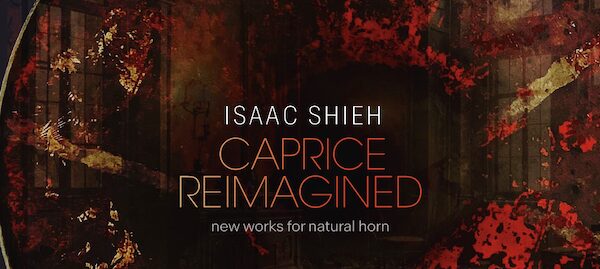
Well, Isaac Shieh, for one, has another reason. As an undergraduate he was assigned to play Mozart on the natural horn as an exercise to improve his French horn playing. And there, as he writes in his liner notes to Caprice Reimagined: New Works for Natural Horn, the natural horn chose him – as instruments do sometimes.
New and Old Music for Natural Horn
To see where he could go with the instrument, Shieh has paired the Twelve Caprices for natural horn by the 19th-century composer, educator, and natural horn player Jacques-François Gallay with new commissions by contemporary composers. The resulting recordings demonstrate Shieh’s gifts as a musician and, more generally, the potential for continued life for this ancient, “outdated” member of the brass family.
James B. Wilson, one of the commissioned composers, describes the natural horn thus: “The instrument is, at its core, a long brass tube that produces pitch using nothing but air pressure, a [metaphorical] embouchure of steel, and hand-stopping technique. It has no guard rails – playing it is an exercise in ferocious, athletic precision.” That’s what Wilson’s piece, “Chroma-Maxima,” calls for, with its intricate melodies. The capaciously talented Shieh is up to the challenge here and throughout the album.
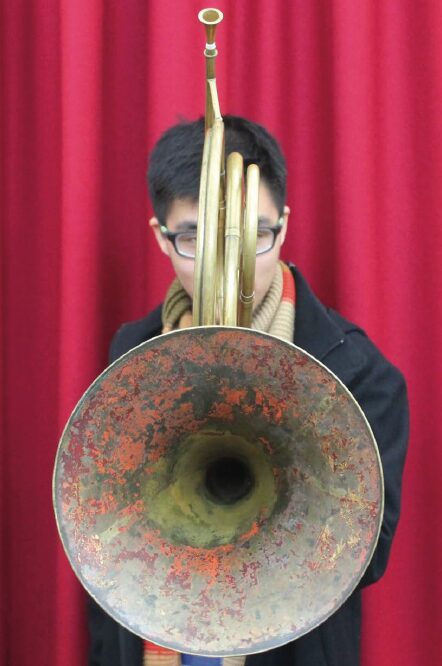
Many of the commissioned composers are only in their 30s, a number of them previously unknown to me. Others, like Dal Fujikura, Timo Andres, Scott Wollschleger, and the prolific Michael Finnissy (who is nearing 80), have been on the scene for a while. But a commission for the natural horn is something of a rarity, so Shieh has added notably to the modern repertoire. The new works combined with the Gallay pieces are enough to fill two CDs, or over 120 minutes of music. Taken together, it’s a (perhaps uniquely) broad compendium of the instrument’s continuing capabilities – when it has “chosen” the right musician.
Tones and Techniques
Right at the top we hear the natural horn’s inherent microtonality in the melodic sections of “ele” by Fujikura. The piece also calls for blaring sounds and scratchiness, examples of techniques we might consider nontraditional (similar to what the same composer called for in his recorder concerto). Shieh pairs the piece with Gallay’s Caprice No. 2, a bright, peppy number that brings us back to the standard 12 tones of Western classical music. So we’ve seen already this difficult instrument showing off its multiple personalities.
Other works test other techniques. Shieh’s performance of Gallay’s Caprice No. 9, which has some impressive chromatic feats, also has a few notes that sink into an almost sine-wave like “flatness.” Articulation and dynamic control seem to be the main points of Lloyd Coleman’s “Sgraffito.”
A few of the works are for more than a single horn alone. Shieh multi-tracked the four parts of Timo Andres’ horn quartet “Loud Ciphers.” Chattering repeated notes alternate or collide with chorales in different timbres. It’s one of the album’s most striking pieces.
Also interesting is Georgia Scott’s “The Ghost in the Machine,” which uses multiple horn tracks to explore the musician’s “embodiment” vis-à-vis the instrument in the context of disability. (Scott and Shieh both have disabilities.)
Amanda Cole’s “Fabric of the Universe” includes an electronic drone on the notes of the harmonic series that the piece explores. (These are the open notes the natural horn “naturally” produces without manipulation). It’s paired with Gallay’s delightful Caprice No. 10, where Shieh displays several elements of his greatest virtuosity in just over two minutes.
“DOCK LEAF” by Robin Haigh closes the album with pretty, legato melodies reminiscent of “Shenandoah,” played against a bed of sounds from nature and something like wind chimes.
Expanding the Natural Horn’s Possibilities
Notable tracks include Grace-Evangeline Mason’s subtle “In the Garden of a Museum,” crafted on the foundation of a poem. Here Shieh appropriately gives the horn a sensuous quality like that of a human voice. Rockey Sun Keting’s “Chuan II,” inspired by the Tibetan horn, positions ululating phrasing in free space (think a brassy shakuhachi), along with a few vocalizations (think Ian Anderson’s flute playing) and elephant-like shouts.
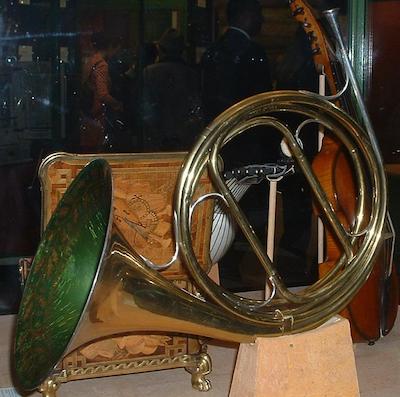
Scott Wollschleger’s multi-track “YOU ARE PERFECT JUST AS YOU ARE” dives deepest into the natural horn’s microtonal possibilities. In other words, it will sound glaringly “out of tune” to Western ears, especially as it follows two of Gallay’s Caprices on the album. A variety of timbres and attacks add to its intriguing sound world. Parts of it suggest music from a warped brass quintet.
In contrast, “The Mastic Orchard” by Electra Perivolaris hews essentially to Western tonality, its liveliness deriving from evocative melodies and dynamic contrasts and accents.
Michael Finnissy shows off the instrument’s dynamic range and virtuosic potential in his own Six Caprices, reminiscent of (for example) Gallay’s Caprice No. 1 with which Shieh pairs it. Shieh produces an almost velvety timbre in the many quiet passages, elsewhere a bell-like sound, and in Finnissy’s Caprices 4 and 6, proof of the musician’s facility with nailing high notes in isolation, sometimes – even more difficult – very softly. Still, these six Caprices, with all their references to Italian opera of Gallay’s time, sound rather pedestrian to me.
As a former mediocre French horn player, I can probably appreciate Shieh’s technical accomplishments in these recordings more than the average listener. But anyone can take note of his musicality and the variety of compositional approaches. This isn’t a double album to listen to straight through; there’s too much solo horn playing to make that a continuous pleasure. But take it a little at a time and the natural horn will start to feel like what it was on past times: a natural member of the musical instrument family.
Caprice Reimagined: New Works for Natural Horn is out now on New Focus Recordings and available at Bandcamp.