 Blogcritics The critical lens on today's culture & entertainment
The capstone of my career as a classical pianist was a rushed performance with my high school orchestra of the first movement of Mozart’s Piano Concerto No. 15 in Bb Major. Little did I know then that my at-best-middling rendition wasn’t the only thing misrepresenting what Mozart’s own audiences heard during his lifetime. It was also the instruments we were playing – in my case, a modern piano.
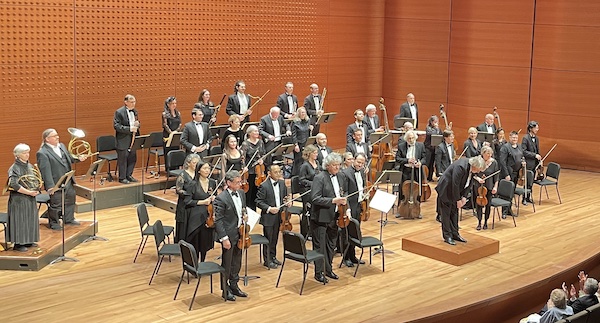
The American Classical Orchestra (ACO), a period-instrument ensemble, provided at its May 7 concert a much better approximation of what Mozart’s music, and Beethoven’s, sounded like in the 17th and early 18th centuries. And the reasons went beyond the musicians’ virtuosity and deep feeling for the music, two essential qualities that the 17-year-old me lacked.
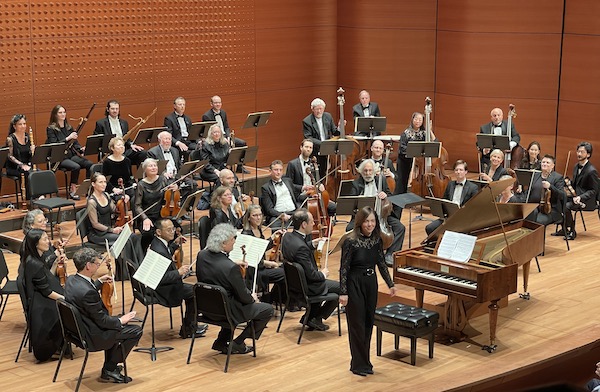
The most striking difference between modern and classical-era sound quality came from the fortepiano played by original-instrument specialist Petra Somlai in Beethoven’s Piano Concerto No. 4. But first came Mozart.
The Mind of the Master
The ACO’s historical instruments produce very different sounds from their modern counterparts, both individually and collectively. They sound softer, more delicate, more “transparent,” with, as the ACO’s boilerplate says, “a delicacy in the gentler phrases and a pungent bite in the stronger musical passages.”
That’s very apparent with Mozart. We’re used to hearing his music sound crisp and full, especially in modern concert halls with carefully tuned acoustics and on pristine digital recordings using the most modern microphone technology. In contrast, the ACO’s rendition of the Symphony No. 35, the “Haffner,” one of Mozart’s most enduringly popular compositions, showed the composer’s genius at drawing the the finest dynamic gradations from an ensemble and the most possible force from instruments with limited projection power.
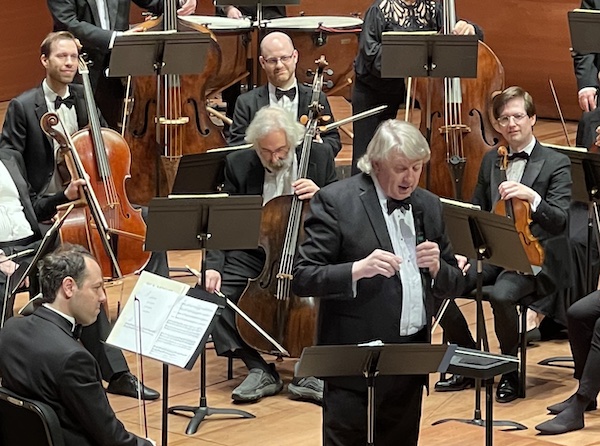
The first movement felt, for want of a better term, juiced. Key to the themes and development are the sharply delineated grace and pickup notes. Their clarity exemplified the synchrony of the ACO’s musicians, especially the strings. In the Andante those same violins softened to an angelic tone as the movement glided sweetly by.
As is their custom, director Thomas Crawford and the orchestra gave valuable pre-concert demonstrations of themes and other aspects to listen for in the music to come. The conductor’s discussion skipped the “Menuetto” third movement, but I found it almost the most revealing of all, with its contrast between a majestic start, surprisingly stout for a minuet, and the soothingly pastoral interior. The finale boasted superb articulation from all corners of the orchestra, most obviously the violins.
The performance wholeheartedly conveyed all the harmonic richness of Mozart’s universe through a historical lens.
As Maestro Crawford told me in an interview some years back, “authenticity matters to people, and great art is worth that much effort…once the genie is let out of the bottle that Mozart used a different flute that in fact sounded very different, [people will want to hear it]…Over the years the players have practiced and practiced and it’s become institutionalized. Now you can get a degree in baroque violin playing.”
All Hail the Bassoonist
The came a lesser-known treat, the Bassoon Concerto in B-flat Major, with the erudite and accomplished veteran Andrew Schwartz the soloist.
Even positioned downstage, a single bassoon can’t readily compete with a full orchestra in volume. But the youthful Mozart’s compositional spacing (he wrote the concerto when he was just 18) and Maestro Crawford’s skilled dynamic control kept the soloist’s sound clearly audible, from the dark lower register to the warm middle and the nasal upper.
While this concerto may not be heard terribly often in concert, every bassoonist must reckon with it, in auditions if nowhere else, so it’s probably safe to assume that Mr. Schwartz has had it under his fingers for decades, which may well account for the evident fun he had with it, even drawing delighted laughter from the the audience at several moments.
After spinning the first-movement cadenza with a flourish, he demonstrated deep feeling in the second movement. The instrument’s shadowy tone came through at its best in this “Andante ma adagio,” which feels more like a duet between two instruments than a soloist with accompaniment.
The final-movement Rondo felt like a stately minuet speckled with quick triplets and 16th-notes from the soloist. Mr. Schwartz’s performance earned a standing ovation – probably a rarity for a bassoonist, and well deserved.
Beethoven on the Fortepiano
From the standpoint of appreciating period instruments, the concert’s high point was the Beethoven. The performance enabled one to image the composer himself playing his music with a (hopefully) enthusiastic orchestra behind him. Though the fortepiano is more percussive and much less resonant than a modern pianoforte (what we commonly call a piano), Petra Somlai brought dynamism, presence, and touch to spare. Her nimble and expressive chords, runs, and trills projected gracefully and bloomed brightly even with the orchestra at maximum fulness.
The downside in the first movement was timing, as the piano figures often landed well ahead of the accompaniment. I don’t know if Somlai was nervous (as I was in my shining high-school Mozart moment) and therefore rushing, or if there hadn’t been enough rehearsal, but in spite of her dazzling technique, things were off. Whatever the case, the problem did not recur in the third movement, where it might have.
The program also limned the progression of the classical style from Mozart and his milieu to Beethoven. The Concerto is full of spectacular and sometimes unexpected harmonic changes. Somlai’s playing even brought Rachmaninoff to mind, that’s how deeply into proto-Romanticism Beethoven had moved by this point. The passionate dialogue between piano and orchestra in the second movement was supremely moving. And the famous Rondo finale, unmarred by timing issues, blossomed with energy, redoubling in the exciting presto at the end, and finishing off a revealing and rejuvenating concert in exquisite period style – one more classic from the American Classical Orchestra.