 Blogcritics The critical lens on today's culture & entertainment
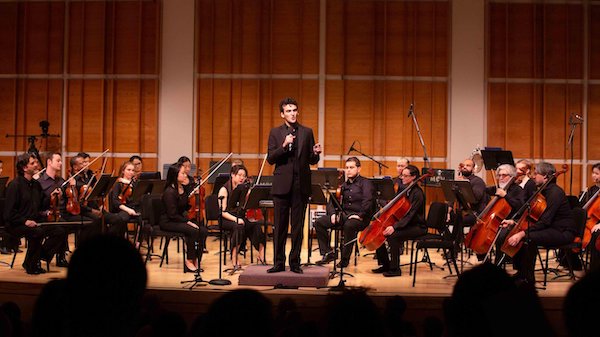
The Parlando Chamber Orchestra goes bold on its first album release. Founder and music director Ian Niederhoffer conceived the program for Censored Anthems after he became, he says, “entranced by the idea of music as cultural resilience…in the face of censorship.”
Like every Parlando concert, the program tells a story. The album’s tales are told in music by two Soviet-era Russian composers, Dmitri Shostakovich and Mieczysław Weinberg, and one Armenian, Edvard Mirzoyan, son of a survivor of the Armenian Genocide.
Also like a Parlando concert, the album includes spoken commentary by Niederhoffer, here presented in three tracks at the end.
Shostakovich and the Scottish Play
The album opens with a selection from Shostakovich’s opera Lady Macbeth of Mtsensk, arranged by Niederhoffer. Stalin’s reaction to this 1934 opera and the ensuing review describing the composer as a “bourgeois decadent” constituted, Niederhoffer writes, “the first high-profile instance of Soviet musical censorship.” The brief instrumental selection here establishes both the album’s theme and the ensemble’s sensitive touch.
Fear and Longing
Following is the Concertino for Violin and String Orchestra by the Polish, Soviet and Russian composer Mieczysław Weinberg, whose career was shaped by persecution first as a refugee from the Nazi invasion of his homeland and later during Stalin’s anti-cosmopolitan (read: anti-Jewish) campaign.
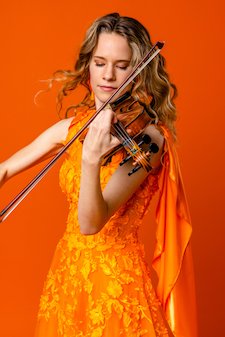
American violinist Aubree Oliverson is the featured soloist in this 1948 work. This rendition of the enormously touching and appealing first movement adroitly conveys the composer’s mastery of form and melody. Under watchful eyes, Weinberg had to restrain his innovative instincts; not surprisingly, the lovely second movement, a Cadenza and Adagio, while in some respects prosaically expressive, carries an almost unbearable tension at certain moments, expressing both fear and longing.
The finale is marked “Allegro moderato poco rubato” – moderately fast, with a little stretching of the rhythm. Neiderhoffer and Oliverson take a judicious approach to this direction, subtly misshaping the waltz-like rhythms just enough to create a flow of tension and release while never fully realizing a release. The result, perhaps paradoxically, is a beautiful clarity.
Putting on the Kettle
Parlando timpanist Andrew Beall is the featured soloist in Mirzoyan’s 1962 Symphony for String Orchestra and Timpani. Neiderhoffer describes the work as “a monument of Armenian resilience in the face of [the] cultural erasure” imposed on the composer in his studies in Russia. Here Mirzoyan asserted his Armenian roots, infusing the four movements with Armenian themes and folk songs. Parlando’s ebullient performance aptly expresses the courage of the composer’s convictions, beginning with the peripatetic yet thematically integrated first movement and carrying through the nervous repetitions and eerie whispers of the second.
The doleful third movement suggests an elegy for the victims of the Armenian Genocide, much as Korngold’s Symphony from a decade earlier can be taken to reflect the horrors of World War II. The “Allegro risoluto” section in particular benefits from the ensemble’s relatively small numbers, as its sound reveals the starkness of the emotion rather than enveloping (or smothering) the listener in it as it creeps toward unresolved accented chords at the end.
The invigorating finale flips the mood, celebrating the spirit and survival of the Armenian people. Yet hints of uncertainty linger. It’s a jubilant but still thoughtful conclusion to Parlando’s first recording.
Words on Music
“What does it sound like when your government silences you?” asks Neiderhoffer in his commentary on the Shostakovich. The instrumental selection on the album only hints at the “intense satirical drama and thrilling jagged music” the conductor describes, but his recounting of Shostakovich’s career crash when Stalin condemned his till-then popular opera is jarring.
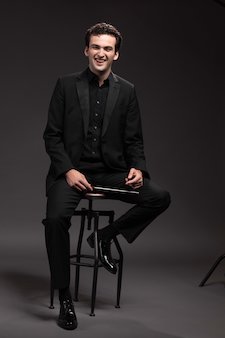
“It’s not easy to compose with a KGB agent in the room,” quips Neiderhoffer in his Weinberg commentary. The composer had lost his parents and sister to a Nazi concentration camp, and the USSR was sanctuary for him – until 1948. The Violin Concertino reflects Weinberg’s “nervous energy” as he is forced to restrain his creative instincts. Neiderhoffer goes deeper than that, too. His commentary is well worth a harken – after you listen to the music, and before you listen to it again, which you should.
He goes even deeper in his discussion of the Mirzoyan symphony, noting that each movement “captures a different aspect of Armenian identity.” I’m actually not sure just how the first movement evokes an Armenian church choir, but I’m no expert in Armenian church choirs, and the overall point stands. For the second movement, Neiderhoffer even spins a sample of a recording of the folk song behind the theme.
In all three composers’ music, their “spirits endured in spite of adversity,” the conductor tells us. It’s a good lesson for our own time. How far behind the Soviet oppressors can the United States be when the nation’s number one Washington investigative news source bows to its owner’s political will – and an authoritarian president can proclaim himself king of the Kennedy Center?
Censored Anthems from Parlando is out February 28, 2025 on Delos. The ensemble’s next concert is February 23 in New York City.