 Blogcritics The critical lens on today's culture & entertainment
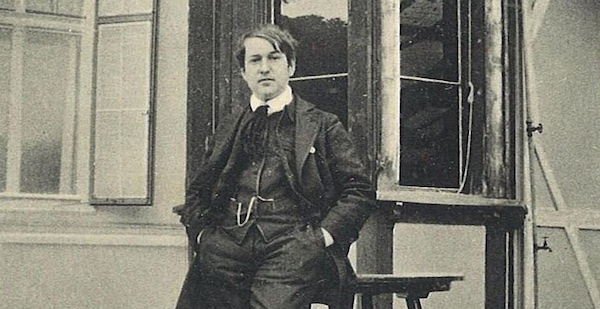
Erich Wolfgang Korngold may still be best known for his timeless film scores (The Adventures of Robin Hood, The Sea Hawk, et al.), but outside his Hollywood career he composed concert music that established him as a major 20th-century flag-bearer of late Romanticism. He composed only one symphony, however, his Op. 40 in F-sharp major, and though Korngold’s “serious” music has experienced a resurgence in recent years, the symphony is not too often heard.
A new release might change that. The Korngold Symphony pairs a historic recording of the symphony by the Orchestra della Svizzera Italiana with a treasure from the Korngold family vaults: a performance by the composer himself of his piano transcription, recorded sometime in the early 1950s for his own use and preserved on a pair of hand-labeled LPs.
An Orchestra on the Piano
“First movement!” he announces in his distinctive Austrian accent at the start of the first LP, then launches aggressively into the music. Digitally cleaned up but still rough-sounding, the recording is clear enough to project both the emotion and the musical intention behind it. Korngold was a great pianist and it’s a remarkable performance.
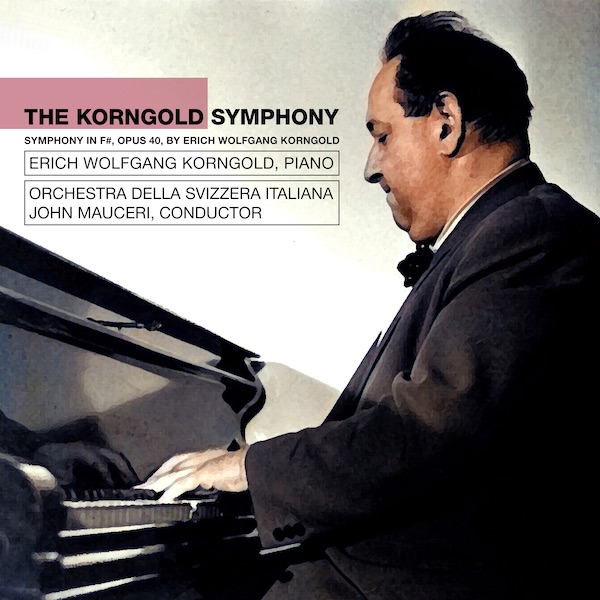
He may have made this recording for a potential conductor’s reference, but the piece didn’t receive its concert debut until some 20 years later, long after the composer’s death. (A radio debut in 1954 was apparently poorly played and poorly received.) How much the recorded transcription informed conductor John Mauceri’s interpretation in the 1997 orchestral rendition also presented here is for Mauceri to know, but he did get a good listen. One thing that’s for sure: In the first movement, Mauceri tempers the fury of Korngold’s pianism.
The orchestra’s recording lasts three and half minutes longer. The slower pace enables us to appreciate the sharply delineated colors of the ensemble through Korngold’s skillful orchestration. Parts lean toward the modernism of Stravinsky, but Korngold succeeds like no other composer at fusing this strain with gothic romance. Not surprisingly, it’s in the orchestral performance that we can best appreciate this.
The piano recording gives us only selections from the Scherzo. The jumpy, cinematic orchestral score contains a heroic theme that puts me in mind of John Williams, who was no doubt influenced by Korngold’s film scores.
Wartime, Recollected in…Tranquility?
Mauceri believes that “based on how it sounds and how it feels” the symphony is “a portrait of the war [WWII].” Korngold himself very much wanted his concert music to be perceived as entirely abstract – Brahmsian as opposed to Wagnerian. But it’s plausible to hear the first movement, as Mauceri does, as “the opening march of evil into Europe,” and the Scherzo with its panicky triplets as “the representation of the Resistance within Europe.”
Whether or not Korngold meant the remarkable Adagio to represent “the revelation of the horrors of the concentration camps,” this longest movement carries a trainload of tragedy and despair. Both its unresolved, jazz-tragic chord changes and its dynamic Lisztian passages claw at the heart. When I listened through my Airpods to the piano version, an artifact of the recording (or the mastering?) made the sound wobble between the left and right channels, disturbing my brain and tempting me to suspect something supernatural.
In Mauceri’s orchestral rendition of this masterpiece of misery, which extends to more than 17 minutes, the varied voices of the ensemble make it feel more like a conversation expressing several perspectives on an incomprehensible disaster. At the same time, the descending scales, minor and chromatic, with their variations and developments, keep the focus on a chasm of cries and silences. Korngold’s language grows grandly operatic, yet never emotionally manipulative – and always agonizingly honest.
Korngold Times Two
Mauceri reported that when he played a recording of the symphony for Leonard Bernstein in 1988, Bernstein said he thought it should have ended with the Adagio. The movement is so titanic it may seem nothing could have been said afterward. But Korngold’s impish Finale refashions those descending scales into an efflorescent expression of hope. Themes from the earlier movements return transformed into playful gambols.
And yet. Halfway through, they revert, temporarily, to their original stark forms. Korngold seems to be saying that within revival and hope still lie the seeds of evil. In the final minutes the chromatic woodwind descents create a pastoral moment before the brass take over for a triumphal finish.
I recommend listening to each version in its entirely, then listening to each piano movement followed by its orchestral counterpart. The gritty piano performances give a look into the soul of this remarkable composer. The fully polished and orchestrated versions can’t do that in the same way. But the latter reveal his brilliance as a musical master of ceremonies.
Whether or not this release encourages more performances of Erich Wolfgang Korngold’s Symphony in F#, it seems sure to contribute to the current revival of interest in his concert music. The Korngold Symphony is out January 31, 2025 on co-producer Richard Guérin’s Supertrain Records.
Also hear a New Classical Tracks interview with John Mauceri about this release.