 Blogcritics The critical lens on today's culture & entertainment
The Hairy Ape
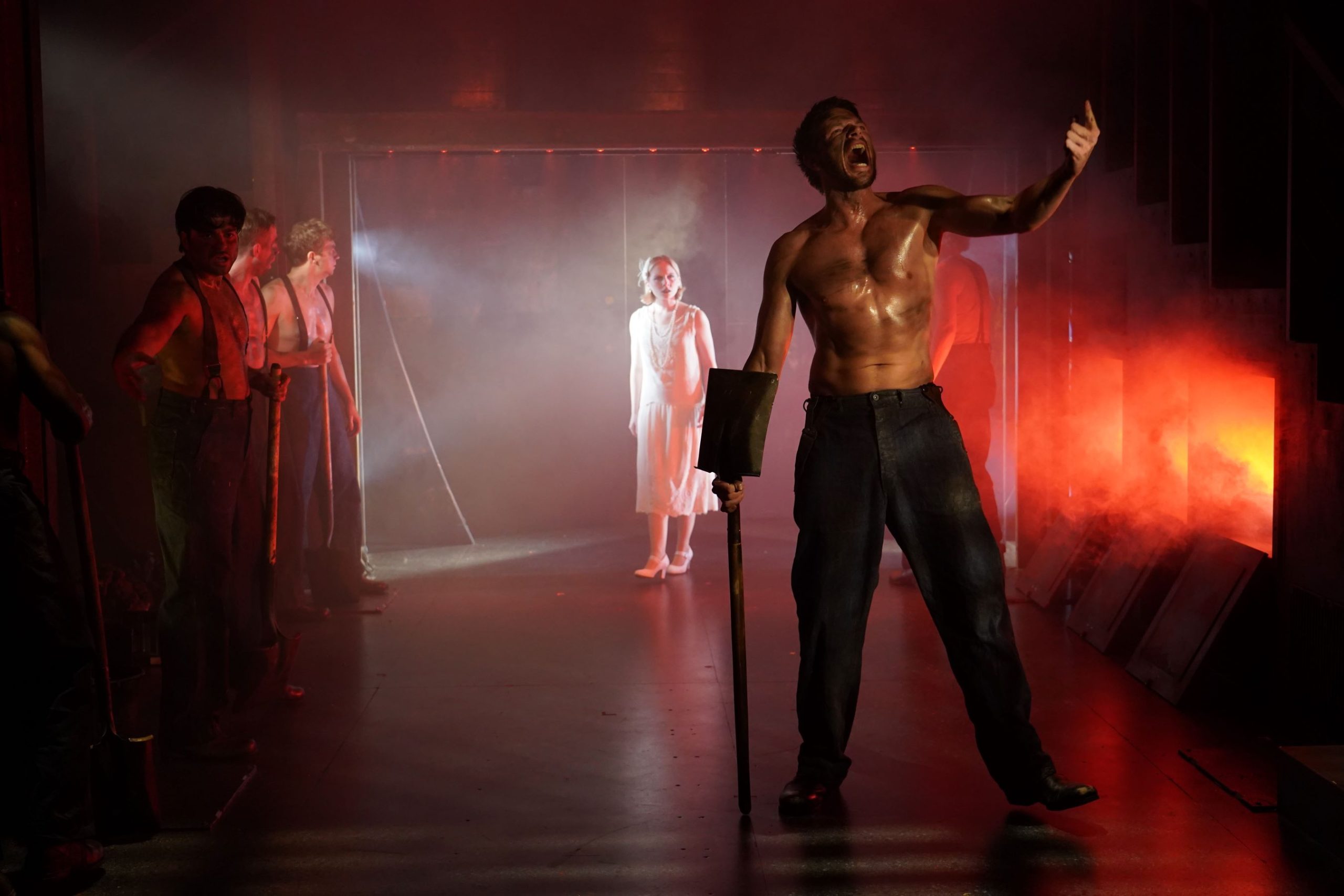
Eugene O’Neill labeled his 8-scene play The Hairy Ape “a comedy of Ancient and Modern life.” Surely, the playwright sardonically jested because the themes relayed through the journey of the anti-hero, Yank (superbly portrayed by John Beavers) a coal stoker on a luxury cruise ship, mirror those found in Greek tragedy. However, comedic elements at times peak through the fine revival directed by Ciarán O’Reilly which runs through Novmber15, 2026 at Irish Repertory Theatre.
The shattering of Yank’s proud ego (his fatal flaw) immerses the audience in his fateful journey, and shakes us to the core. With empathy we follow Yank’s growing realization that he must redefine his purpose and identity. By degree, he learns he can never fit in with the corrupt society of soul dead wealthy and oppressed working stiffs alike. Eventually, the truth of his discovery destroys him before he redeems himself and creates a place where he feels comfortable.
Yank asserts his purpose to the men
Initially, when O’Neill introduces Yank, we note his bellowing assertions of his sense of purpose. Amongst his fellows shoveling coal, carousing on breaks to sustain themselves as they feed the fiery furnaces in the ungodly heat, Yank projects confidence. In defining himself as integral to the movement of modern progress, he uplifts himself and his fellows’ importance to society.
Without their work, their physical prowess and the steel-like resolve of what they face each back-breaking day, the weak, lazy, unregenerate upper classes could not sustain themselves.
Indeed, Yank’s comments seem true enough. Certainly, the upper classes have always eschewed drudgery work and foisted it off on the lower, uneducated classes, who they also get to fight their wars to maintain their power and profits. This seems the case from feudalism to 1922, O’Neill’s setting. However, until Yank’s eyes are opened, he doesn’t understand class bigotry, nor how workers are exploited, disempowered and soul drained by a system rigged against them.
Yank gains comfort being in control
Because Yank commands the conversation and men in Charlie Corcoran’s suggestive and stylized bunk room, and later in the smoking, red hot furnace room deep in the ship’s belly, he has pride of place. Unfortunately, his inflexible stance leaves no room for other viewpoints.
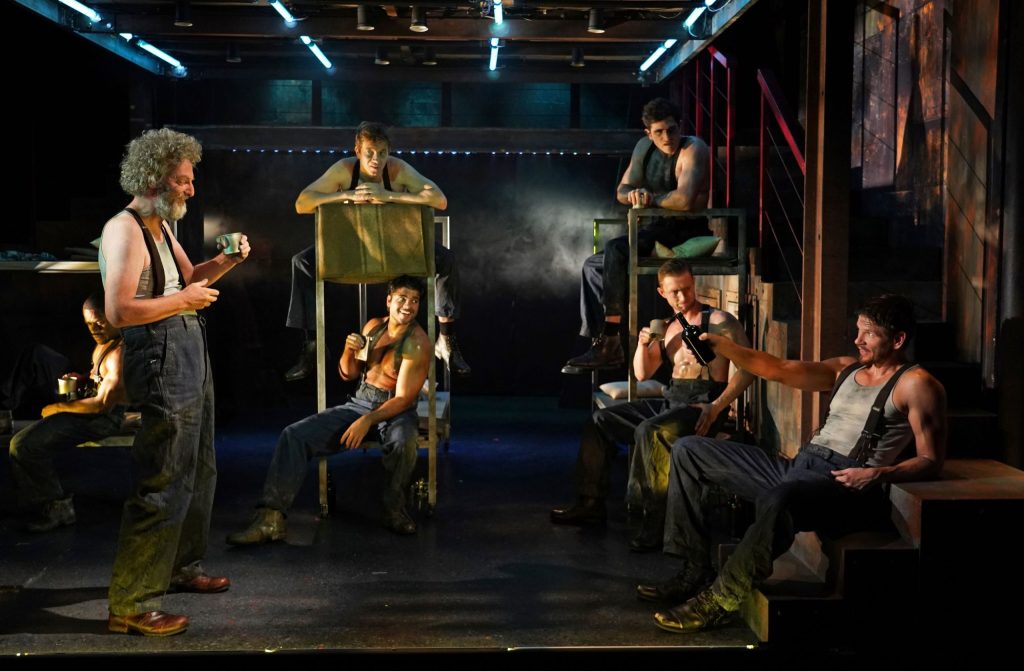
For example Yank thinks Paddy’s lyrical comments about the clipper ships with their healthful, unpolluted air, allowing the sailors to see the sunsets reveal he’s past his prime. Despite its filthy, toxic, coal dust, and smoke-filled polluting byproducts, Yank embraces industrialization. Pridefully, Yank revels in the stoke hold. When he proclaims the heat, filth and stink of the coal dust are the perfect climate for him, a man, he insists, “I’m what makes iron into steel! Steel, dat stands for de whole ting! And I’m steel—steel—steel! I’m de muscles in steel, de punch behind it.”
O’Neill’s Expressionism
Through these oversized speeches which Beavers (Yank) and John Keating (Paddy) have made their own, we recognize O’Neill’s expressionism. By setting up these initial ideas and symbols, O’Neill then mines the concepts throughout the rest of the play. Additionally, these symbols that Yank and the others express, become the platform from which Yank takes his great fall into the abyss which breaks him apart.
From the realistic set design of the “the lower depths,” the scene moves to a view of the level above with two representatives from the upper class unproductively at leisure. The young Mildred (Elizabeth Teeter) and her aunt (Joanna Glushak) snipe at each other while they sun themselves on the upper deck of the cruise ship. Because Mildred wants to feel a sense of purpose, she studies sociology. Using the ship like a laboratory, she arranges to see “how the other half lives” by visiting the engine room. Though her aunt objects calling her a “poseur,” questioning her sincerity, the officers escort Mildred to bowels of the ship.
The encounter and Yank’s fall
At the worst time for her visit, when Yank is raving at the Captain’s whistle, Mildred arrives. Shocking the men, she emerges like a ghost into their midst. When she sees and hears Yank, he turns around. As they look at each other in alarm, she calls him “a filthy beast,” and faints in disgust as the officers remove her. Unnerved by her insult, the antithesis of how he characterizes himself, Yank tries to recover.
As the men tease Yank and discuss her classist slur, they turn over the purpose of her visit to “look” at them, like animals in a zoo. Paddy translates her look at Yank as if he was a “hairy ape.” Beside himself with rage at her humiliation, that he is lower than a man, Yank vows to find her, avenge himself and restore his smashed ego.
Yank’s slide into desolation
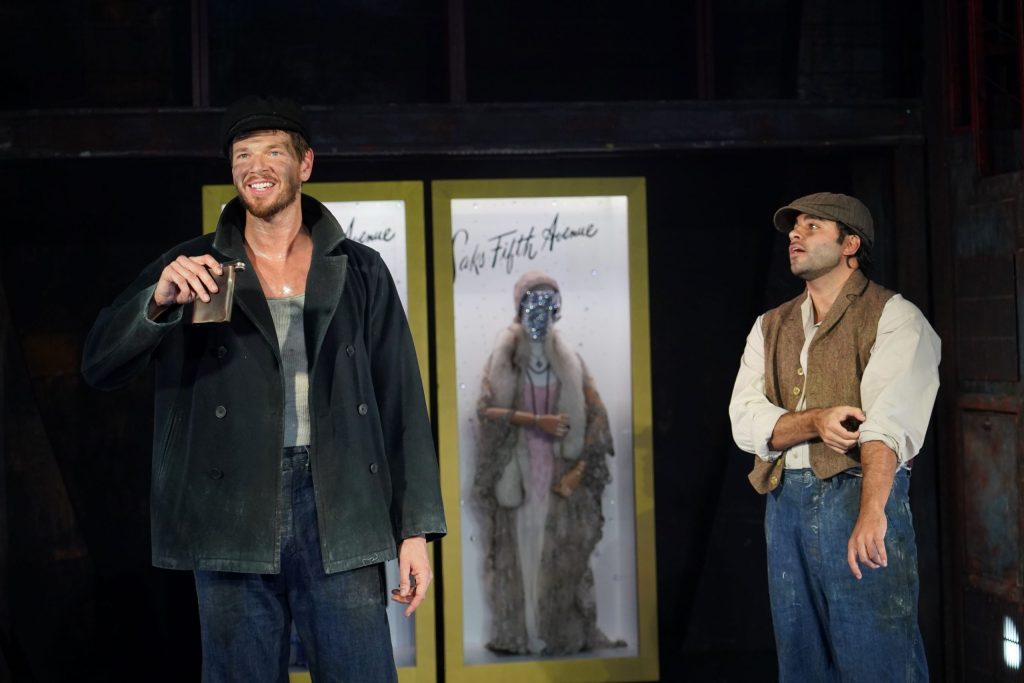
Unless one understands the depths of Yank’s despair and fury at her conversion of what he loved most about himself, “a manly man,” into an ape, his journey for vengeance and and loss of self makes no sense. By degrees Beavers expertly reveals Yank’s shattered soul. Unable to release himself from “her truth,” he allows Long (Ariyan Kassam) to take him to Fifth Avenue. Perhaps Mildred may be found after church services (an ironic hypocrisy). Or she may visit the exclusive shops that ironically feature a monkey fur jacket in an upscale store window that lures the shoppers.
O’Reilly expressionistically stages the Fifth Avenue scene threading O’Neill’s symbolism of the fake, artificial society to highlight the contrast with the coal stoker. The wealthy wear stylized outfits and gesture like stiff, unreal figures. Their mannerisms reference Yank’s earlier characterization of them not being alive.
The beginning of the end
Confused by the Fifth Avenue crowds dressed symbolically in masks and glitter like jacked up, automatons, Yank searches for Mildred. Not seeing her, angry, he attempts to confront and engage any of them in the medium he feels most comfortable, a physical fight. Then, ignored, rebuffed Yank’s behavior gets him thrown in jail. Contrasted with the mannered upper classes, only the cops and Yank appear real. Ironically, their authenticity versus the artificial socialites sadly ends in his being brutalized and caged (like a beast in the zoo).
Later that day, during Yank’s incarceration, the fellow prisoners give him tips about how to fight Mildred and her class. Thus, Yank ends up at the offices of the International Workers of the World. After five minutes of conversation with the Secretary (Adam Petherbridge), they reject his membership. Because they suspect his weird, ignorant comments, they toss him onto the streets.
Once again, a strata of society rejects Yank. Meanwhile, the parallels between the wealthy and the IWW in their response to Yank are suggestive and telling. By this point Yank has completely lost his former confidence and perspective. By allowing others to judge him and cast him out, he feels overwhelming alienation and isolation. Thus, where does he belong?
Yank’s realization leads him to further danger
Of course, the irony tantalizes philosophically. Not fitting in can be something wonderful. Indeed, individuals go to spiritual retreats, psychiatrists, writing classes or therapy sessions when the ego shatters and self-knowledge opens one’s mind and soul in painful awareness. Not fitting in with the toxic and corrupt is an advantage. Unfortunately, Yank has neither the money, the status, the intellectual or psychological means to lift himself up, make sense of his feelings and make his own place away from the nullifying society. O’Neill’s expressionism, well conveyed by the actors, creatives and O’Reilly’s direction, indicts the industrial, technological machinery of progress that Yank thought emblazoned him, but instead, destroys him.
At O’Neill’s fascinating conclusion we note that Yank goes to a place seeking comfort, in order to look at himself in a different mirror. There, he sinks to a depth from which he never returns and never saw coming. And neither did the audience.
The Hairy Ape has no intermission and runs 1 hour 30 minutes on the Francis J. Greenburger Mainstage. https://irishrep.org/whats-on/the-hairy-ape