Blogcritics The critical lens on today's culture & entertainment
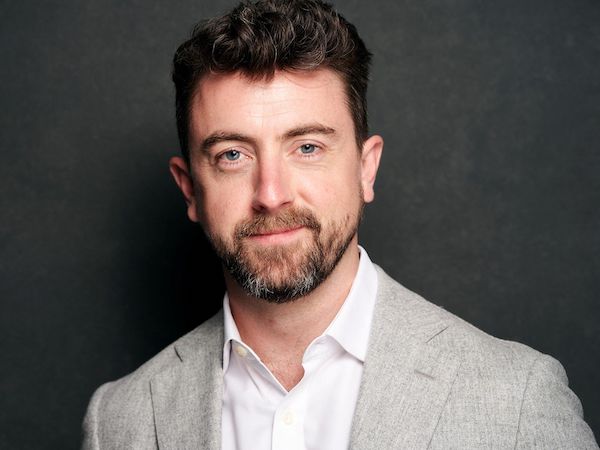
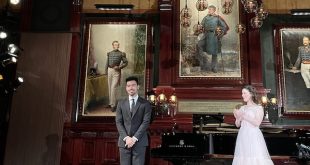
Going for a cabaret vibe at a vocalist’s recital can be tricky. Without the clink of glasses and the dark hum of the theater, performances that focus on intimate bonding between performer and audience can feel awkward. Thanks to the personality/persona of tenor Ben Bliss, he and pianist Christopher Allen avoided this at the elegant Board of Officers Room at the Park Avenue Armory on Friday night. A cabaret feeling did arise, especially during the first set, at their genre-spanning show of American songs.
Life is a Recital, Old Chum
Bliss worked a range of vocal styles into his showmanship. Two high-spirited Sondheim selections called forth comedy (“I’m Calm”) and patter (“Everybody Says Don’t”). Bliss smoothly integrated the musically quirky in “The Things Our Fathers Love” by Charles Ives and a Lowell Liebermann setting of the Longfellow favorite “The Arrow and the Song” (“I shot an arrow into the air / It fell to earth, I knew not where”).
The heart of the first set included knife-sharp renditions of a pair of obscurities, settings by the critic John Gruen of poems by e.e. cummings. Bliss had actually performed a valuable service by acquiring the original manuscripts from Gruen’s family so that he could introduce us to these worthy unpublished art songs.
The set’s emotional peak arrived with a shift to the folk-rock canon. Bliss and Allen performed “Bridge over Troubled Water” straight, the melody, phrasing, and piano part more or less true to the timeless Simon and Garfunkel original. Bliss is by no means the only singer with vocal prowess far superior to Art Garfunkel’s to take on this classic. (See Aretha Franklin’s version, for example.) But he showed that a great singer can profitably train his trained operatic voice on a pop song without sounding like he’s slumming. Bliss sang the song with golden clarity, entirely in his chest voice (saving his falsetto for later in the program). The number was a knockout.
Bliss and Allen’s rendition of “America the Beautiful” took after Ray Charles‘ soulful version, bandut was sung without undue ornamentation or showing off. Here however I did feel a bit of a clash between the r&b phrasing and the vocal quality – although I may be hypersensitive to the line between tribute and co-option. It was also a hit with the audience.
Comedy returned with the sort-of-novelty song “Are You Having Any Fun?” The set closed strongly with a boldly delivered “I’m Gonna Live Till I Die.”
Street Scenes and Nocturnes
The second set – and I’m aware I’m using a term, “set,” associated with cabaret and not concert recitals – began with “Lonely House,” a setting of Langston Hughes lyrics from the 1947 musical Street Scene, by Kurt Weill, whose career, like this recital, spanned genres. Here Bliss’s masterful fusion of vocal instrument and material was on maximum display. It was also in this number, at the end, that he used his falsetto to fine effect.
The Broadway theme continued with “Where or When” from 1937’s Babes in Arms by Rodgers and Hart: “And so, it seems that we have met before / And laughed before and loved before / But who knows where or when?” There was more on the theme of love with the Op. 13, No. 4 Nocturne of Samuel Barber, on a poem by Frederic Prokosch, from the same time period as those relatively early Broadway musicals. This art song was an artistic highlight of the recital, with its lovely melody and gorgeous piano accompaniment. And it included a galactic high note that reinforced the element of operatic presence in the house.
After a couple more sentimentally swinging Broadway numbers came another highlight of the program, a piece of later Sondheim, from Company. “Being Alive” confirmed Ben Bliss as an excellent Sondheim interpreter.
His vocabulary also includes soft crooning, as in “Some Other Time” and the evening’s only selection from across the pond, Noël Coward’s “Let’s Say Good-bye.” More impressively, Bliss showed a knack for jazz phrasing in a thoughtful rendition of the drowsy chestnut “One for My Baby (and One More for the Road).”
Big Finishes
The “one more” that followed wasn’t a typical cabaret or recital closer, but the spoken-word “Wichita Vortex Sutra,” from the Allen Ginsberg antiwar poem, with piano accompaniment written by Philip Glass. There were too many words in this long passage from a long poem to follow closely in the moment, at least for me. A pretentious number? Maybe a little. But the cumulative effect was powerful.
A ready encore took Bliss and Allen into operatic mode. That was a sensible choice, as listeners are probably more likely to see Ben Bliss perform on the opera stage than in an intimate venue. It was’t an aria I knew, however, and I had to ask what it was: the art song “Pace non drovo” by Franz Liszt, one of his settings of poems by Petrarch. This was an ideal showcase for Bliss’s prodigious core talents and skills. Had it not been an encore, I would have called it a showstopper, and it capped a formidable recital, a.k.a. cabaret show, by a tenor at the peak of his powers and an accompanist of great skill.
The Park Avenue Armory’s Recital Series continues.