 Blogcritics The critical lens on today's culture & entertainment
We are in a new age of the countertenor. After a long era of obscurity, the presence and popularity of the male mezzo-soprano has returned in force. Ambitious exemplars like Anthony Roth Costanzo and the charismatic countertenors of ensembles like Profeti della Quinta have been raising the profile of this once-common specialty – at one time notoriously populated by castrati – in baroque, classical, and early music circles across the realm of Western music.
Giulio Cesare
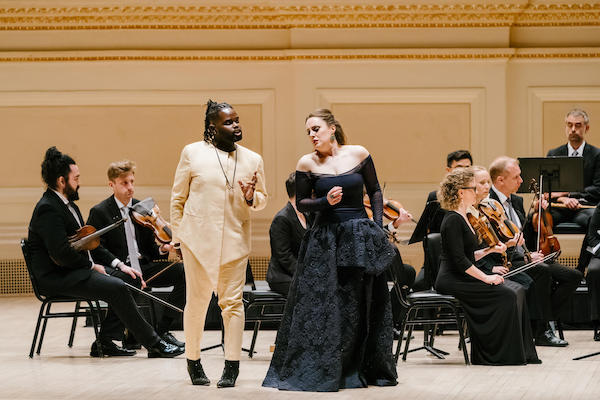
Thus there is plenty of talent available to do full justice to great countertenor roles like those in George Frideric Handel’s 1723-24 opera Giulio Cesare in Egitto. This magisterial work received a mighty performance by the period-instrument orchestra The English Concert and soloists, directed from the harpsichord by Harry Bicket, at Carnegie Hall on May 4. It includes three countertenor roles, including the protagonist and romantic lead (Julius Caesar) and the villain (Ptolemy).
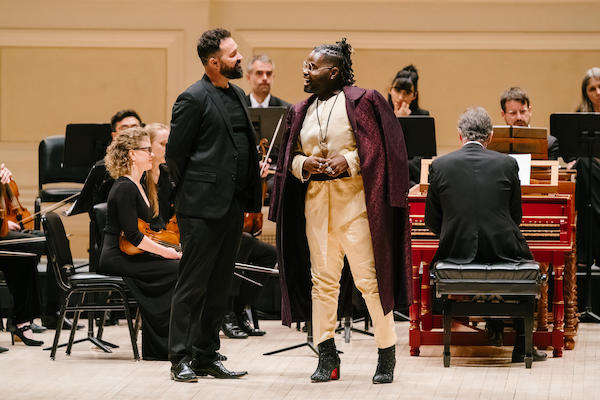
This concert staging excelled at dramatic storytelling – including romance and humor – within the limits of a concert stage without sets or props. The acting was on par with the singing, with praiseworthy performances from all eight soloists. Countertenor Christophe Dumaux as Giulio Cesare (Caesar) showed off his supple melisma skills and sly charisma in his initial arias as Cesare brags of his defeat of rival Pompeo (Pompey) and conquest of Egypt.
An Unwanted Gift
The good feelings crash when Egyptian co-ruler Tolomeo’s (Ptolemy’s) general Achilla (baritone Morgan Pearse) presents Cesare with the head of Pompeo, intended as a token of respect. But deeply offended at this treatment of an honorable foe, Cesare sends him away.
Here we’re introduced to one of Handel’s and librettist Nicola Francesco Haym’s most vivid characters. A frequent Handel collaborator, Haym gave Pompeo’s grieving widow Cornelia as central a role as the legendary Cleopatra, who doesn’t appear until later. Rich-voiced mezzo-soprano Beth Taylor gives Cornelia much depth. The low end of her range resonates like a tenor, while her upper reaches carry equal parts beauty and solidity. Add in perfect pitch control and dynamic fluidity and you have a performance to be remembered.
With three male characters sung by men in high-pitched voices (Meili Li, the third, is an effective Nireno), the score calls for a fourth to be sung by a soprano: Cornelia’s adolescent son Sesto, played here by Paula Murrihy. In the dramatic aria “Svegliatevi nel core, furie d’un alma offesa” Sesto assures his mother of his intent to avenge his father’s death.
We then meet the Egyptian monarchs: Cleopatra, strong, flirtatious, conniving and appealing as sung by Louise Alder; and Tolomeo, played as a mincing, half-comical lecher by John Holiday, one of the most fluid-voiced countertenors around.
Crammed into the first act are further highlights. Cesare’s memorable hunting aria “Va tacito e nascosto” is essentially a duet for countertenor and natural horn (a valveless French horn predecessor), the latter played admirably by Ursula Paludan Monberg. Pearse’s Achilla sings a powerful aria too before the act closes with one of the opera’s most arresting numbers and indeed one of Handel’s most gorgeous pieces of music, Cornelia and Sesto’s duet “Son nata a lagrimar” (“Born to weep”). Taylor and Murrihy melded their voices divinely before a rapt audience.
The second act starts with “V’adoro pupille,” a show-within-a-show performed by Cleopatra for Cesare’s benefit. (In a cute touch, Dumaux took a seat in the audience for it.) Accompanied by a mini-band, Alder sang from upstage with a supple, silvery tone, commanding our attention as firmly as Cesare’s. Soon after, concertmaster Nadja Zwiener took a sweet turn fiddling the role of a songbird in Cesare’s “Se in fiorito ameno prato.”
#MeToo, 18th-Century Style
Despite the story’s violence, an air of gaiety hovers over the proceedings – until we’re shaken into a recognition of another of the opera’s themes, a depiction of men as predators. Cesare’s general Curio (the excellent baritone Thomas Chenhall), Achilla, and Tolomeo himself all lust after Cornelia as if she were a mere object, the pharaoh even threatening outright rape.
Cornelia isn’t entirely helpless, as we find out later. And in many scenes Cleopatra is a strong active character too. But one of the queen’s most moving moments is the aria “Se pietà di me non senti” in which, believing Cesare to have been killed, she begs heaven to pity her. This was another especially high point in a performance without low ones.
But the fulness of these female characters doesn’t negate the attitude of those male ones.
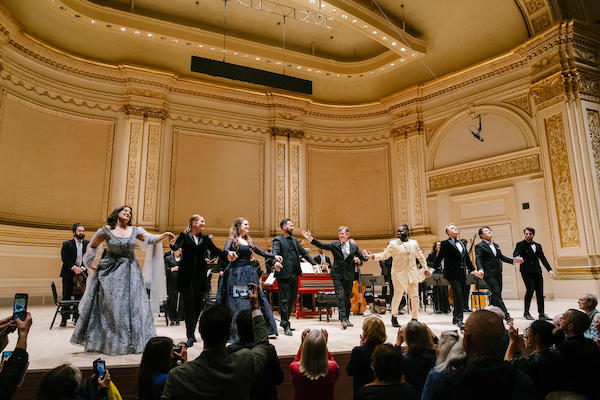
In the third act there’s no letup in the quality of the music, and the quality of the performances continued to shine. Cornelia’s “Non ha più che temere quest’alma” was as affecting as anything in the production. Alder sang much of Cleopatra’s “Piangerò la sorte mia” from down on the floor. Cesare’s “Dall’ondoso periglio” was Dumaux’s most powerful moment, and the pair’s duet at the happy conclusion was a delight.
None of this would have been as good without the skills of the chamber orchestra and Bicket’s creative and historically informed direction. The ensemble included extra-orchestral period instruments including harp and not one but two theorbos. Handel went all out for this absorbing opera in many ways.
Including two fairly brief intermissions, the performance lasted just shy of four hours, almost like a grand opera of a later era. It remained captivating throughout.
After a May 11 performance in London, The English Concert turns to another Handel opera, Rodelinda, Beethoven’s Fidelio and more. Details are online.