Blogcritics The critical lens on today's culture & entertainment
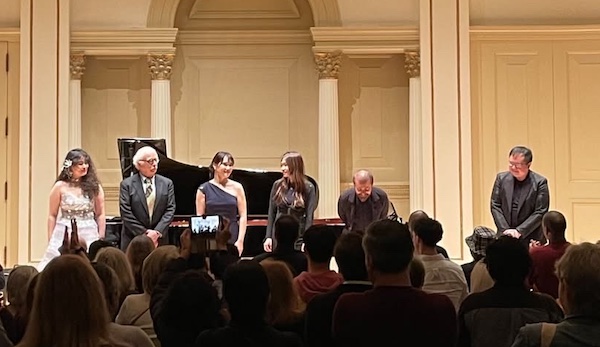
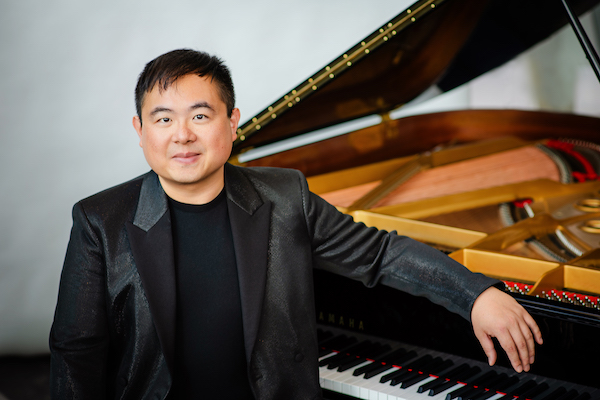
Back in January, I was at Merkin Hall when pianist Chengcheng Ma gave his New York City solo recital debut. I was moved to describe the concert as “an almost nonstop whirlwind of effervescent power.” Last night Ma returned to New York for an arguably bigger debut: his first concert at Carnegie Hall’s Weill Recital Hall, presented by Forte International Group. And this time he brought a whole team of guest pianists.
Was it the unrelenting momentum of his January program that led Ma to enlist the aid of four other pianists for this one? I can only speculate about that. I can say, though, that last night’s concert was no walk in the park; Ma needed his driving muscularity for solo pieces and duets alike at this challenging and often dazzling multicultural program, which included two world premieres.
Chinese, American, and Fairy Tales
This time around, Ma included only one familiar work from a canonical classical composer: selections from Mikhail Pletnev’s two-piano arrangement of the Cinderella Suite by Sergei Prokofiev, performed by Ma and fellow pianist Pavel Nersessian. Though the popular Cinderella music is relatively “accessible,” part of its excitement lies in how Prokofiev broke molds and challenged listeners to follow him to unexplored places. In that way, the suite fit well with the preceding pieces on the program.
The concert opened with Ma on his own, giving the U.S. premiere of Reflections on Dunhuang by the young pianist-composer Nansong Huang. It’s like many works by composers with roots in China in that it explicitly references specific places, images, or elements of traditional culture.
Musically it was an easy way in to the program. The first movement, “The Slumbering Caves,” evokes the Mogao Caves, an important historic site along the Silk Road, with the clangor of temple bells ringing from stark perfect fifths. Ma enhanced the simulation by producing brassy harmonics from the keyboard’s upper range. As the music developed into a deeper fantasia, its rich imagery emerged in greater relief.
Fanciful swirls and trills drove the second movement, which depicts the figures of the Flying Apsaras (wingless, angel-like deities) found in the caves. Warm arpeggios and silvery melodies led to a quick, syncopated dance.
The last movement lived up to its title, “The Whirling Dance,” also rooted in a cultural tradition. Despite occasional muddiness in the passagework, the driving speed of the rhythms – reminiscent of tango and tarantella – made the movement an impressive showpiece.
Ma then called upon American blues and jazz, offering a dizzying rendition of the “Offertory Meditation” by pianist and composer Mary Lou Williams. To call this a 6/4 blues would be to oversimplify. Ma made much of the shifting left-hand rhythms and the right hand’s wide-ranging seeming-improvisations over vast territories of tilted harmonics and blue notes.
In this head-spinning performance the piece leaped forth as a modern masterwork in a way that went beyond Williams‘ classic Montreux Jazz Festival rendition from 1978. And it certainly helped live up to Ma’s promise that the works he selected for this program “reflect my own path – from China to the United States, from classical repertoire to contemporary commissions and jazz.”
New Music for Two Pianos
One of the guest pianists, Rodney Lister, was also the composer of one of the world premieres. “My Time with the Cholmondeleys” for two pianos was commissioned for Ma and performed by him and Lister. Ma had told me back in January that though Lister’s piano music can be extremely difficult to play, it appeals to Ma because “his works combine intellectual depth with emotional candor, and even when the musical language is complex, there is always a clear sense of human presence – vulnerable, searching, and perceptive.”
I called the Lister piece from the January concert (“Many’s the Time I’ve Seen Her Nude at the Piano”) a “perpetual-motion ogre” that left me open-mouthed at times. The shorter “My Time with the Cholmondeleys” is similar but different, a compact thunderbolt of dissonant anguish. It does pack a wallop as the two pianos work, it seems, at cross-purposes and together. It was a gruff listen that I expected to go on longer – and wouldn’t have minded if it had. The clarity of the fast passages was spectacular.
The other world premiere was also a commissioned work, “The Persistence of Time” for two pianos, by Chinese-American composer Stella Sung. Korean pianist EunAe Lee performed this one with Ma. This is the piece that stood out for me the most. In constant forward motion, it’s full of rhythmic and and thematic interplay, with the two pianos coalescing into great heaving clouds, ever-evolving and leavened with patches of whimsy. The two pianists brought to this exciting piece the impressive coordination needed for clarity in the busy passagework.
China West and Cinderella
The program then rocked from the abstract back to the expressly cultural, as Yimiao Fang joined Ma for the four-movement China West Suite for two pianos by Chen Yi. Here Yi builds brilliant color and harmonic depth out of folk themes from various western Chinese traditions, transporting folk melodies and instruments to the world of the piano.
After a bright opening movement, the slow and stately second put me in mind of Pictures at an Exhibition. The third featured intricate interplay between the pianos while suggesting traditional instruments associated with the folk themes, especially the bamboo flute. The closer was a brief, bright, almost furious gallop.
In his transcription of the Cinderella Suite, Pletnev skillfully evokes the sound of an orchestra. Not long ago, a YouTube commenter called this work “one of the greatest additions to the two-piano repertoire in recent memory.”
The different sides of the orchestra made themselves known through these eight movements, including immediately in the “Introduction,” which over just a few minutes moves from stark and angular to lyrical to dramatic. A grim polka energy made the “Quarrel” a highlight. Once again the pianists, here Ma and Nersessian, displayed gratifyingly excellent coordination.
They also attained something like orchestral density in the stunning “Cinderella’s Waltz” movement, reveling in both Romantic splendor and modernist eccentricity. And they achieved an organ-like sound in the theme of the “Finale” with its whiplash-inducing twists and dark, hyperactive polonaise feel.
Sustain-pedal thunder at the end brought the evening to a crashing close. No encore was performed, nor was one needed. With this program, Ma “wanted to bring Chinese, American, and European musical voices into dialogue, allowing each tradition to retain its identity while illuminating the others.” Mission well accomplished.