Blogcritics The critical lens on today's culture & entertainment
The Dreamed Adventure
Valeska Grisebach’s Cannes Jury Prize-winning film The Dreamed Adventure had its U.S. premiere in the Main Slate section of the 64th New York Film Festival. The movie turns from an initial easy setup to a thriller with chilling moments of suspense. Full of twists and turns, it defies narrative stereotypes. Grisebach casts local townspeople, cinéma vérité-style. Then, shepherding their authenticity, she carefully creates tension, suspense and surprise.
Interestingly, The Dreamed Adventure begins like a spaghetti western (without Ennio Morricone’s music). The setting, a Bulgarian border town lost to the modern age, is peopled with gristled, thuggish-looking types. There, a stranger drives in a small car without air conditioning to do business with a townie leader.
A middle-aged, craggy-looking protagonist
Initially, we meet middle-aged Said (Syuleyman Alilov Letifov) in close-ups and medium shots. Then, we follows the rugged mystery man’s actions in Svilengrad, a Bulgarian border town at the crossroads of Turkey and Greece. With a slow unraveling of action the film keeps us questioning the why and what.
The movie then reverses its initial “hero” trope. When Said attempts to settle business with someone in the town, staying overnight to wait for him, an unknown thug steals his car. We sense that the impoverished town covers crimes easily and looks away, used to injustice. Though malevolent forces victimize him and make him helpless, Said remains poker-faced and unemotional. Perhaps the cronies of the man he waits for are gaming him.
A twist
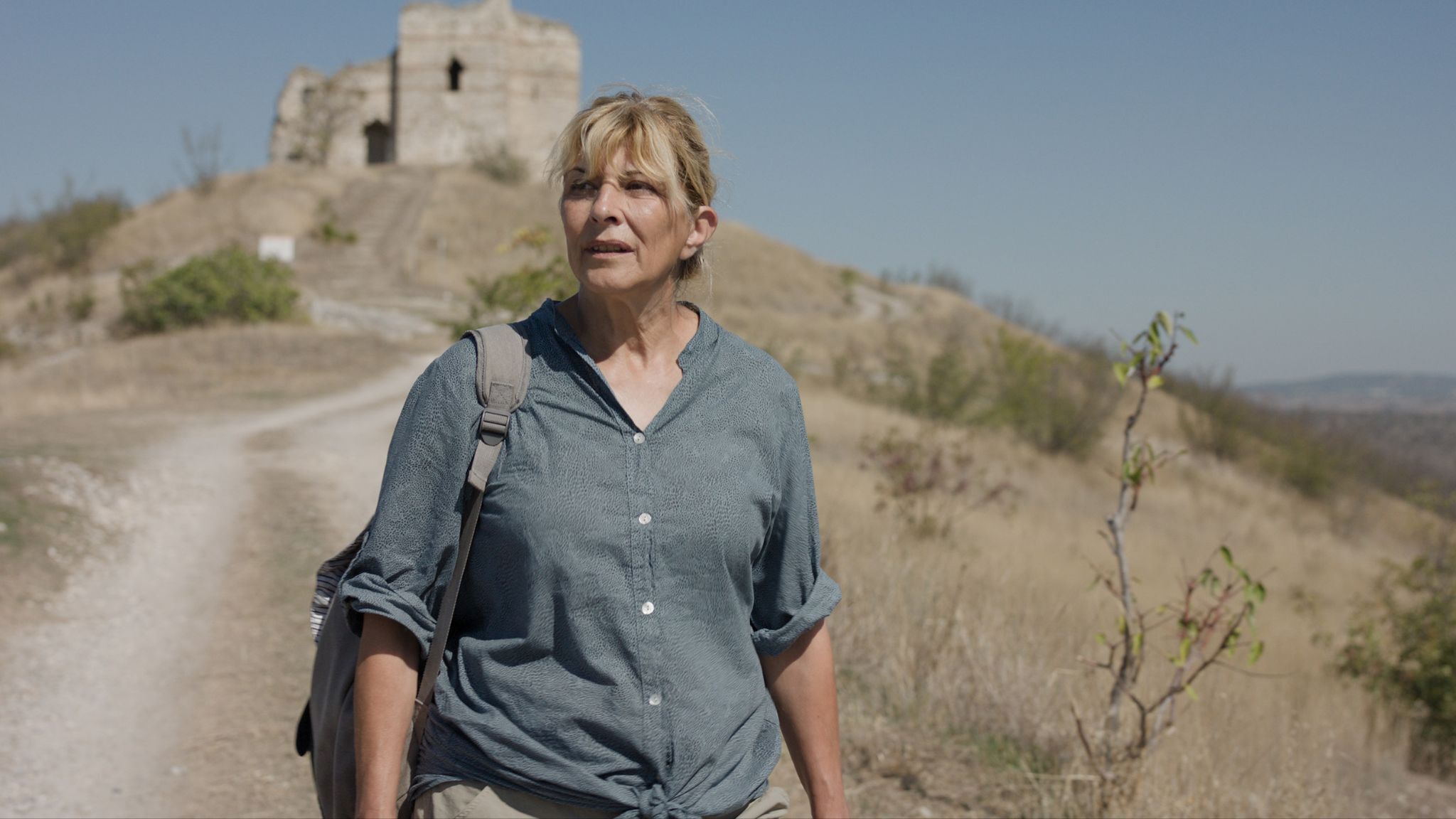
In another twist, the fates step in and Said sees middle-aged Veska, an old flame (the sterling Yana Radva). An archeologist, Veska currently works at a site in Matochina.

After hearing about the theft, Veska suggests he help her on her dig. On the journey to the ancient site they become reacquainted. However, he reveals little information. We realize from their natural pauses and looks that they had been together years before and may still have a bond. Said, a Muslim, references his life under Soviet-era repression. In a peek beyond the veil, we note his ironic annoyance when he explains how his parents changed his name to fit in and make it “acceptable” in Bulgaria. Perhaps this, and later information we overhear about his possibly having “disappeared” a bullying young man, explain why he left the area.
As an omen of good luck, Said fixes Veska’s metal detector. This enables her to find a valuable artifact. Then the filmmaker shifts the narrative’s direction.
Another twist
Said lopes off with a younger woman he meets in a bar after Veska drops him off. Swapping out Said, Grisebach turns the homespun, sharp-eyed, prescient Veska into the film’s protagonist. We never find out what happens immediately after Said takes off with the other woman. When he doesn’t show up for the dig the following morning, an upset Veska searches for him unobtrusively. Is he in danger?
She visits with the locals, in the cafe, the bar, and at after-dinner get-togethers with people in their homes, trying to find out what happened to Said. The groups connect over smokes, drinks and conversation. The cast (the locals have un-Hollywood-like faces) reveal a fascinating contrast between the women’s and men’s groups and the culture of this non-thriving border town.
The women discuss disappearances, and we understand how the town’s ripe position on the border promotes human trafficking. The men flirt with Veska; she teases them and flirts back. Gradually, she discovers the criminal network’s theft of diesel, a payment needing to be made and the conflict between two criminal leaders vying for turf. Patriarchy rules the town, but Veska rises above it cannily to search for Said, alive or dead.
Veska gets along because she goes along
Veska can understand and manipulate the groups because fundamentally she participates in some way. As an observant antihero, she keeps a compromised morality and avoids sanctimonious self-righteousness to survive. Rather than take the moral high ground, she blends in and gets along. Apparently, in the past she used mane sexually and allowed them to use her. Romantically she hooked up with one of the mafia locals. Still, when another, younger group of men warn her to stop nosing around, she obeys and leaves.
With each encounter, Grisebach ratchets up the tension. Hearing about about a package, Veska cleverly follows up and finds and stashes a gun. It comes in handy when a drunk young woman, gets into a dicey situation. Veska safeguards her, now as a protector figure, challenging our impressions of her.
Our expectations shift once again
Still trying to help Said, she gives herself over to an unlikely, unappealing crony of the criminal network. Grisebach turns the idea of a Hollywood-style romantic sexual encounter on its head, crafting the situation between Veska and the crony, both older adults, with stylistic realism. The scenes are unexpected.
After Veska finally finds her man Said, the film leaves their next encounter to our imagination. It concludes, as the title suggests, as if nothing really happened, as if Veska has experienced a dream. We realize that with those living on the border struggling to survive, everything stays covered up.
Grisebach gives an amazing portrait of a time, place and characters which are more real than most films could ever achieve. Yet, this border town represents border towns across the globe whose people live beyond the law, whose culture makes up its own laws to survive.
Look for The Dreamed Adventure on streaming platforms.