 Blogcritics The critical lens on today's culture & entertainment
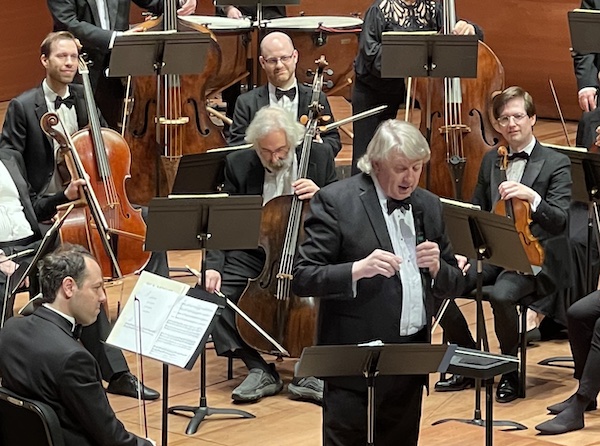
The American Classical Orchestra (ACO) is so named because Thomas Crawford’s veteran period-instrument ensemble focuses mostly on the classical era – Mozart, Haydn, Beethoven, Schubert, etc. But those composers wouldn’t be what they were without the seminal influence of J.S. Bach, so it’s perfectly natural for the ACO to pay tribute to Bach too.
The latest example, a concert program titled “Healing Bach,” consisted of Bach’s Orchestral Suite No. 2 and two Cantatas. The setting was the vast and beautiful Church of St. Vincent Ferrer on Manhattan’s East Side. While the Protestant churches of Bach’s milieu intentionally lacked the cathedral-like splendor of St. Vincent, this was nonetheless an apt setting for the Cantatas.
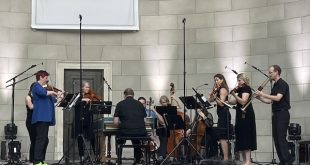
It wasn’t quite as good for the wonderful Orchestral Suite No. 2 in B Minor. Here the overall fuzziness of the acoustics was particularly noticeable. Fortunately, the score highlights the flute, whose tone and pitch carried fairly well over the rest of the instruments, especially in the graceful hands of Sandra Miller. The ACO played as eloquently as ever, even with Crawford on a keyboard in the rear rather than directing from a podium. And Miller – well, might I nominate her as a national treasure? Still the music would have benefited from the tuned acoustics of a concert hall.
That said, it was easy to appreciate the feat of extended flute virtuosity that is the Rondeau; the superb precision and exciting pace with which the musicians navigated the Badinerie and the fast Bourée; and my favorite of the Suite’s dances, the Polonaise, especially its middle section where the cello takes over the theme to accompany a glorious flute solo.
Time Travel
Bach’s Cantatas were originally heard in church, and so somehow it feels right to perform them in a church today (more so than his secular music), especially on period (sometimes referred too as “original”) instruments. As Crawford told me in an interview awhile back, “The whole orchestra is a ‘period instrument,'” and with Bach, that period is quite some time ago. Fortunately there are many musicians who specialize in original instruments today, and the ACO is New York’s preeminent good-sized period-instrument ensemble. It’s both moving and educational to hear Bach this way.
Any performance of these works also benefits from the presence of excellent soloists. In Ich habe genug, baritone Edward Vogel tempered and projected his voice ideally for the echoey space. This cantata also features the oboe, here beautifully represented by Marc Schachman playing his modern copy of a baroque instrument.
These keyless oboes are harder to play than their modern descendants. Schachman demonstrated his at an informative pre-concert lecture where we could hear it isolation. But it wasn’t hard to appreciate the beautiful oboe parts during the Cantata, although better acoustics would have benefited it as well.
Singing Bach’s gorgeous melodies, Vogel displayed a pillowy, burnished tone. View the young baritone’s performance schedule and you’ll see a lot of Bach; it’s clear he has a strong affinity for old Sebastian. Along with his fine diction and intonation, he brought a warm, un-flashy attitude to his performance that I appreciated, especially given the subject matter of the lyrics: Religious faith spawns in the poet a grim contentment with an approaching death.
The concert concluded with the cantata Jachzet Gott in allen Landen featuring soprano Nola Richardson. Richardson seems to be everywhere these days demonstrating impressive versatility. She sounded as silvery-clear in the high-flying melismas as in the exquisite melodies of the first recitative, and as assured in the “Höchster, mache deine Güte” aria accompanied only by cello and organ as in the final “Hallelujah!”
As Richardson, also blessed with a sweetly expressive stage personality, made Bach’s challenging writing sound easy, baroque trumpeter Steven Marquardt and cellist Myron Lutzke added further luster to a fine overall program. An ACO concert always delivers top individual talent.
In general, big churches like this one work best for vocal and small-ensemble music. But there is value – something healing, perhaps – in experiencing Bach’s religious masterworks in a space akin to those for which he composed them.