 Blogcritics The critical lens on today's culture & entertainment
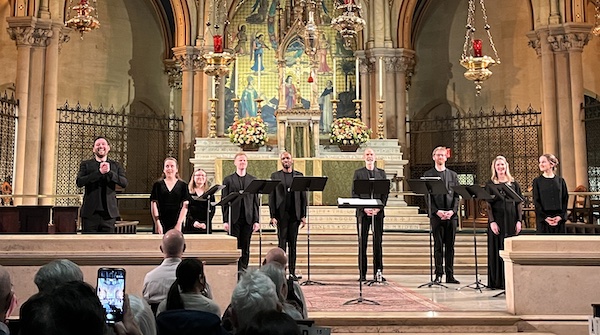
On February 14, 2026, the Marian Consort once again graced the Church of St. Mary the Virgin in Times Square with exquisite harmonizing and a journey into the past. The estimable British a cappella choir specializes in Renaissance music, and this time their Miller Theatre Early Music Series concert in NYC focused on music associated with the Eternal City in the 1500s.
The composers on the program hailed from around Europe. But cross-national and even cross-continental influences and musical innovations were merging prolifically at the time, with Rome an important nexus. (The Consort’s 2024 Miller Theatre series concert focused on music from Scotland.)
Josquin des Prez, a Frenchman whose name surfaces repeatedly in considerations of early/Renaissance music, was a member of the papal chapel choir in the late 15th century and evolved into a supremely influential composer. The program opened with a strong reading of his setting of the “Ave Maria…virgo serena.”
That piece concluded with a profoundly powerful “Amen” that put to rest any doubt a newcomer to the series might have had about how clear an eight-member choir could sound in the vastness of this church. Indeed, artistic director and conductor Rory McCleery has molded his singers such that they gain every advantage and squelch any possible disadvantage of the echoey space.
Roots and Branches
Tenor Edward Woodhouse then sang, alone, a plainchant that served to remind us of two things. First, the root of all the glorious harmonies of Renaissance and Baroque sacred music lies in plainchant – a single, unaccompanied line of melody, as in Gregorian chant. Second, the highest level of vocal skill is needed in a choir where members sing one to a part.
The program included music by two other Frenchmen. Jean Mouton composed not in Rome but for the French royal court. Yet his music was well known in the papal court, and he was said to have been a favorite of Pope Leo X, who died in 1521, the same year Josquin died and a year before Mouton’s death. Mouton’s canonic composition “Ave Maria gemma virginum” had a deeply haunting quality in this reading. Still more impactful was the six-voice “Surrexit pastor bonus” by Jean L’Héritier, a French composer who spent part of his career in Rome. The choir stepped beautifully through its unexpected harmonic shifts.
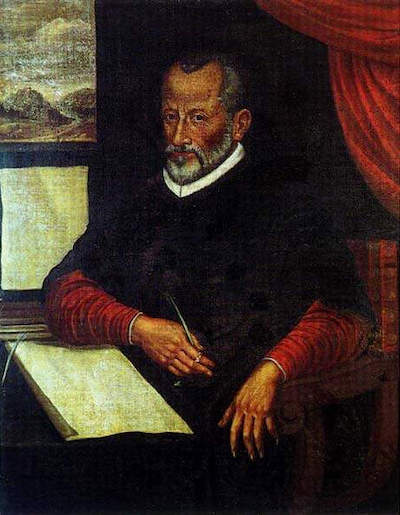
The inclusion of only one piece that is entirely by the influential Giovanni Pierluigi da Palestrina testified to the variety of musical talent in 16th-century Rome’s orbit. The “Missa Benedicta es” Kyrie is a substantial, three-part work. The church’s rich acoustics magnified the music’s density and complex beauty.
We heard Francesco Soriano’s double-choir arrangement of Palestrina’s “Missa in Pape Marcelli.” Together with a work by Tomás Luis de Victoria, one of the program’s Iberian immigrants to Rome, it highlighted the distinct effects of dividing the choir into two. At times one quartet answers the other; at others, like the “Gaude gloriosa” of the Victoria and the explosive end of the Palestrina/Soriano “Gloria,” they come together like two merging spotlights.
International Voices
The motet “Regina caeli Laetare” by the African-Portuguese Vicente Lusitano received another inspired performance. Lusitano, who worked in Rome in the 1550s, was a music theorist and the first known mixed-race composer of the European Renaissance. In this work the Marian Consort showed how full and rich a mere five top-notch voices can sound in a large acoustic space.
We also heard a brilliant performance of Lusitano’s eight-voice reworking of Josquin’s motet “Inviolata.” This peaceful but gorgeous composition closed the program with a rhythm that resembled steady, slow breathing, even as it went to some unexpected harmonic places.
The encore was a short Marian motet by Mouton, putting an exclamation point on the idea that Mary was everywhere at this concert. We may not know what the real-life mother of Jesus of Nazareth was like, but she would surely have been amazed by the honors bestowed upon her through music like this, in a performance by a choir whose very name invokes her, and, on this occasion, at the Church of (who else but) St. Mary the Virgin.