 Blogcritics The critical lens on today's culture & entertainment
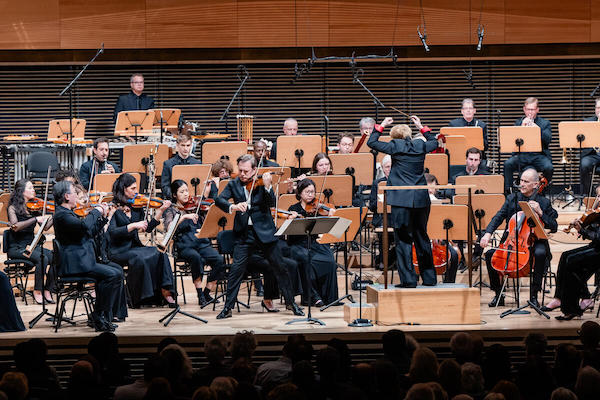
This past weekend the New York Philharmonic presented a concert program that at first glance looked a bit random but turned out invigorating and well-thought-out. Marin Alsop’s intense March 2025 outing with the orchestra commenced with the Leonore Overture No. 3 by Beethoven, a powerful opener by design, which came across with the requisite drama and gravitas. Alsop paired it in the concert’s first half with the world premiere of the Violin Concerto by Nico Muhly, co-commissioned by the orchestra and featuring an outstanding solo performance from French violinist Renaud Capuçon.
Brahms’ Variations on a Theme by Haydn and Stravinsky’s Firebird Suite rounded out the program.
Nico Muhly and a New Violin Concerto
The Muhly concerto, part of the composer’s multi-concerto project focusing on several different solo instruments, struck a sweet balance between experimental and accessible. Its three movements run together so that it feels like one contiguous piece. Mr. Capuçon’s keening violin and the oboes introduced a slow build of imitations among different sections of the orchestra. The result was something like a poem studded with internal rhymes.
The higher-pitched instruments speak among themselves like the play of light on flowing water. The lower instruments interject mutterings at first only occasionally. Then as it slowly crescendoes the first movement folds into almost Romantic harmonic changes, streaked with persistent descending scales. The solo violin and orchestral parts danced brightly together, full of surprising gestures and reflections. Mr. Capuçon and Maestra Alsop worked with visibly similar intensity.
As the concerto progresses, repeating eighth-note chords underlie increasing tension and excitement behind acute-angle melodies from the soloist. In Mr. Capuçon’s hands these read like spoken words, an eccentric text unknown to the audience and set in uncertain time signatures yet followable without difficulty. The full colors of the ensemble asserted themselves here in constantly interesting ways; Mr. Muhly is a wizard of imaginative orchestration. From this and the soloist’s virtuosity much beauty emerged.
After a cadenza heavy with emotion and double-stops, the violinist must crash through an intensive perpetual-motion sequence before the concerto comes to a decisive end. Capuçon somehow made this look easy, and looking back, I felt the same way about the entire performance, with Alsop guiding the orchestra with focus and grace. This music no doubt presents challenges to the musicians but this performance flowed so easily that one might have thought it was no sweat at all.
Brahms and Stravinsky: Two Old Friends of the New York Philharmonic
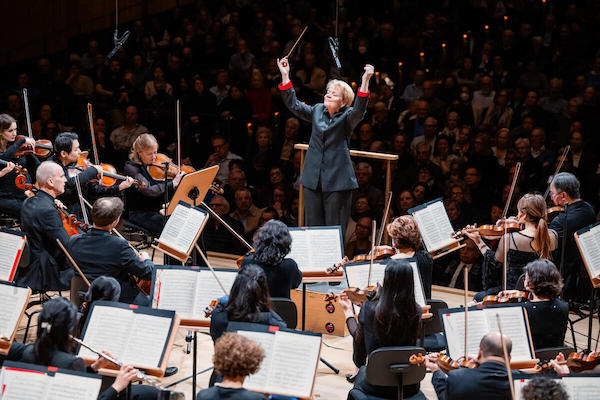
Alsop brought the same clarity to the Brahms. The Variations on the Theme by Haydn is one of those pieces you – or at least I – can only fully appreciate in concert. Or at least, I’ve never found myself smiling all the way through a recording of it, but here I couldn’t stop marveling with delight, sometimes shaking my head in wonder, at Brahms’ brilliant twistings of the simple “Chorale St. Antoni” (not written by Haydn after all, it turns out). This exciting rendition unearthed all the treasures within, from the wicked second variation and the dark fourth through the urbane, ballet-like seventh and the stately, expressive Finale.
Stravinsky’s Firebird Suite was one of those pieces I listened to over and over again as a child and on into adolescence, along with the likes of Holst’s The Planets and Handel’s Royal Fireworks. This performance captured the music’s mystery and arch charm, especially in the “Princesses’ Round-Dance,” which hides that elusive melody that begins in the oboe and that haunted me as a youngster. Danger pulsed in the witchy beat of the “Infernal Dance.” The sweetly haunting chromatic phrases of the “Lullaby” calmed things down but they never quite manage to lull, leading to the irresistible takeover by the Finale’s striking and insistent theme – a tune that kept resounding in my head for the rest of the night and into the next day.