 Blogcritics The critical lens on today's culture & entertainment
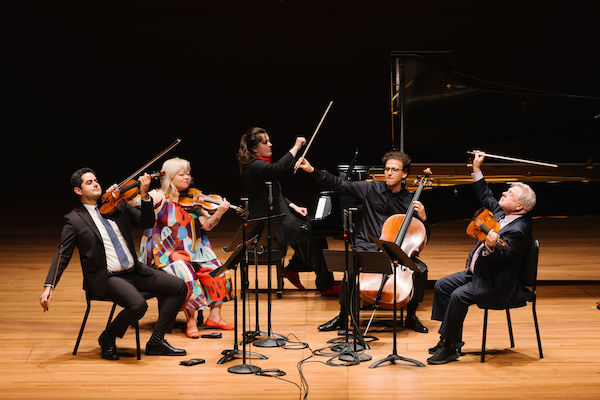
Logistics, bookings, rehearsal time, finance – classical music concert programs take a lot of planning. So programs like the Chamber Music Society of Lincoln Center’s (CMS) April 10 concert, Liszt and Bartók: A Night in Budapest, are planned well in advance.
Yet as I sat down to write this review, the program of four Hungarian composers seemed extremely timely. An election in Hungary had just ousted from power the autocrat Viktor Orbán and his Fidesz party. On the Friday before the election, a free seven-hour concert drew tens of thousands to Budapest’s Heroes’ Square. More than 50 musicians and performers appeared without pay to perform music critical of the regime. Daily News Hungary reported that “the line-up read like a who’s who of Hungary’s most influential contemporary music scene.”
Hungary sees its musical stars as heroes of a sort. Just a few blocks from Heroes’ Square is Kodály körönd, a large circle named for one of the country’s most renowned composers, Zoltán Kodály. And should you want to visit, you’ll likely fly into the country’s busiest airport, which happens to be named for the granddaddy of Hungarian composers – and the first name in the CMS April 10 program: Ferenc (Franz) Liszt.
Romantic Drama
Tristia, the piano trio version of Vallée d’Obermann, kicked off the concert tribute to Hungarian composers. The Tristia develops slowly. Pianist Anna Geniushene, violinist Arnaud Sussman, and cellist Nicholas Canellakis projected a tender, pristine sound, with the kind of warmth that often surprises me in the capacious Alice Tully Hall. Epitomizing the music’s graceful flow were the descending lines where the cello picks up the melody from the violin.
The musicians achieved a lyrical ease in the feathery, dance-like section, built to a satisfying romantic climax, and ratcheted up the tension in the grimly foreboding passages that followed, descending scales continuing to dominate. The stirring violin-cello unison runs added to the romantic drama that struck me as quintessential Liszt.
Crying Out
Béla Bartók, another Hungarian totem, composed his Sonata for Violin in a very troubled time: 1944, the year before his death in New York, to which he had uncomfortably fled early in the war. The folk music-infused modernism of, say, his six masterful string quartets persisted into his late work. But I have trouble with this Sonata.
A steely performance from Yura Lee notwithstanding, the four movements, lasting almost half an hour in total, felt fragmented. Stark, edgy, cutting – the music is all of those. It seems to cry out in pain.

Lee’s dynamics were outstanding throughout the shouted chords and crossing of strings. The fugue-like Scherzo demands great virtuosity, not a problem for Lee. The melodic “Adagio” third movement revealed her exquisite facility and control with double-trills and in the violin’s highest register. Still, the only movement I actually enjoyed hearing was the last, with its buzzing-bee sounds and overall feeling of fun, made especially effective through Lee’s mastery of the variety of tones and techniques required.
The Youthful Ligeti
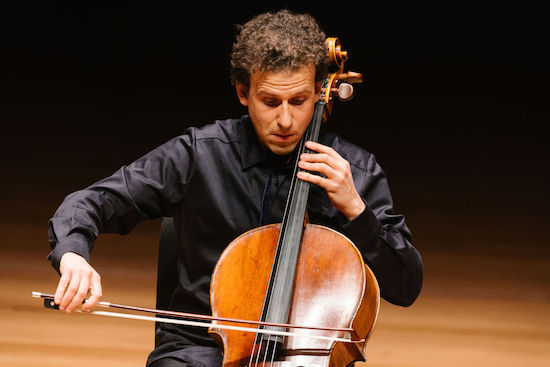
Canellakis shone in the Sonata for Cello by György Ligeti, a sunnier work from Ligeti’s pre-avant-garde period. The pizzicato glissandos and rich melodies of the “Dialogo” first movement emerged in a songful, emotional performance. The agitated “Capriccio” found the cellist shivering up and down the strings with a rough-edged energy that conveyed the friendly, knowing smile characteristic of Cannelakis’s playing.
The program then looped back to the final years of Liszt’s century with an early work – indeed the Opus 1 – of Ernő Dohnányi, the Quintet No. 1 in C minor for Piano, Two Violins, Viola, and Cello. Highly influenced by Brahms, the composer hadn’t yet arrived at a fully distinctive voice, and parts of the first movement verged on schmaltz. But to me the Scherzo’s spidery syncopations made up for it, creating off-kilter counter-rhythms. The quintet gave the quite active slow movement a swaying, barcarolle-like air, revving up as the music grew more impassioned, heavier, almost panting. And a performance of charm and panache made the finale, with its ambiguous time signatures, a pleasure.
Whichever way political winds are blowing, for centuries Hungary has been fertile ground for music. It was so in Liszt’s time, it was so through the nightmares of the 20th century, and it continues during today’s more scattered nightmares – and moments of potential redemption. I mean to spend some of my own nights in Budapest one of these years, and as I walk through Ferenc Liszt International Airport I will be looking forward to experiencing contemporary Hungarian music as well as everything else the capital has to offer. And I’ll be thinking of Liszt, Bartók, and the many other musical sons and daughters of Hungary.