 Blogcritics The critical lens on today's culture & entertainment
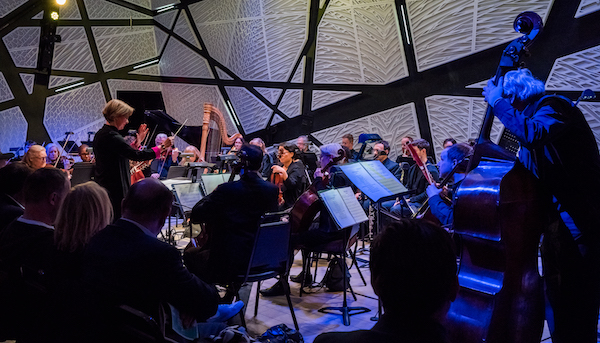
Brooklyn’s National Sawdust presented a veritable festival of compositions by Karen LeFrak on Wednesday night. Eminent guitarist Sharon Isbin performed, as did cellist Jeffrey Zeigler, pianist Forrest Eimold, the Orchestra of St. Luke’s, and others. The concert featured by far the largest ensemble I’ve ever seen at this unique, forward-looking venue.
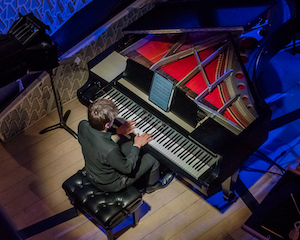
Presumably to accommodate a larger crowd, row seating replaced the venue’s usual café-style arrangement. But the room still had its communal feeling, with front-row patrons just a knee-jerk away from the performers. After an introduction by composer and venue co-founder Paola Prestini, Eimold took a seat at the Bösendorfer piano to play a set of LeFrak’s piano miniatures.
The Essential Karen LeFrak
These effective and affecting pieces display LeFrak’s method in its most essential form. She combines vernacular rhythms, harmonic borrowings from jazz and other genres, and her gift for melody to create soundscapes that at their best coalesce into deep meditations on music’s emotional power. One miniature carried an air of mystery and uncertainty with an air of romance; another suggested an old pop song with a hint of jazz harmonies; still another veered into storminess, driven by an active bass line, and so on. Eimold displayed a warm, sensitive touch with a good balance of firmness and emotionality.
Building on this foundation, Eimold and Zeigler played two compositions that transferred most of the melodic responsibility to the cello. In the contemplative “February” and the lullaby-like “December” I found myself missing the busier interplay of left and right hand that enlivened the solo piano works, but Zeigler’s rich songlike tone offered its own rewards.
Orchestral Maneuvers
The orchestra’s string players joined the party for a piece enigmatically titled “Dedication Morphing into Nothing Left.” A placid piano introduction and orchestral main body reflected a simple melody that occasionally went unexpected places over some full-throated harmonies. Making a greater impression, still on the contemplative tip, were the next selections, titled “Space” and “Gravity.” The first had yearning, unsettled melodies and a layered, ambient quality that vividly depicted the vastness of outer space. A solo cello led the second’s romantic harmonies and interesting modulations.
The most impactful orchestral music came in the evening’s main event, the New York premiere of LeFrak’s Miami Concerto for Guitar and Chamber Orchestra, with Sharon Isbin as soloist, and winds, harp and percussion joining the strings.

First, though, Isbin, backed by a small ensemble, performed two energetic, crowd-pleasing Latin-inspired works. One had a tango rhythm, of a gently stirring, soft-pedal sort. The band included a whole raft of percussionists who ably backed the wandering, reflective guitar melodies. The other, a captivating piece called “Urban Tango,” included the most experimental music of the evening. Opening and closing sections in skewed-sounding time signatures enclosed a central straight-ahead 4/4 section, with Isbin backed only by Eimold and two percussionists. This was an absorbing listen throughout.
Swagger and Restraint in a Latin-flavored Concerto
The Miami Concerto partook of Latin flavors too. A somber melodic preface introduced by the French horn, then taken up by the oboe, flowered into a brisk dance. Trumpets double-tongued (I surmised) with a mariachi swagger under fluid melodies from the guitar.
The slow movement was a sleepy tango with a nice guitar cadenza (though a few too many endings). A bright 3/8 beat reestablished the celebratory spirit in the closing movement, titled appropriately “Festivo.”
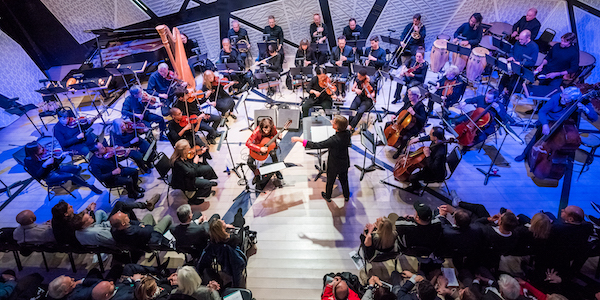
Isbin shone throughout the performance, no surprise. The Orchestra of St. Luke’s conducted by Elizabeth Askren adapted quite nicely to the small venue, playing with enough restraint to allow the guitar to be heard, and in the bigger passages filling the acoustically unorthodox space will well-balanced dynamics.
A Slow Build
The structure of the concert, building from solo piano to full-on orchestration, allowed one to appreciate several of the many sides of Karen LeFrak’s work (she is also known for ballet and children’s music). As she told me in a 2021 interview, “My personal mark as a composer is infusing easygoing melodies with harmonic complexities, modulations, and unexpected turns and nuances to create more depth.” This robust program bore that out, with music in several formats, all displaying the composer’s unique stamp while wearing proudly LeFrak’s varied influences and inspirations.
For more on Karen LeFrak, visit her website.